GemologyThe Mayuri Journal27 March 2026
Enriched on 19 August 2026
Emerald
Emerald Guide: everything you need to know before buying an emerald jewel
The complete guide to emeralds: origins, quality, treatments, pricing and expert advice to help you choose.
Written by Johan Nel, Jewellery designer & goldsmith · trained in gemmology · Mayuri ParisReading 18 min12 chapters
What the maison says
What to remember
Emeralds have captivated humanity for more than 4,000 years. From Cleopatra, who owned her own mines in Upper Egypt, to the royal crowns of Europe, this precious gemstone embodies regality, renewal, and eternal love. It is the third most valuable precious gemstone in the world, after diamonds and rubies, and the most iconic member of the beryl family. Its unparalleled green colour comes from chromium and vanadium, a geological accident that occurs only under extremely rare conditions. This guide covers Emeralds from every angle: mineralogical definition, origins, quality criteria, treatments, pricing, care, symbolism, and Mayuri's Canopée Collection. Each section provides the essentials and links to a dedicated article for deeper exploration.
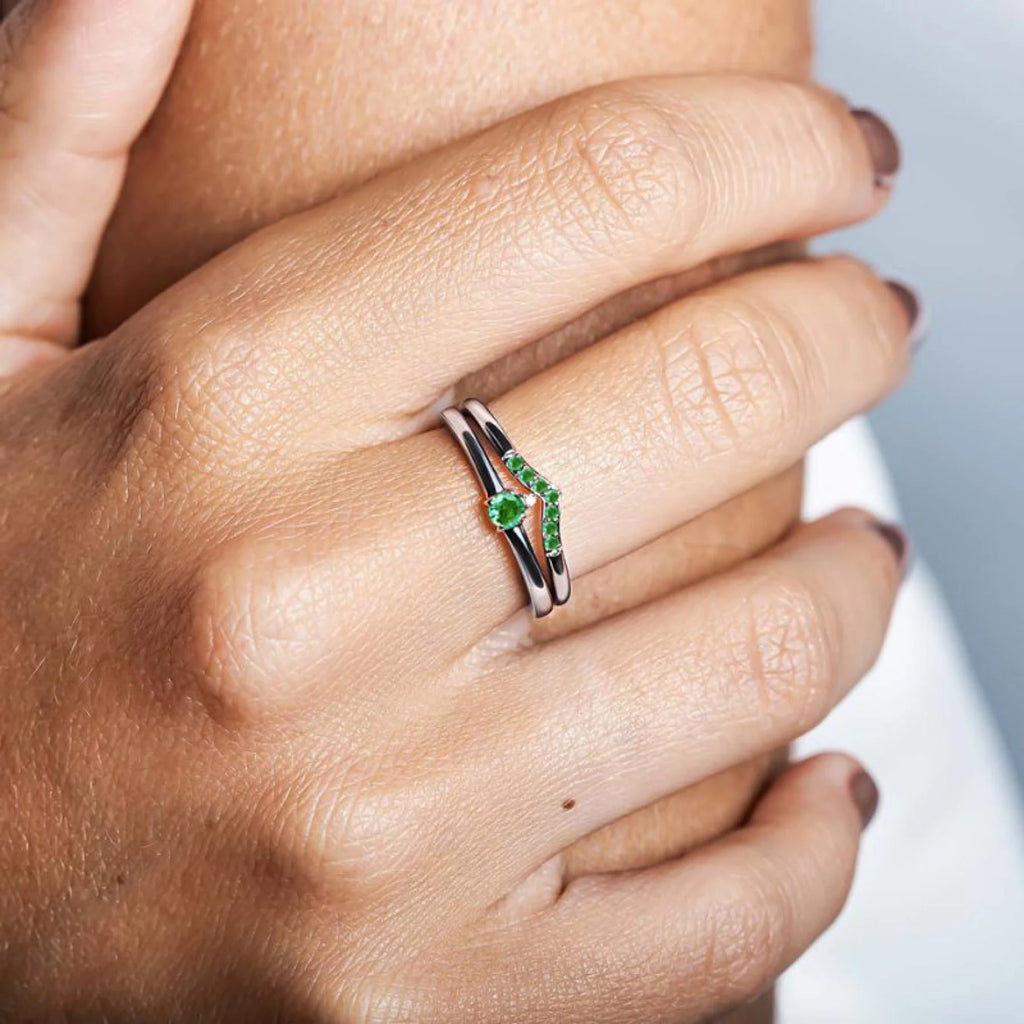
Mayuri emerald ring in 18ct yellow gold worn on the hand
What is an Emerald? Definition and mineralogical family
The Emerald is a green variety of beryl, a mineral with the chemical formula Be₃Al₂(SiO₃)₆. It belongs to the same family as aquamarine (blue), morganite (pink), and heliodor (yellow). What sets it apart from its cousins is the presence of chromium and/or vanadium as chromophoric elements, which give it that uniquely intense green colour, unmatched in the mineral world. The Emerald is recognised as a precious gemstone by the GIA and the entire international gemological trade.
Its hardness falls between 7.5 and 8 on the Mohs scale, harder than quartz, yet its toughness is low due to the natural inclusions present throughout. This paradox explains its reputation as a "fragile" stone: hard on the surface, yet vulnerable to impact because of its internal network of micro-fractures.
The "garden" of the Emerald is perhaps its most fascinating characteristic. Unlike diamonds, where inclusions are considered flaws, the Emerald is the only precious gemstone whose inclusions are expected and appreciated by gemologists. This network of micro-fractures, trapped crystals, and fluids encased during formation is called the "garden," a poetic term reflecting the botanical complexity visible under magnification. A natural Emerald entirely free of inclusions would be so rare as to raise suspicion. Its refractive index of 1.565 to 1.602 gives it a vitreous lustre, with a pronounced dichroism: blue-green and yellow-green depending on the angle of observation.
The origins of Emerald: Colombia, Zambia, Brazil and beyond
The origin of an Emerald directly influences its colour, its type of inclusions, and its price. This is a key evaluation factor that every informed buyer should understand.
Colombia dominates the market by value (accounting for 50 to 60% of global production). The legendary mines of Muzo, Chivor, and Coscuez produce the most sought-after Emeralds in the world. Their signature: an intense, pure green, sometimes enhanced by a hint of blue, and three-phase inclusions (liquid, gas, and salt crystal) unique to this origin. The finest Colombian stones, known as "gota de aceite" (drop of oil), have achieved record prices at auction.
Zambia is the world's leading producer by volume, thanks to the Kagem mine operated by Gemfields. Zambian emeralds offer an appealing blue-green hue with transparency that is generally superior to Colombian stones, and an excellent quality-to-price ratio that makes them the preferred choice of many jewellers.
Brazil (Bahia, Minas Gerais) is the world's third largest producer, with stones that tend to be lighter in colour and more heavily included. Other origins deserve attention: Ethiopia (a more recent source, often yielding large, clear stones), Afghanistan (Panjshir, exceptional but rare stones) and Russia (the Ural Mountains, a historic deposit now nearly exhausted).
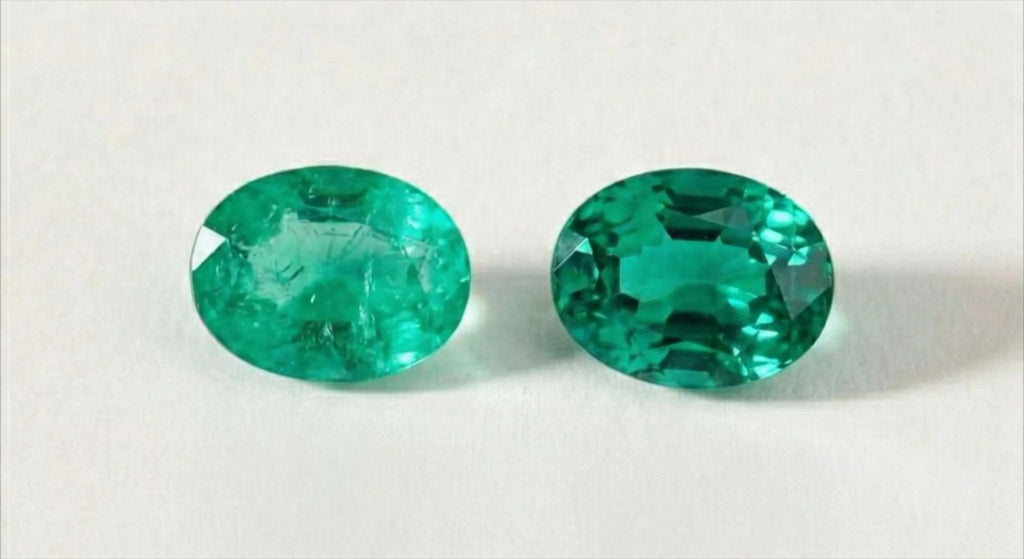
Visual comparison between a Colombian emerald and a Zambian emerald
The diamond "4Cs" (colour, clarity, cut, carat) apply to emeralds as well, but with a radically different hierarchy. For emeralds, colour accounts for 60 to 70% of the value, far ahead of clarity.
Colour is the defining criterion. Gemologists evaluate three parameters: hue (pure green, blue-green or yellow-green), saturation (the intensity of the green) and tone (light to dark). The ultimate ideal is an intense, well-saturated green with a medium to medium-dark tone. Colombian "gota de aceite" emeralds are the holy grail for collectors, prized for an inner luminosity that seems to radiate from within the stone itself.
Clarity is assessed differently than it is for a diamond. inclusions are to be expected (the famous "garden"), and the evaluation focuses on their visual impact rather than their absence. An eye-clean emerald of good colour is an excellent purchase, and will always be more highly valued than a large, pale stone.
The classic emerald cut (a rectangular step cut with cropped corners) was developed specifically to protect this stone from chipping. Oval, cushion and cabochon cuts are also widely used, and each one highlights the colour in its own distinct way.
Carat weight drives prices upward exponentially: a 3-carat emerald of comparable quality can be worth five to ten times the price of a 1-carat stone.
More than 95% of emeralds on the market have undergone cedar oil treatment. This is the market standard, not a flaw. The oil fills the natural micro-fissures and improves transparency without altering the stone's chemical composition. This age-old process has existed for centuries in the Colombian trade.
The types of agents are clearly distinguished. The cedar oil remains the standard of high jewellery: a traditional treatment, reversible and the most widely accepted by all laboratories. Synthetic resins (Opticon, Permasafe) offer superior durability but are less reversible and less valued by the market. Tinted oils, which alter colour in addition to transparency, are to be avoided entirely.
The leading laboratories (SSEF, Gübelin, GIA) classify the level of treatment on a scale: None, Insignificant, Minor, Moderate, Significant. The impact on value is considerable: a "No Oil" Emerald can be worth two to five times more than an equivalent "Minor Oil" stone. A "Significant Oil" is worth 30 to 50% less than a "Moderate".
At Mayuri, our Emeralds are treated exclusively with cedar oil, the standard of high jewellery. We use neither synthetic resins nor tinted oils.
Emerald vs tsavorite: two green stones, two worlds apart
The Emerald and the tsavorite are the two most sought-after green stones in fine jewellery, yet they belong to entirely different mineral families.
The Emerald is a beryl (beryllium aluminium silicate), coloured by chromium and vanadium, with a hardness of 7.5 to 8 on the Mohs scale. Its abundant inclusions form the characteristic "jardin", and it is almost always oil-treated. Its history spans more than 4,000 years, from Cleopatra to the Mughal emperors and the royal crowns of Europe.
The tsavorite is a grossular garnet (calcium aluminium silicate), also coloured by chromium and vanadium, with a hardness of 7 to 7.5 on the Mohs scale. Generally cleaner than the Emerald and untreated, it was only discovered in 1967 by geologist Campbell Bridges in Tanzania.
The fundamental difference? The Emerald offers a historic green, rich in symbolism and royalty. The tsavorite brings a vivid, brilliant green, untreated, with a naturally modern character. The two complement each other far more than they compete.
This is precisely the bridge that the Canopée Collection by Mayuri explores: a gradient from deep tsavorite to Emerald to light tsavorite, uniting both stones within a single piece of jewellery and transcending any comparison between them.
Mayuri Tarang tsavorite bangle from the Canopée collection in 18ct gold
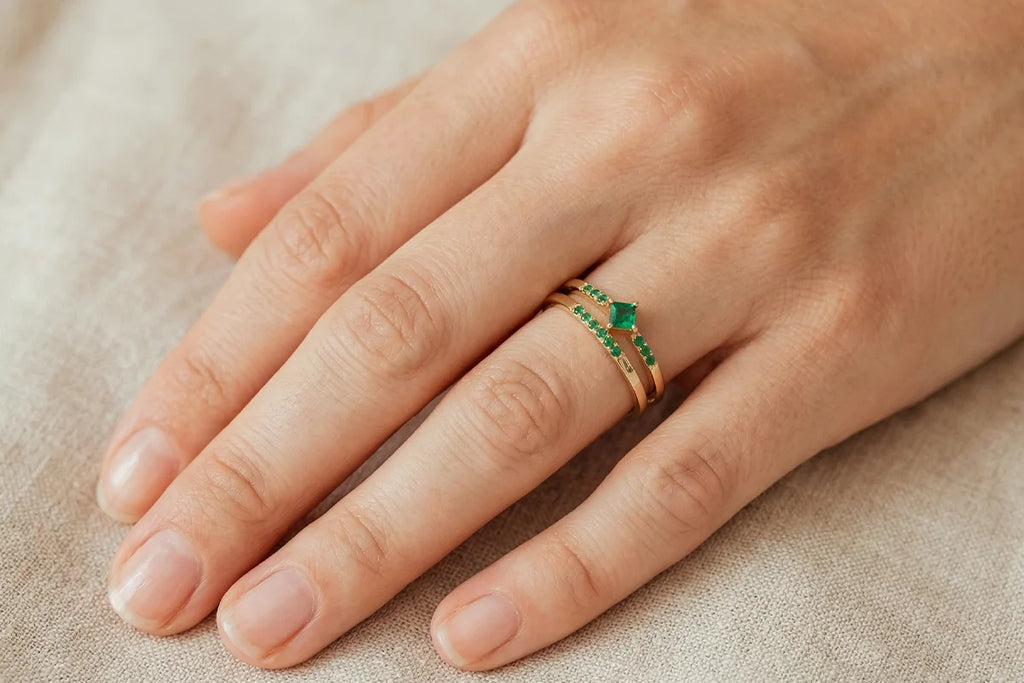
Mayuri solitaire emerald ring in 18ct gold worn on the hand
The Emerald engagement ring
The Emerald engagement ring is experiencing a remarkable rise, championed by celebrities such as Hailey Bieber (cabochon-cut Emerald), Victoria Beckham (Emerald surrounded by Diamonds) and, historically, Jackie Kennedy (a 2.84 ct Van Cleef & Arpels Emerald). This deeply personal and original choice appeals to those who wish to stand apart from the classic Diamond solitaire.
Why choose an Emerald for an engagement? It symbolises eternal love, renewal and fidelity. Its green hue evokes growth and nature, values that resonate beautifully with the beginning of a shared life. It is also a stone of character, one that says something meaningful about the person who wears it.
There are important considerations to keep in mind: the Emerald is more delicate than a Diamond or Sapphire. For everyday wear, favour a protective setting (bezel, semi-bezel, or Diamond halo) to shield the stone. Avoid cuts with exposed points, such as marquise or pear shapes.
In terms of budget, a "Minor Oil" quality Emerald offers the finest balance between natural beauty and accessible pricing. Ranges span from $950 for a 0.5 ct in Moderate quality, up to $12,000 and above for a 1 ct+ of Fine Colombian quality. The choice of metal also matters: 18ct yellow gold is the most timeless pairing, white gold brings a contemporary contrast, and rose gold adds a beautifully romantic touch. At Mayuri, Vermeil offers access to all of these combinations at a gentler price point, with no compromise on stone quality.
The Emerald is more delicate than a Diamond, Sapphire or Ruby. Its hardness (7.5 to 8 on the Mohs scale) is acceptable, yet its toughness is low due to natural micro-fractures. Care must be tailored to preserve the stone's beauty over time.
The right habits: clean with a soft damp cloth and a mild soap, store in an individual jewellery case to prevent scratching, and have the piece inspected by a gemologist every three to five years. Daily contact with the skin does not degrade the oil treatment.
Gestures to avoid entirely: the ultrasonic cleaner (it dislodges the oil and can widen fractures), the steam cleaner (it evaporates the oil), and all chemical products, including solvents, acetone, alcohol, and perfume applied directly to the stone.
If transparency diminishes over time (the stone appears more milky), a jeweller-gemologist can perform a re-oiling treatment in a cedar oil bath under vacuum. This non-destructive process restores the stone's original transparency. Estimated cost: $60 to $180.
Our best daily habit recommendation: put on your emerald jewellery last (after perfume, cream, and hairspray) and take it off first. With these simple gestures, an emerald can be worn every day for decades; it is a stone for living, not for display.
In the Vedic tradition, the emerald is the stone of Budh (Mercury). It is known as Panna in Hindi and Marakata in Sanskrit. This connection to Sanskrit resonates with Mayuri's design names (Surya, Anaya, Kiran, Shanti): a shared heritage between traditional gemology and contemporary creation.
In Western symbolism, the emerald is the stone of Venus. It embodies eternal love, fertility, wisdom, and renewal. It is the precious stone of spring and the official birthstone of May, a month that celebrates it across many cultures.
The emerald has an unparalleled royal past. Cleopatra owned her own mines in Upper Egypt. The Incas venerated it as a goddess. The Mughals engraved Quranic verses onto large Colombian emeralds. Some of these pieces are today displayed in the world's greatest museums.
In crystal healing (without any medical claims), the emerald is associated with balancing the heart chakra, inner calm, and mental clarity. It is traditionally regarded as the "stone of the clairvoyant."
The emerald is not merely a precious stone; it is a recurring figure in the great stories of humanity. Certain named stones have crossed centuries, passed between emperors, queens, and collectors, and achieved record prices at auction.
The Mughal Emerald (217.80 ct), dated 1695, is one of the most celebrated in the world. Rectangular in shape, with Islamic inscriptions engraved on one face and floral motifs on the other, it once belonged to the Mughal emperor Aurangzeb. Sold at Christie's in 2001 for $2.2 million, it speaks to the place of emerald in Islamic art.
The Crown of the Andes brings together 453 emeralds totalling 1,521 carats. Created in the 16th century as an offering to the Virgin Mary to protect her from a smallpox epidemic, its largest stone (45 ct) bears the name of Atahualpa, the last Inca emperor. Faith, beauty, and survival, distilled into a single object.
The Bulgari Emerald of Elizabeth Taylor is perhaps the most romantic of all. Offered by Richard Burton during the filming of Cleopatra (1963), it creates a sense of wonder: the greatest actress of the 20th century wears a true emerald while portraying the ancient queen who loved this stone above all others. Sold at auction in 2011 for 6.1 million dollars.
The Patricia (632 ct), discovered in 1920 at the Chivor mine in Colombia, was deliberately left uncut, preserving its natural hexagonal crystalline form. The choice not to cut it is a powerful tribute to the beauty of the stone as nature created it. It is on display at the American Museum of Natural History in New York.
And then there is the most spectacular myth of all: in Parzival (Wolfram von Eschenbach, c. 1210), the Holy Grail is said to have been carved from an emerald that fell from Lucifer's forehead during his fall from paradise. The emerald of damnation becomes the chalice of redemption, an image that inspired Wagner and continues to resonate throughout the Western imagination.
The Mayuri Canopée Emerald Collection
The Canopée concept introduces a colour gradient unique in fine jewellery: dark tsavorite, emerald, light tsavorite: three shades of green evoking the tropical canopy, from the shadow of the undergrowth to the light filtering through the leaves. This gradient combines three distinct stones (two varieties of tsavorite garnet and emerald) to create a visual effect impossible to achieve with a single stone.
Each piece bears a Sanskrit name: Surya (solar light), Anaya (protection), Kiran (ray of light), Nadi (river). These names bridge the gap between Mayuri's Indian heritage and contemporary gemology, a connecting thread that links the choice of stones to the language of design.
The Canopée pieces are available in 18ct gold (yellow, white, and rose) and in Vermeil, offering an accessible entry point with no compromise on stone quality. This is a rare positioning: most jewellers reserve precious stones exclusively for solid gold.
Our Zambian Emeralds are individually selected for their deep green colour and their clarity, treated exclusively with cedar oil. Colombian Emeralds (from Muzo or Chivor provenance) are available on special order.
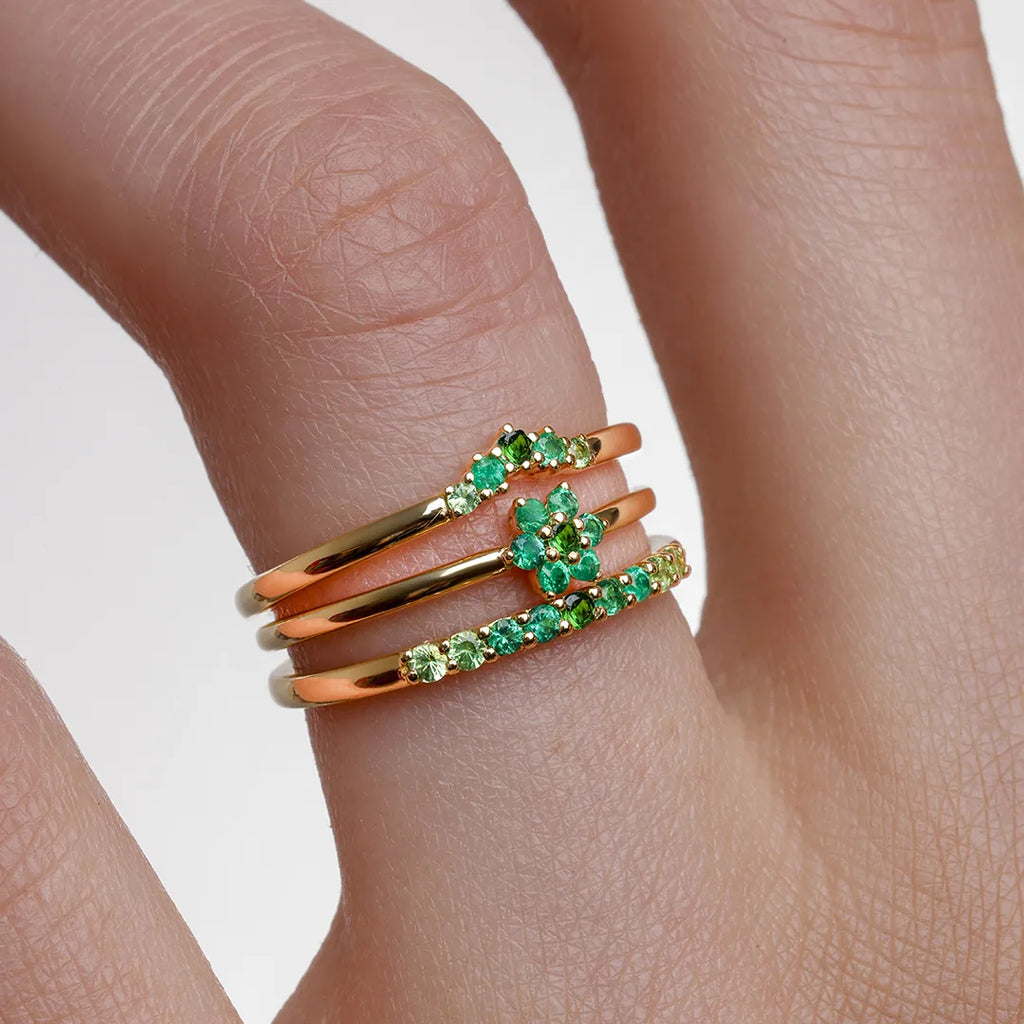
The Canopée rings are designed for stacking: the gradient reaches its full dimension when all three rings (Surya, Anaya, Kiran) are worn together on the hand, creating an arc of colour that flows from forest green to tender green. Worn individually, each ring has its own distinct personality; stacked together, they tell a story of nature and light. The bangles (Tarang, Ganga), necklaces, and Earrings complete the collection in the same spirit of gradation.
Mayuri Canopée emerald ring stack featuring Surya, Anaya and Kiran in 18ct gold, with a tsavorite and emerald gradient
The price of an Emerald varies considerably depending on quality, origin, treatment, and weight. Here are some general price ranges for a natural Emerald (stone price only, without setting):
Range
Typical Origin
Treatment
Guide Price (1 ct)
Buyer Profile
Entry-level
Brazil, Ethiopia
Significant Oil
$120 - $600
Fine fashion jewellery
Mid-range
Zambia, Colombia (standard)
Moderate Oil
$600 - $3,000
Fine jewellery, meaningful gift
High-end
Colombia, Zambia (fine quality)
Minor Oil
$3,000 - $10,000
Collection pieces, premium engagement rings
Exceptional
Colombia (Muzo, finest)
No Oil / Insignificant
$10,000 - $36,000+
Investment, high jewellery
Prices increase exponentially with weight: an Emerald of 3 carats of comparable quality can be worth five to ten times the price of a 1-carat stone.
The best value for money? A Zambian Emerald "Minor Oil" with a beautiful colour offers an excellent balance between beauty and investment. This is the sweet spot that discerning buyers seek.
At Mayuri, Emerald jewellery starts from accessible prices thanks to our Vermeil combined with precious stones, a rare combination that makes Emerald jewellery attainable without compromising on stone quality. For the most precious pieces, 18ct gold (yellow, white, or rose) brings the durability and prestige that a fine Emerald deserves. And for a truly unique piece, our bespoke service allows you to choose your stone, your metal, and your design; each creation is crafted by hand in our partner workshops.