Emerald vs Tsavorite: which green stone should you choose?
Emerald or tsavorite? A gemological comparison covering color, hardness, price and expert guidance to help you choose.
Written by Johan Nel, Jewellery designer & goldsmith · trained in gemmology · Mayuri ParisReading 12 min8 chapters
What the maison says
What to remember
Emerald or tsavorite? The question arises time and again among lovers of green stones. These two gems share an intense green colour that can make them nearly indistinguishable to the naked eye, and yet they have almost nothing in common. Emerald is a beryl (Be₃Al₂(SiO₃)₆), a cyclosilicate formed under extreme conditions of pressure and temperature. Tsavorite is a grossular garnet (Ca₃Al₂(Si₃O₁₂)), a nesosilicate from an entirely different mineral family. Two chemistries, two crystal structures, two geological histories, and two radically different behaviours in jewellery. This article compares the two stones criterion by criterion: gemological properties, colour, rarity, price, and care. The goal is simple: to give you all the keys to choosing the stone that suits your project. And for those who refuse to choose, we offer a third path, the Canopée Emerald collection, which brings both stones together in a single piece.
Emerald and tsavorite are green. That is more or less their only common ground.
Emerald belongs to the beryl family, the same family as aquamarine (blue), morganite (pink), and heliodor (yellow). Its chemical formula, Be₃Al₂(SiO₃)₆, reveals a cyclosilicate structure: silicon atoms form hexagonal rings stacked one upon another. Its crystal system is hexagonal, producing the characteristic elongated prismatic crystals found in Colombian and Zambian mines.
Tsavorite belongs to the garnet family, and more precisely to the grossular subgroup (ugrandites). Its chemical formula, Ca₃Al₂(Si₃O₁₂), is that of a nesosilicate: the silicon tetrahedra are isolated from one another, connected only by calcium and aluminium cations. Its crystal system is cubic, a fundamentally isotropic structure.
The conditions of formation differ just as much. Emerald forms in pegmatites or hydrothermal veins, at temperatures ranging from 300 to 700°C. Tsavorite is born in metamorphic rocks, graphite gneisses, at depths of 10 to 20 kilometres, under considerable pressure.
Why does this difference in structure matter so much? The hexagonal structure of beryl encourages directional fractures and multiple inclusions; this is what is known as the emerald's "garden". The cubic structure of garnet, being more isotropic, produces crystals that are naturally cleaner and more homogeneous. This crystallographic difference explains almost everything that distinguishes the two stones in fine jewellery: the fragility of emerald, the resilience of tsavorite, and the need to treat one but not the other.
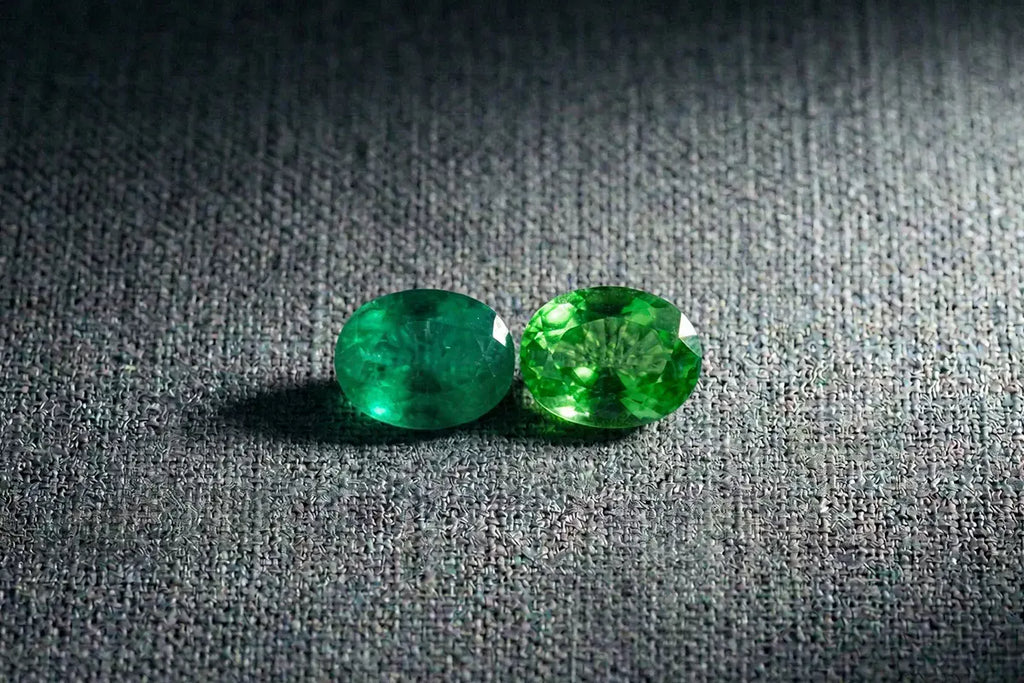
Emerald and tsavorite set side by side against a dark background
Gemological comparison
Both stones share an intense green colour, yet their physical and optical properties differ significantly. The table below summarises the key differences for the informed buyer.
Emerald vs Tsavorite: A Gemological Comparison
Physical and optical properties of both green stones
Property
Emerald
Tsavorite
Mineral family
Beryl (cyclosilicate)
Grossular garnet (nesosilicate)
Chemical formula
Be₃Al₂(SiO₃)₆
Ca₃Al₂(Si₃O₁₂)
Mohs hardness
7.5 – 8
7 – 7.5
Density
2.67 – 2.78
3.49 – 3.67
Refractive index
1.56 – 1.60
1.74
Inclusions
Common and expected (the "jardin")
Rare (a naturally clean stone)
Standard treatment
Oiling (>95% of stones)
None
Crystal system
Hexagonal
Cubic
Emerald
Family
Beryl (cyclosilicate), Be₃Al₂(SiO₃)₆
Hardness
7.5 – 8 Mohs
Density
2.67 – 2.78
Refractive index
1.56 – 1.60
Inclusions
Common and expected (the "jardin")
Treatment
Oiling (>95% of stones)
Crystal system
Hexagonal
Tsavorite
Family
Grossular garnet (nesosilicate), Ca₃Al₂(Si₃O₁₂)
Hardness
7 – 7.5 Mohs
Density
3.49 – 3.67
Refractive index
1.74
Inclusions
Rare (a naturally clean stone)
Treatment
None
Crystal system
Cubic
Three differences deserve particular attention. First, inclusions: they are expected and valued in emerald (the celebrated "garden"), whereas an eye-clean tsavorite is the norm. Second, treatment: more than 95% of emeralds are oiled, an industry-accepted standard, while tsavorite is never treated. Third, the refractive index: at 1.74, tsavorite possesses more than 95% of emeralds are oiled, an industry-accepted standard, while tsavorite is never treated. Third, the refractive index: at 1.74, tsavorite possesses a noticeably superior brilliance and lustre to that of emerald (1.56–1.60).
One often overlooked point: tsavorite's higher density (3.49–3.67 versus 2.67–2.78) means that at equal carat weight, a tsavorite will appear visually smaller than an Emerald. This is a detail worth keeping in mind when making a purchase.
Comparing greens: chrome, vanadium and visual perception
The Emerald owes its colour primarily to chromium (Cr³⁺), sometimes accompanied by vanadium (V³⁺). Chromium produces a deep, warm green, with bluish nuances in the finest Colombian stones. Zambian Emeralds, coloured more by iron alongside chromium, tend toward a cooler, more bluish green.
Tsavorite is coloured by vanadium (V³⁺) as its primary chromophore, often accompanied by chromium. The result is a brighter, more saturated green, with superior luminosity. The finest tsavorites achieve a green so intense it rivals the most beautiful Colombian Emeralds.
To the naked eye, the difference is subtle yet perceptible when the two stones are placed side by side. The Emerald offers a "deep" and "rich" green, the classic green of high jewellery, steeped in millennia of history. Tsavorite offers a "radiant" and "vivid" green, more modern, more luminous. The finest stones from both families, the Colombian "gota de aceite" Emeralds and gem-quality Kenyan tsavorites, each achieve a spectacular green in their own right. The preference between the two is ultimately a matter of personal taste.
Origins and rarity
Emerald: thousands of years of mining history
The history of the Emerald stretches back to Cleopatra's mines in Egypt, active as early as 1500 BC. Today, Colombia (Muzo, Chivor, Coscuez) produces 50 to 60% of global volume and 70 to 80% of total value. Zambia (Kagem mines) is the second largest producer, followed by Brazil and Ethiopia. Deposits are abundant, geographically diverse, and mined on a large industrial scale.
Tsavorite: a recent discovery with limited deposits
Campbell Bridges, a Scottish geologist, discovered tsavorite in Tanzania in 1967, in the Merelani region. He went on to find a workable deposit in Kenya in 1971, in the Taita Hills, near Tsavo National Park. Henry Platt of Tiffany & Co. named it "tsavorite" in 1974, a name evoking the neighbouring national park. A few recent discoveries in Madagascar round out the picture, but volumes remain low and no large-scale industrial mine comparable to Colombian or Zambian operations exists.
The rarity-price paradox
Tsavorite is objectively rarer than Emerald. Its deposits are limited, its large crystals exceptional, stones exceeding 3 carats in gem quality are exceptionally rare. And yet, it costs less. The explanation comes down to a single word: recognition. The Emerald benefits from millennia of history, a universally acknowledged status as a "precious stone," and sustained global demand driven by the great jewellery houses. Tsavorite, discovered barely 60 years ago, has not yet attained that prestige, but therein also lies an opportunity for the discerning collector.
Tarang Canopée tsavorite bangle by Mayuri in 18ct gold, worn at the wrist
The price ranges of these two stones reflect very different market realities.
Emerald, price ranges per carat
The spectrum is exceptionally wide, due to the combined influence of treatment, origin, and colour. At commercial quality, expect $120 to $600 per carat. At good quality (Moderate Oil, beautiful colour), the range rises to $600–$3,000 per carat. At high quality (Minor Oil, Colombian origin), prices reach $3,000 to $6,000 per carat. Exceptional stones, No Oil, Colombian "gota de aceite", exceed $6,000 to $36,000+ per carat at auction.
The dominant pricing factors for Emerald are, in order of importance: colour saturation, treatment level (No Oil, Minor, Moderate, Significant), origin (Colombia, Zambia, Brazil at equivalent quality), and carat weight.
Tsavorite, price ranges per carat
Carat weight is the single most important factor, as large stones are exceptionally rare. At commercial quality (under 1 carat, light green): $60–$180 per carat. At good quality (1–2 carats, saturated green): $240 to $960 per carat. At high quality (over 2 carats, intense green): $960–$2,400 per carat. Exceptional stones (over 3 carats, intense green, eye-clean) reach $2,400–$6,000+ per carat, though they remain extremely rare.
Key takeaways
For an equivalent budget, tsavorite generally offers a larger, cleaner stone with no treatment. Emerald brings a prestige and a history that tsavorite cannot, at least not yet, match. It is a trade-off between objective value and emotional resonance.
Emerald is the most delicate of the four precious stones. Its natural inclusions create areas of structural weakness, and oil treatment requires specific precautions: no ultrasonic cleaner (which risks dislodging the oil and widening fractures), no steam or extreme heat, no chemicals such as solvents or acetone. The recommended method remains gentle cleaning with lukewarm soapy water and a soft cloth. Professional re-oiling should be considered every 5 to 15 years depending on how frequently the piece is worn.
Tsavorite is considerably more resilient for everyday wear. With no treatment to preserve and no weakening inclusions, it withstands standard cleaning with lukewarm water, mild soap, and a soft brush. The usual precautions apply: avoid direct impact and extreme temperature variations. It is a stone perfectly suited to everyday wear with no particular concerns.
In summary: if you are looking for a green stone for a piece worn daily, whether a wedding ring or an engagement ring, tsavorite is the most practical choice. For a fine jewellery piece worn on special occasions, Emerald remains a timeless classic.
The Canopée Emerald collection: where both stones meet
At Mayuri, we never ask lovers of green stones to choose between emerald and tsavorite. Our Canopée Emerald collection brings both together in a single piece, in a gradient of greens that evokes the canopy of a tropical forest.
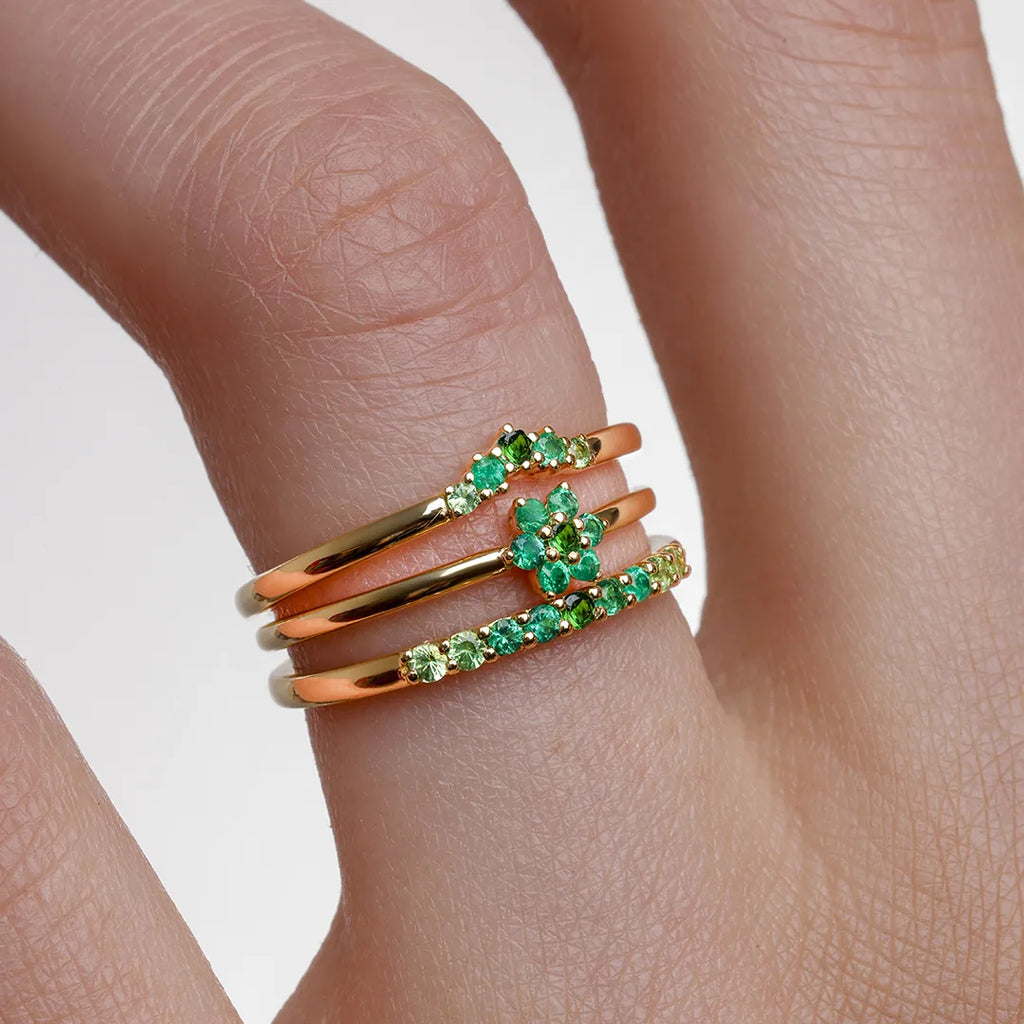
The concept unfolds as a signature three-step gradient: dark tsavorite (deep, intense green) flowing into emerald (classic, rich green), then light tsavorite (luminous, fresh green). Each stone is individually selected to fall within this chromatic progression. The result is a play of tones and luminosities impossible to achieve with a single variety of stone.
This gradient also holds its own from a gemological perspective. The differing refractive index of the two stones, 1.56 to 1.60 for the emerald versus 1.74 for the tsavorite, creates a subtle contrast of brilliance within the gradient. The tsavorite brings the sparkle; the emerald brings the depth. It is a complementarity that only a jeweller with mastery of both stones can fully harness.
The collection includes rings, bangles and pendants with Sanskrit-inspired names, Surya, Anaya, Kiran, Tarang, set in 18ct gold (yellow, white or rose). Each piece may be worn alone or stacked to amplify the gradient effect. It is our answer to the question "emerald or tsavorite?": both, together.
Stacking Canopée emerald rings by Mayuri, Surya, Anaya and Kiran in 18ct gold
The choice between emerald and tsavorite depends on the use you have in mind. Here is a simple decision guide.
For an everyday piece, a ring or bangle worn daily, tsavorite is the preferred choice. More durable, free of treatments to preserve, it withstands daily wear without any special precautions. It is the most practical and carefree choice.
For a special occasion, an engagement, an anniversary, a birth gift, emerald is the natural choice. Its prestige, its centuries-old history and its symbolism (renewal, eternal love) make it the stone of life's great milestones. Its status as a "precious stone" lends it an unrivalled emotional value.
For a one-of-a-kind, distinctive piece, the Canopée collection. Combining both stones in a green gradient is a rare and immediately recognisable concept. It is the choice of those who wish to take a truly original path in fine jewellery.
For an investment, opt for a high-quality emerald (Minor Oil or No Oil, Colombian, over 2 ct). The market for exceptional emeralds has grown by 25% in value between 2019 and 2024. Tsavorite does not yet have an equally established secondary market.
For a first green gemstone piece, tsavorite offers the best value for money. A beautiful, clean, untreated stone, at a fraction of the price of an emerald.
No. Tsavorite and emerald are two green stones from completely different mineral families. Emerald is a beryl (Be₃Al₂(SiO₃)₆, cyclosilicate), while tsavorite is a grossular garnet (Ca₃Al₂(Si₃O₁₂), nesosilicate). They share a green colour due to chromium and vanadium, but their chemistry and crystal structure are entirely distinct.
Which green gemstone is the most expensive?
Emerald. An untreated Colombian emerald ("No Oil") of exceptional quality can reach $35,000 per carat and beyond at auction. Gem-quality tsavorite in large carats (over 3 ct) can exceed $6,000 per carat, yet its market remains below that of emerald.
Is tsavorite more durable than emerald?
In practice, yes. Although emerald has a slightly higher Mohs hardness (7.5–8 versus 7–7.5), its toughness is lower due to its natural inclusions. Tsavorite, naturally cleaner and requiring no treatment to preserve, is more resistant to impact and everyday wear.
Does tsavorite change color?
No. Tsavorite is a stable stone that does not change colour over time, with light, or with heat. It is not subject to any treatment that could degrade. This is one of its key strengths compared to emerald, whose oil can evaporate over time.
Can emerald and tsavorite be combined in a single piece of jewellery?
Absolutely. This is the principle behind Mayuri's Canopée Emerald collection: a gradient ranging from deep tsavorite to emerald, then to light tsavorite. The difference in refractive index between the two stones creates a subtle interplay of brilliance within the gradient.
Which green gemstone requires no treatment?
Tsavorite. This is one of its major advantages: it is sold exactly as nature created it, with no oiling, no heating, and no enhancement of any kind. By contrast, more than 95% of commercially available emeralds are treated with cedar oil to improve their clarity, a standard and industry-accepted practice.