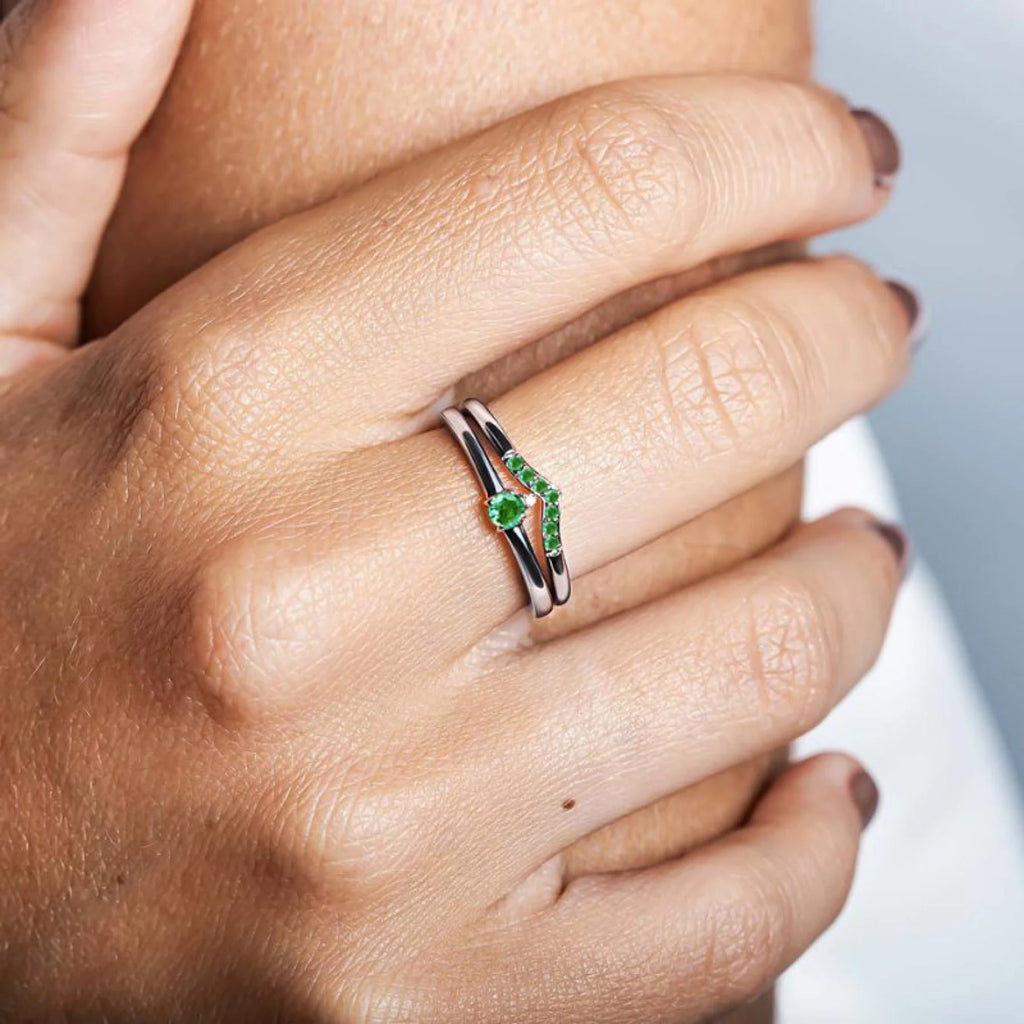
How to care for an emerald jewel: gentle cleaning, products to avoid, and tips for handling its natural fragility.
Written by Déborah Baid, Founder · Mayuri ParisReading 9 min6 chapters
What the maison says
What to remember
Emerald is the most precious of all green gemstones, yet it is also the most delicate of the four precious stones. Not because it is soft, its hardness of 7.5–8 on the Mohs scale is quite respectable, but because its natural inclusions and oil treatment require precautions that Diamond, Ruby, and Sapphire do not.
If you own a ring, a bracelet, or a necklace set with an Emerald, this article walks you through the concrete steps to preserve it for decades. From at-home cleaning to professional re-oiling, each stage is explained simply, as a jeweller-gemologist would at their counter.
Why is Emerald more fragile than other precious stones?
To understand Emerald care, one must first understand what makes it different from other precious stones.
Hardness vs. toughness
Hardness measures resistance to scratching (Mohs scale). Toughness measures resistance to impact. These are two entirely distinct properties. Emerald registers a hardness of 7.5–8, comparable to that of topaz, and more than sufficient to resist everyday scratches. Yet its toughness is rated "generally poor" by the GIA due to its natural inclusions.
The Emerald's "garden." Gemologists use the term "garden" to describe the network of inclusions and micro-fractures that form naturally during an Emerald's crystallisation. Unlike Diamond, where inclusions are considered flaws, in Emerald they are expected and form part of the stone's identity. An Emerald entirely free of inclusions would be cause for suspicion. Yet these inclusions create internal points of vulnerability: an impact can trigger a fracture along a pre-existing inclusion.
Oil treatment.More than 95% of Emeralds on the market are treated with cedar oil to enhance their clarity. This treatment is accepted across the international gemological trade, but it means that proper care must also protect the oil. Anything that evaporates or dissolves the oil will degrade the transparency of your stone.
This is the most frequently asked question, and the answer is reassuring. The method recommended by the GIA is also the simplest. Here is what you will need, and the steps to follow.
What you will need
A bowl of lukewarm water (30–35°C, never above 40°C)
A mild soap (Marseille soap or baby soap, never detergent)
A soft-bristled brush (a new toothbrush kept exclusively for this purpose)
A microfibre cloth
A second bowl of clean lukewarm water for rinsing
The 6 steps to cleaning
Preparing the bath: fill a bowl with lukewarm water and add a few drops of mild soap. Hot water can cause thermal shock that evaporates the treatment oil; keep the temperature below 40°C (104°F).
Soaking the piece: gently immerse the jewellery for 2 to 3 minutes maximum. Prolonged soaking may dislodge the oil from the stone's surface micro-fractures.
Brushing gently: use the soft brush to remove deposits (cream, soap, dust) around the setting and across the stone. Use light, gentle strokes without applying pressure. Pay particular attention to the underside of the bezel, where dirt tends to accumulate.
Rinsing with clean lukewarm water: hold the piece under a gentle stream of lukewarm water, or immerse it in the second bowl. Ensure all traces of soap are thoroughly removed.
Pat drying: place the piece on the microfibre cloth and pat it dry with care. Never rub vigorously. Allow to air dry at room temperature.
Inspecting: examine the stone in natural light. If its clarity appears diminished compared to when it was purchased, consider a visit to a professional.
Recommended frequency: once a month for regularly worn jewellery, and after any special occasion (an evening out, a wedding) if the piece has been exposed to cosmetics or fragrance.
Gentle cleaning of a Mayuri Emerald ring with a soft cloth
If there is one rule to take away from this article, it is this: never use ultrasonic cleaning on an Emerald. It is the most widely used cleaning method among general jewellers, and the most damaging for your stone. Below is a complete guide to the practices to embrace and those to avoid, validated by the recommendations of the SSEF and the GIA.
Action
Verdict
Why
Ultrasonic cleaner
FORBIDDEN
Vibrations dislodge the cedar oil and can widen pre-existing fractures
Steam cleaner
FORBIDDEN
Intense heat (100 °C+) instantly evaporates the treatment oil and causes thermal shock
Chemical products (acetone, alcohol, bleach, detergent)
FORBIDDEN
Solvents dissolve the cedar oil; even a single contact with acetone can permanently damage the stone's clarity
Toothpaste
FORBIDDEN
Micro-abrasives (silica, hardness 7) scratch the Emerald's surface (hardness 7.5–8)
Prolonged exposure to direct sunlight
AVOID
Extended solar heat (such as in a display case or on the beach) can gradually evaporate the surface oil
Sudden temperature changes
AVOID
Thermal shock creates internal stress along inclusions, with a risk of cracking
Applying perfume or cosmetics directly onto the jewel
AVOID
Alcohols and essential oils attack the cedar oil; always apply perfume and creams before putting on your jewellery
Sport, gardening, housework
REMOVE
Risk of mechanical impact, plus contact with chemicals such as chlorine and household cleaning products
Lukewarm water, mild soap, and a soft brush
RECOMMENDED
The only risk-free method, recommended by the GIA
Soft microfibre cloth
RECOMMENDED
Ideal for a quick daily wipe without rubbing
Individual soft fabric pouch
RECOMMENDED
Protects against scratches caused by contact with harder stones such as Diamond or Sapphire
Oil treatment and everyday care
Your Emerald is very likely oil-treated, and this is perfectly normal. This is neither a flaw nor a falsification: it is an age-old process recognized and accepted by the entire international gemological trade. Cedar oil fills the stone's natural micro-fractures and enhances its transparency.
Every care step described in this guide serves one central purpose: preserving the treatment oil. Avoiding ultrasonic cleaners, steam, and harsh chemicals means preserving the oil, and therefore preserving the transparency of your Emerald.
Signs that the oil has degraded
Over time, the oil may partially evaporate. Here are the signs to watch for:
The stone appears more milky or more included than when purchased
Inclusions become more visible to the naked eye
The colour appears less deep, less saturated
The overall brilliance has diminished despite regular cleaning
If you notice these changes, there is no need to worry: a professional re-oiling can restore the stone's original transparency. The treatment is entirely reversible.
When to re-oil your Emerald
On average, every 5 to 20 years depending on how frequently the piece is worn and the conditions of use. Emeralds worn daily, such as rings, deteriorate more quickly than those worn occasionally, such as pendants or Earrings. Accidental exposure to solvents or aggressive cleaning can accelerate the process.
Proper storage is a form of care in its own right. When stored carelessly, an Emerald can become scratched or lose its treatment oil without ever being worn.
A jewellery case or individual pouch: never store an Emerald loosely alongside other jewellery. Contact with harder stones, Diamond (hardness 10), Sapphire or Ruby (hardness 9), would cause irreversible surface scratching to your Emerald. Even between two Emeralds, surface inclusions can cause micro-scratches.
A soft lining: fabric, velvet, or microfibre. Avoid hard plastic compartments or rigid bases that transmit shocks.
Away from heat sources: not on a radiator, not in a jewellery case exposed to direct sunlight, not in the bathroom (fluctuating humidity, heat, and contact with chemical products).
Stable hygrometry: an excessively dry atmosphere can accelerate the evaporation of cedar oil. If you store your jewellery in a bank vault (a very dry environment), always use a protective pouch and regularly check the condition of the stone.
Mayuri Emerald ring in 18ct yellow gold, worn on the hand
When to have your Emerald jewel professionally serviced
Even with impeccable care at home, certain checks require the eye and tools of a jeweller-gemologist.
Annual inspection. Have the condition of the prongs (or bezel setting), the security of the mount, and the overall condition of the stone checked once a year. A worn prong is the leading cause of stone loss, the most common claim according to jewellery insurers.
Professional re-oiling. When clarity begins to fade, a gemologist can re-oil your Emerald. The process involves removing the old oil through a solvent bath, then immersing the stone in cedar oil under vacuum to encourage penetration into the micro-fissures. This is a non-destructive and entirely reversible process. Indicative cost: £45 to £130. Frequency: every 5 to 20 years on average.
After an accidental impact. If your jewellery has sustained an impact such as a fall or a knock against a hard surface, have the stone inspected even if no damage is visible to the naked eye. An undetected internal micro-fracture can worsen over time and under the everyday thermal stresses of wear.
Professional cleaning. A gentle in-workshop clean (without re-oiling) costs approximately £25 to £70. The jeweller uses manual techniques suited to Emerald, never ultrasonic cleaning. It is also the ideal opportunity to combine your annual cleaning with a thorough inspection.
Yes, provided you adopt the right habits. Remove your ring before sport, housework, and gardening. Avoid contact with perfumes and cosmetics (apply them before putting on your ring). A hardness of 7.5 to 8 on the Mohs scale protects the Emerald from everyday scratches, but it is its fragile toughness that calls for caution against impacts.
Can Emerald be cleaned with an ultrasonic cleaner?
No, never. This is the most important rule. Ultrasonic vibrations dislodge the cedar oil from micro-fissures and can widen pre-existing fractures, causing irreversible damage. Use only the lukewarm water and mild soap method described in this guide. If your jeweller suggests ultrasonic cleaning, decline and request a manual clean instead.
Is Emerald sensitive to water?
Lukewarm water poses no problem for a brief rinse (2 to 3 minutes). However, avoid hot water (thermal shock), chlorinated water (swimming pools) and seawater (salt and sand). Remove your piece before showering to avoid contact with gels and shampoos.
How can I tell if my Emerald needs to be re-oiled?
Compare the current clarity of your stone with how it looked when you first purchased it. If it appears cloudier, more included, or less luminous, it is likely that the cedar oil has partially evaporated. A gemologist can confirm the diagnosis and carry out re-oiling (£45 to £130).
How much does professional Emerald care cost?
Allow £25 to £70 for a professional clean (inspection and gentle cleaning without re-oiling) and £45 to £130 for a full re-oiling (removal of the old oil and vacuum bath treatment). Re-oiling is typically only required every 5 to 20 years on average.
Is Emerald sensitive to sunlight?
Brief exposure (daily outdoor wear) poses no problem. However, avoid prolonged, direct exposure: a sun-facing display case, a car dashboard, or extended sunbathing. Accumulated solar heat can gradually evaporate the surface oil.