BirthstonesThe Mayuri Journal17 May 2025
Enriched on 11 March 2026
Birthstones
Emerald: The Birthstone of May
Discover the emerald, May's birthstone: admired for its soothing green hues and rich spiritual symbolism.
Written by Déborah Baid, Founder · Mayuri ParisReading 4 min11 chapters
What the maison says
What to remember
Emerald is the official birthstone of the month of May, an association rooted in lapidary traditions dating back to the 12th century, formally codified in 1912 by the American Gem Trade Association. The third most precious gemstone in the world after Diamond and Ruby, the Emerald is also the most iconic member of the beryl family.
This guide covers everything you need to know about the May Emerald: symbolism, origins, gemological properties, a Colombian vs. Zambian comparison, a buying guide, pricing, and care advice. Whether you are looking for a birthday gift or an engagement ring, you will find here all the keys to choosing your Emerald with confidence.
What is the birthstone for May?
The official birthstone of May is the Emerald, a green variety of beryl coloured by chromium and/or vanadium. This association has its roots in medieval lapidary lists, formalised in 1912 by the National Association of Jewelers (now known as Jewelers of America).
Emerald symbolises the renewal of spring, fertility, wisdom, and eternal love. It is also the traditional gemstone for 20th and 55th wedding anniversaries. To gift an Emerald for a May birthday is to unite the depth of an ancient precious stone with the freshness of new beginnings.
Cleopatra was working the Egyptian Emerald mines of Wadi Sikait as early as 1500 BC. The queen adorned herself with Emeralds as a symbol of power and eternal youth, making this green stone the very embodiment of ancient luxury.
Long before the arrival of the Spanish conquistadors, the Incas of Peru and the Muzo people of Colombia regarded the Emerald as sacred. The Muzo mines still produce some of the most coveted Emeralds in the world (Ringsrud, Emeralds: A Passionate Guide, 2009).
In European tradition, the Emerald is associated with Venus, goddess of love, and Mercury, planet of communication, lending it its symbolism of truth and clarity of vision. In Indian tradition, the Emerald (panna) is the stone of the planet Mercury (Budh), worn to to stimulate intellect and prosperity.
Gemological properties of the Emerald
The Emerald belongs to the beryl family, alongside aquamarine, morganite, and heliodore. All share the same basic chemical composition (Be₃Al₂Si₆O₁₈), with only the chromophores differing (Sinkankas, Emerald and Other Beryls, 1981). Aquamarine, the birthstone of March, is the blue cousin of the Emerald.
Colour: green from chromium (Cr) and/or vanadium (V). The finest colour is a pure, intense green, neither too blue nor too yellow, with a vivid saturation.
Hardness: 7.5 to 8 on the Mohs scale, durable yet fragile due to natural inclusions (low toughness).
Density: 2.67–2.78 g/cm³
Refractive index: 1.565–1.602 (birefringent)
The "garden" is the poetic name given to the inclusions found in Emeralds. Unlike diamonds, where inclusions are considered flaws, in Emeralds they are a mark of authenticity and sometimes a true aesthetic asset.
The origins of the Emerald: Colombia, Zambia and beyond
Colombia (50–60% of global production by value): the mines of Muzo, Chivor, and Coscuez yield Emeralds of a pure, intense green. Their three-phase inclusions (liquid, gas, and halite crystals) serve as a distinctly Colombian signature. The "gota de aceite" (drop of oil) Emeralds are among the most sought-after in the world.
Zambia (Kagem mine, Gemfields): the largest Emerald mine in the world by volume. The stones display a slightly bluish green fewer inclusions than Colombian stones. Our sourcing is responsible and transparent. Mayuri Emeralds come primarily from Zambia, selected for their deep green hue and exceptional clarity.
Brazil: a historically significant producer, with colours ranging from yellow-green to deep green. Ethiopia: an emerging source since 2016, offering beautiful colours, though its presence on the market remains uncertain.
Origin
Dominant Colour
Price Range (per carat)
Colombia
Intense pure green
$1,200 to $36,000+
Zambia
Slightly bluish green
$600 to $6,000
Brazil
Variable (yellow-green to deep green)
$250 to $2,400
Virtues and benefits of the Emerald
In crystal healing, the Emerald is associated with the heart chakra (Anahata). It symbolises unconditional love, harmony, and emotional renewal.
A stone of truth and wisdom, the Emerald was said to reveal deception and strengthen memory. In astrology, it is particularly favourable for Taurus (April 20 to May 20) and, in certain traditions, for Virgo as well.
In Ayurvedic medicine, the Emerald is the stone of Budh (Mercury), worn to encourage intellect, communication, and financial prosperity.
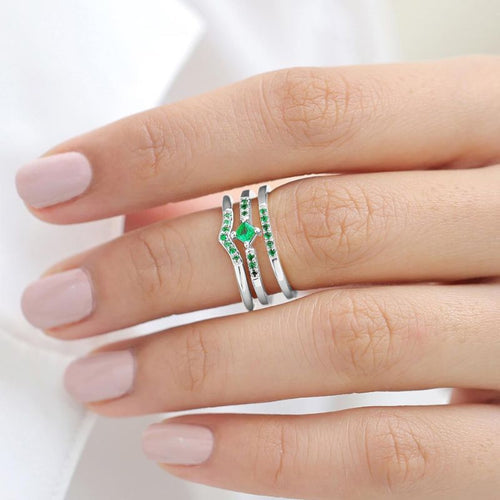
Kali collection emerald rings in 925 silver, worn, Mayuri
Colombian vs. Zambian: which Emerald to choose?
Criterion
Colombian
Zambian
Dominant colour
Intense pure green, sometimes slightly yellow
Slightly blue-green, deep
Inclusions
Three-phase (liquid + gas + salt), pronounced "garden"
Fewer inclusions, greater transparency
UV Fluorescence
Weak to moderate (deep red)
None to very weak
Average price (1 ct, good quality)
$1,200 to $6,000
$600 to $2,400
Rarity
Rarer at high quality
Stable production (Kagem / Gemfields)
Mayuri's choice
Available on request (special order)
Standard collection, AAA quality
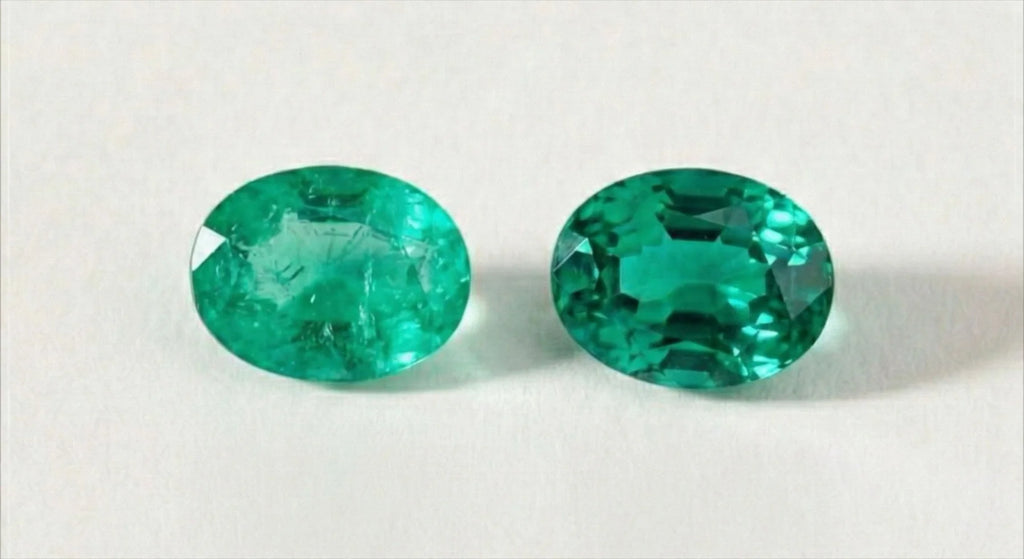
Colombian emerald and Zambian emerald side by side, a comparison of colour and clarity
There is no single "best" origin; it is a matter of personal preference. Colombian Emeralds offer a legendary, pure green; Zambian stones deliver superior clarity and outstanding value. For bespoke orders, Mayuri sources Colombian Emeralds from the Muzo and Chivor mines.
Colour (the primary criterion): look for a medium to intense green, free from overly dark or pale areas. Saturation is more important than clarity. The GIA evaluates colour across three dimensions: hue, tone, and saturation.
Clarity: inclusions are natural and expected in Emeralds. A stone that appears too flawless should raise questions, as it may be synthetic. Seek good transparency with discreet inclusions.
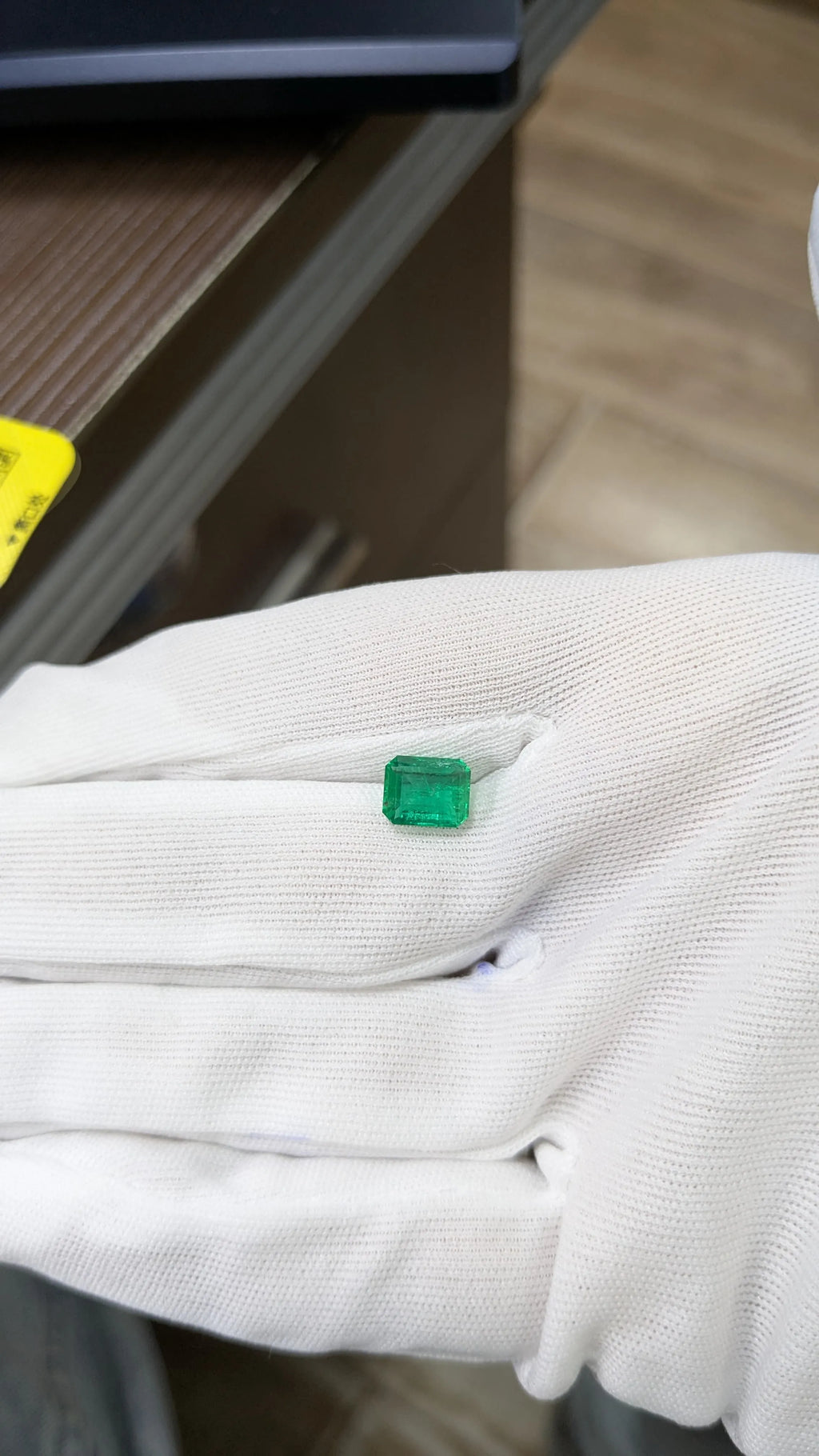
Eye-clean Colombian emerald, emerald cut, on a white glove
Cut: the emerald cut (rectangular with cropped corners) protects the stone's delicate angles. Other popular options include oval, cushion, and pear.
Carat weight: for a first Emerald piece, a solitaire between 0.5 and 1 carat offers an excellent balance between visual impact and budget ($350 to $1,800, depending on quality and origin).
Treatments: approximately 99% of Emeralds are oiled (with cedar oil). This is a standard, widely accepted treatment recognised by all major laboratories. Avoid Emeralds filled with artificial resin, as these are considerably less stable.
Certifications: for any stone above 0.5 ct, a report from GIA, Gübelin, or SSEF is strongly recommended.
The Emerald price guide
Prices vary considerably depending on colour, clarity, origin, and treatment. The following ranges serve as general guidance by quality tier:
Commercial quality: $120 to $600 per carat
Good quality (Zambia): $600 to $2,400 per carat
Fine quality (Colombia): $1,200 to $6,000 per carat
Exceptional (Colombia, untreated, above 3 ct): $6,000 to $36,000+ per carat
A "No Oil" certification (untreated Emerald) can multiply the price by 3 to 10 times; however, such stones represent less than 1% of the market. Auction record: the "Rockefeller Emerald" (18.04 ct, Colombian origin) sold for $5.5 million in 2017 at Christie's.
Our advice: a high-quality Zambian emerald offers the best value for money in fine jewellery. Mayuri's emeralds are individually selected for their deep green hue and clarity.
The Emerald engagement ring: a confirmed trend
The trend is championed by celebrities such as Hailey Bieber (Colombian emerald), Victoria Beckham and Jackie Kennedy (Van Cleef & Arpels ring). The Emerald offers a coloured alternative to the diamond, its green hue symbolising renewal and eternal love.
A note of honesty: the Emerald is more delicate than the diamond (7.5–8 vs 10 on the Mohs scale) and the Sapphire (9 on the Mohs scale). For everyday wear, favour a protective setting (bezel or semi-bezel) rather than an exposed claw setting.
Mayuri's Canopée Emerald concept, a gradient of dark tsavorite, emerald, and light tsavorite, is a signature design that will elevate a truly one-of-a-kind engagement ring.
Do: clean with a soft damp cloth and lukewarm soapy water. Dry immediately. Store in an individual jewellery case, as the Emerald can scratch or be scratched by other stones.
Avoid: ultrasonic cleaners (risk of fracture, as vibrations spread micro-cracks linked to inclusions), steam (thermal shock), and chemical products (acids, chlorine, fragrances).
The cedar oil within an emerald's fissures may evaporate over time, particularly when exposed to heat or solvents. If your emerald appears more included than when first purchased, re-oiling by a lapidary is possible.
Recommended frequency: gentle cleaning once a month, professional inspection once a year. Remove your emerald jewellery before sport, swimming, housework, gardening, and applying fragrance.
The Mayuri collection: Emerald jewellery in 18ct gold
Our emeralds come primarily from Zambia, individually selected for their deep green hue and clarity. Standard cedar oil treatment applied.
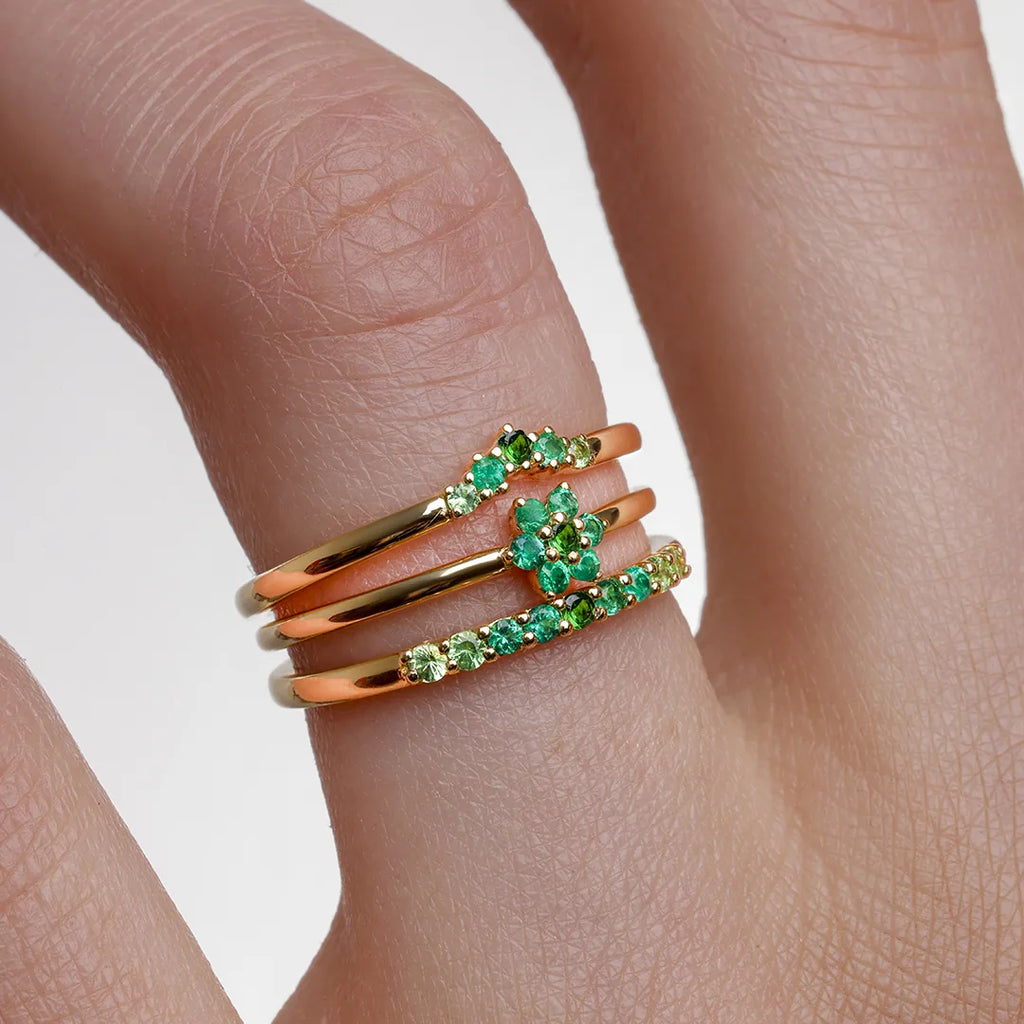
The Canopée Emerald collection embodies Mayuri's signature gradient: deep tsavorite, emerald, and light tsavorite. Three shades of green evoking tropical canopies. For bespoke orders, we offer Colombian emeralds sourced from the Muzo or Chivor mines.
Each stone is individually inspected by our gemologists prior to setting.
Canopée collection emerald rings by Mayuri, Surya, Anaya and Kiran stacking in 18ct gold with a tsavorite and emerald gradient
The official birthstone for May is the emerald, a green variety of beryl coloured by chromium and/or vanadium. This association dates back to medieval lapidary traditions and was formalised in 1912. The emerald symbolises renewal, wisdom, and eternal love.
What is the price of a natural Emerald?
Prices vary according to quality, origin, and treatment: from $120 per carat for commercial-grade stones to over $36,000 per carat for an exceptional untreated Colombian emerald. For a beautiful piece of fine jewellery, expect to pay between $600 and $2,400 per carat for a good-quality Zambian emerald.
Are inclusions in an Emerald normal?
Yes, absolutely. Unlike diamonds, inclusions are accepted and even expected in emeralds. They are given a poetic name: the "garden." An emerald that is too clean is suspicious; it is most likely synthetic. The most prized stones have discreet inclusions that do not affect their transparency.
What is the difference between a Colombian and a Zambian Emerald?
Colombian emeralds offer an intense, pure green with characteristic three-phase inclusions. Zambian emeralds display a slightly more blue-toned green, with fewer inclusions and greater transparency. Colombian stones are generally more expensive ($1,200 to $6,000 per carat versus $600 to $2,400 per carat), though Zambian emeralds offer exceptional value for money.
Where do the finest Emeralds come from?
Colombian emeralds, from the Muzo and Chivor mines, are considered the finest by connoisseurs. Zambia, home to the Kagem mine, produces the most transparent emeralds available. Brazil and Ethiopia serve as complementary sources.
How can you tell if an Emerald is real?
Several tests exist: examining inclusions under a loupe, UV testing, and density verification. For absolute certainty, always request a laboratory report from the GIA, Gübelin, or SSEF.
How to care for an Emerald jewel?
Clean with a soft, damp cloth and lukewarm soapy water. Avoid ultrasonic cleaners, steam, and chemical products entirely. Emeralds are more delicate than diamonds or sapphires; store them separately in an individual jewellery case. Remove your emerald jewellery before sport, swimming, and applying perfume.
Is an Emerald right for an engagement ring?
Yes, provided you choose a protective setting. The emerald (7.5 to 8 on the Mohs scale) is durable, yet more fragile than a Diamond (10) or a Sapphire (9). Opt for a closed or semi-closed setting that shields the edges of the stone. The emerald cut (rectangular with cropped corners) was specifically designed to minimise the risk of impact.