The emerald: its virtues, symbolism, and role across the great civilisations of history.
Written by Déborah Baid, Founder · Mayuri ParisReading 10 min8 chapters
What the maison says
What to remember
Few gemstones carry as much meaning as the Emerald. For over 4,000 years, it has captivated civilisations across the world, from Egyptian pharaohs to Mughal emperors, from the Indian Vedic tradition to pre-Columbian beliefs. The very word "emerald" reveals this universal resonance: it derives from the Greek smaragdos, itself drawn from the Sanskrit marakata, which designates the precious green stone in Vedic texts. This etymology connects the gem directly to India, the cradle of the world's oldest gemmological tradition. This article explores the significance of the Emerald across cultures and centuries: its legendary history (Cleopatra, Nero, the Mughals), its place in the Vedic tradition (panna, stone of Mercury), its symbolic associations (love, renewal, wisdom), its presence in literature and founding myths, and the natural connection between this heritage and the Mayuri collections.
Explore our complete Emerald guide for everything you need to know about its gemological properties, origins, and quality criteria.
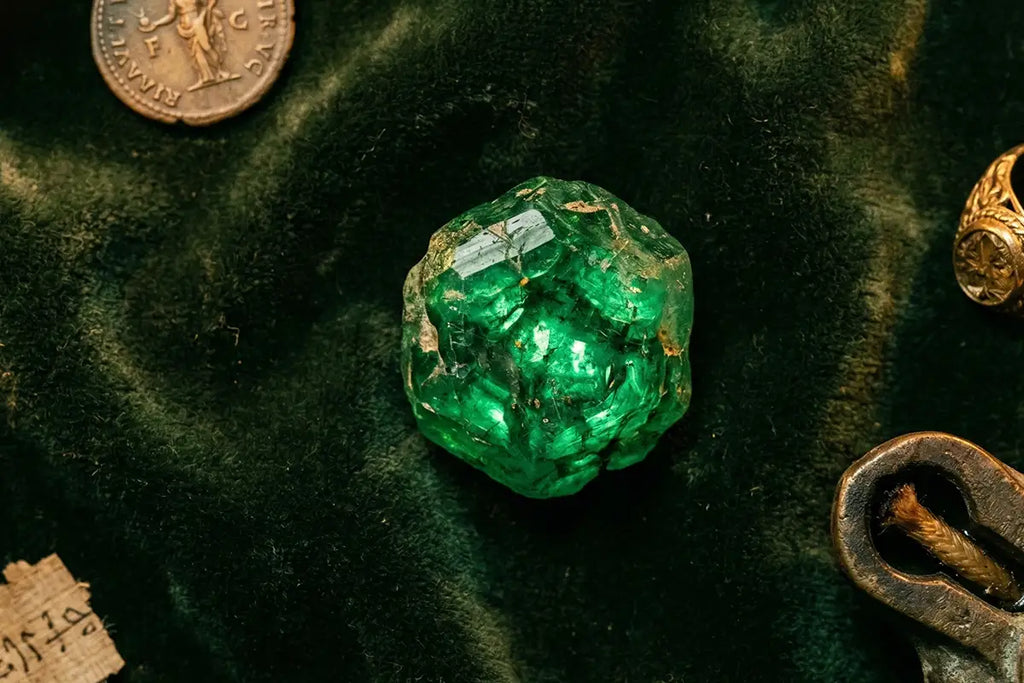
A natural emerald illustrating the virtues and age-old symbolism of this precious stone
Emerald through history: from Cleopatra to the Mughals
The history of the Emerald begins in the Egyptian eastern desert, where the mines of Gebel Zabara and Sikait were in operation as early as 1500 BCE, representing three and a half millennia of documented extraction. Cleopatra held a legendary passion for this stone. According to Pliny the Elder, she presented guests with Emeralds engraved with her likeness, and the desert mines long bore her name. In Egyptian belief, the Emerald symbolised fertility, protection, and eternal life; a stone of Isis, associated with the Nile's spring renewal.
In Rome, Pliny the Elder recounts in his Naturalis Historia (Book XXXVII) that Emperor Nero watched gladiatorial combat through a large flat Emerald, used as a lens, perhaps to rest his eyes. The Romans associated the Emerald with Venus, goddess of love and beauty, and credited it with the power to reveal truth and ward off enchantments.
Further east, the Mughal emperor Shah Jahan, builder of the Taj Mahal, was a devoted collector of Emeralds. His stones inscribed with Quranic verses are among the most celebrated in the world. The Mughal Emerald (217.80 carats, dated 1695) sold for $2.2 million at Christie's in 2001, a striking testament to Mughal fascination. When Spanish conquistadors discovered the Colombian mines in the sixteenth century, they opened the global Emerald trade, permanently connecting East and West.
The Vedic tradition: panna, the stone of Mercury
In Vedic astrology (Jyotish), each planet is associated with a precious stone. The emerald, known as panna in Hindi and Sanskrit, is the stone of the planet Mercury (Budh). Mercury governs intellect, communication, commerce and wisdom. According to Jyotish tradition, wearing an emerald is believed to strengthen these qualities in the wearer, particularly for those whose astrological chart shows a weak or afflicted Mercury.
The emerald is one of the Navaratna (the "nine gems"), a set of nine precious stones corresponding to the nine planets of the Vedic astrological system. The Navaratna is a central concept in Indian gemology: the nine stones are arranged according to a precise planetary scheme, with the emerald occupying the position of Mercury.
Ancient texts such as the Garuda Purana and the Ratnapariksa by Buddhabatta (6th century) describe in detail the properties attributed to each stone. For the emerald, they cite: mental clarity, eloquence, success in business, and the soothing of conflict. The GIA dedicates a comprehensive study to the history and folklore of the emerald, confirming the depth of these traditions. It is in this tradition that the bond between precious stones and cosmic forces is rooted, a heritage that Mayuri's collections carry in their Sanskrit names: Shanti (peace), Kali (time, power), Devi (goddess), Nadi (river), Vanya (forest), Agni (fire).
In Western tradition and contemporary crystal healing practices, the emerald is associated with the heart chakra (Anahata), the fourth chakra, located at the centre of the chest, the seat of love, compassion and emotional balance. This association is no coincidence: the colour green is universally linked to nature, springtime, renewal and hope. The emerald, with its deep and luminous green, embodies these qualities in the most radiant way.
The emerald is also the stone of Venus in Greco-Roman tradition, goddess of love and beauty. For this reason, popular belief holds that the emerald encourages sincere love, fidelity and harmony within a couple. In medieval European tradition, the emerald was said to hold the power to reveal the truth, including the ability to detect infidelity. Knights departing for the Crusades would sometimes offer an emerald to their lady, as a symbol of mutual fidelity. According to tradition, wearing an emerald close to the heart soothes the emotions, strengthens bonds of affection and opens the mind to compassion.
Symbolism and meaning of Emerald across cultures
The emerald is one of the rare precious stones whose symbolism transcends every great civilisation. Here is a concise overview of the meanings attributed to the emerald across cultures.
Culture
Primary Symbolism
Attributed Properties (according to tradition)
Ancient Egypt
Protection, fertility, eternal life
Stone of Isis, associated with the renewal of the Nile and vegetation. Said to protect against illness and ill fortune
Greece / Rome
Stone of Venus, truth, beauty
Believed to reveal truth, protect against spells, and soothe the eyes (Nero). A symbol of love and fidelity
Vedic India (Jyotish)
Stone of Mercury (Budh), intellect
Said to strengthen intellect, communication, commerce, and wisdom. One of the 9 Navaratna stones
Islam
Stone of paradise, sacred colour
Green is the colour of the Prophet. The Emerald is associated with paradise and spiritual prosperity
South America (Muisca)
Eternal love, creation
The legend of Fura and Tena: emeralds are Fura's tears of love, born of the first mythical couple of humanity
Modern Western World
Renewal, hope, love
Birthstone for May, and the gemstone of the 20th and 55th wedding anniversaries. A symbol of renewal and lasting commitment
Remarkably, despite profoundly different traditions, Every culture associates the Emerald with life, love, and renewal. It is this universality that explains the uninterrupted fascination with this stone across four millennia.
Emerald in literature and myth
The Emerald has not only adorned the crowns and fingers of the powerful; it has also fired the imagination of poets, alchemists, and novelists. Its presence in the foundational texts of Western and pre-Columbian culture speaks to a fascination that reaches far beyond gemology.
According to the medieval tradition recounted by Wolfram von Eschenbach in Parzival (circa 1210), the Holy Grail was said to have been carved from an Emerald that fell from Lucifer's brow during his fall from paradise. The Emerald of damnation becomes the chalice of redemption, one of the most spectacular symbolic reversals in European medieval literature. This legend inspired Wagner's operas (Parsifal, Lohengrin) and continues to permeate popular culture to this day.
The Emerald Tablet (Tabula Smaragdina), a foundational alchemical text attributed to Hermes Trismegistus (between the 8th and 10th centuries), inscribes cosmic wisdom upon an Emerald tablet. It contains the celebrated maxim "That which is above is as that which is below", a formula that has endured through the centuries. Isaac Newton himself produced a translation of it, proof that the Emerald captivated scientific minds as powerfully as it did mystics.
In The Wizard of Oz (L. Frank Baum, 1900), the Emerald City symbolises wealth and illusion, its inhabitants wearing green spectacles that sustain the enchantment. The irony is delicious: the true Emerald, for its part, never deceives.
The founding myth of the Muisca people (Colombia) tells of the god Aré, who created two immortal beings, Fura and Tena. Fura's tears of remorse were transformed into Emeralds, which is why the Colombian deposits lie between the peaks of Fura and Tena, in the Boyacá region. The green stone carries within it the memory of humanity's first love and first sorrow.
Finally, the Emerald wrote its own legend in Hollywood. In 1963, Elizabeth Taylor wore her genuine Bulgari Emerald, a gift from Richard Burton, on the set of Cleopatra. The queen of cinema and the queen of Egypt, united by the same passion for the green stone. The Bulgari emerald was sold at auction in 2011 for 6.1 million dollars at Christie's.
May birthstone
Emerald is the birthstone of the month of May, an association formalised in 1912 by the National Association of Jewelers (now Jewelers of America), yet rooted in medieval lapidary traditions. It is also the gemstone of the 20th and 55th wedding anniversaries, a symbol of love that renews and deepens over time. To gift an Emerald for a May anniversary is to offer a jewel carrying 4,000 years of symbolism: spring renewal, hope, fidelity, and wisdom.
For a complete guide to Emerald as the May birthstone, covering its origins, properties, and buying advice, discover our dedicated article.
The trend for Emerald engagement rings grows stronger year after year. Celebrities such as Hailey Bieber, Victoria Beckham, and Jackie Kennedy have helped popularise this choice, moving away from the traditional diamond solitaire. This choice is not merely aesthetic; it carries deep symbolic meaning. The Emerald embodies eternal love (the legend of Fura and Tena), renewal (the stone of spring), and wisdom (Vedic tradition). It is a commitment full of intention.
The Emerald is also a stone of character: each piece is unique, bearing its own natural "garden" of inclusions, much like a love story that is entirely one's own. Discover our complete guide to choosing your Emerald engagement ring.
At Mayuri, our relationship with the Emerald is not simply a commercial choice; it is a cultural coherence. Our collections bear Sanskrit names: Shanti (peace), Kali (time), Devi (goddess), Nadi (river). These names are rooted in the same Indian tradition that first classified precious stones according to their cosmic properties.
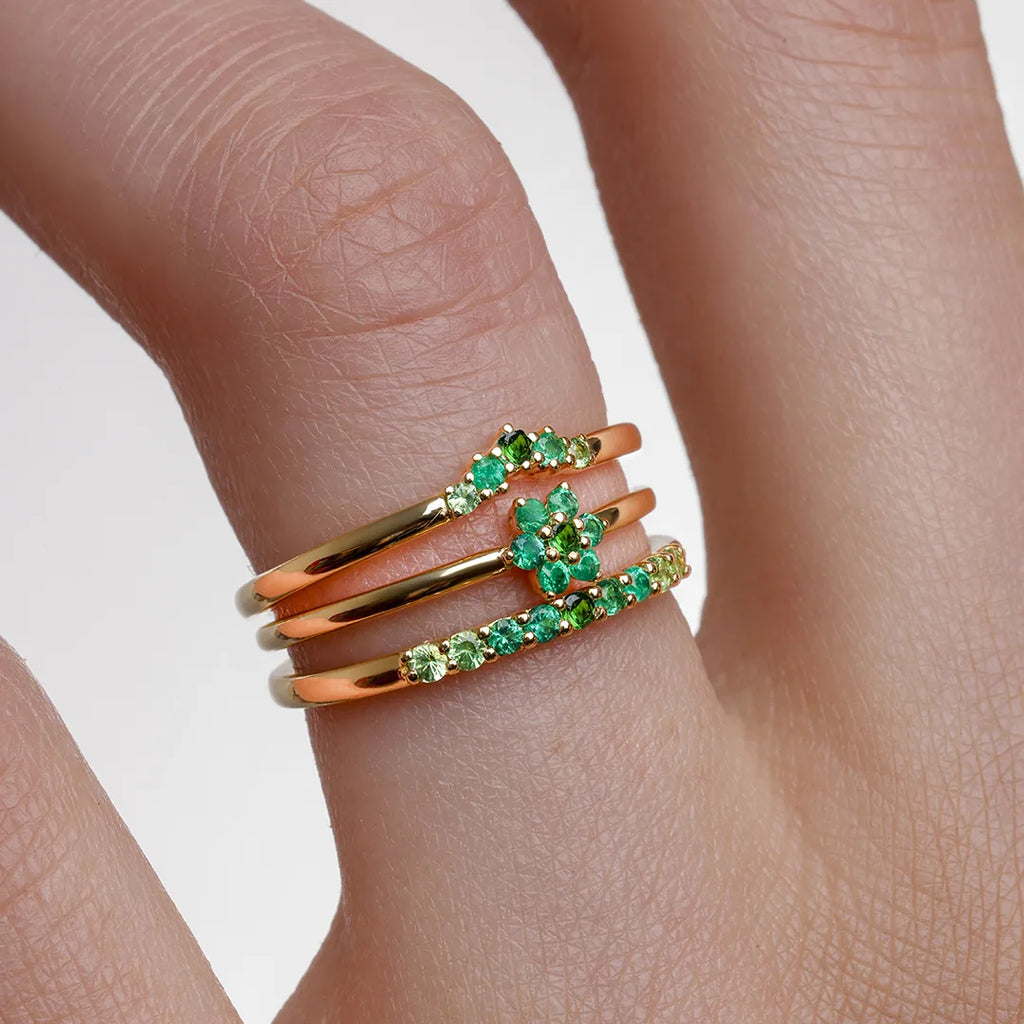
The Canopée Emerald collection is the most complete expression of this connection. Its signature gradient, deep tsavorite, Emerald, and pale tsavorite, evokes the forest canopy, a metaphor for vitality and renewal that echoes the age-old symbolism of the Emerald. Every Mayuri Emerald is individually selected by our gemologists. Our stones are sourced primarily from Zambia (deep green, excellent transparency), with Colombian Emeralds available on special order.
Parisian craftsmanship meets Indian tradition: the settings are crafted in 18ct gold (yellow, white, and rose) and 18ct vermeil, combining genuine precious stones with noble materials in the spirit of accessible fine jewellery.
Mayuri Canopée emerald stacking rings, Surya, Anaya and Kiran in 18ct gold
The Emerald is associated with love, renewal, and wisdom across most cultural traditions. In the Western world, it is the stone of Venus and of the heart chakra (Anahata). In the Indian Vedic tradition (Jyotish), it is the stone of Mercury (Budh), the planet of intellect and communication. In ancient Egypt, it symbolised fertility and eternal life.
Which chakra is associated with Emerald?
According to contemporary crystal healing practices, the Emerald is associated with the heart chakra (Anahata), the fourth chakra. This chakra is the seat of love, compassion, and emotional balance. The connection is rooted in the stone's green colour, universally linked to nature and renewal.
Which astrological sign is linked to Emerald?
In Western astrology, the Emerald is often associated with Taurus (April 20 – May 20) and Gemini (May 21 – June 20), as the birthstone of May. In Vedic astrology (Jyotish), it is the stone of Mercury (Budh) and may be recommended to anyone whose natal chart calls for a strengthened Mercury, regardless of their sign.
Why give Emerald as a gift?
The Emerald is the perfect gift for a May birthday, a 20th or 55th wedding anniversary, or simply to offer a piece of jewellery with deep meaning. It symbolises renewal, enduring love, and hope. It is one of the rare gemstones whose symbolism is universally positive, from ancient Egypt to Vedic India and the pre-Columbian traditions.
Does Emerald bring good luck?
According to many traditions, yes. In the Vedic tradition, wearing an Emerald (panna) is said to strengthen intellect, communication, and commercial success. In medieval European tradition, it was believed to ward off spells and reveal the truth. These beliefs, of course, belong to the realm of tradition rather than science, yet they speak to 4,000 years of fascination with this stone.
What is the difference between the virtues of Emerald and its gemological properties?
The "virtues" of the Emerald belong to cultural and spiritual traditions, including Jyotish, crystal healing, and ancient beliefs; they are not scientific properties. Its gemological properties, however, are measurable: hardness (7.5–8 on the Mohs scale), chemical composition (chrome-bearing beryl), and refractive index. At Mayuri, we honour both dimensions: gemological rigour in the pursuit of quality, and cultural heritage in the pursuit of meaning.