Where do emeralds come from? Colombia, Zambia, Brazil
Colombian vs Zambian emeralds: origins, colour differences, clarity, and their impact on value.
Written by Johan Nel, Jewellery designer & goldsmith · trained in gemmology · Mayuri ParisReading 12 min8 chapters
What the maison says
What to remember
The Emerald is undoubtedly the most fascinating of all precious stones, and the rarest of the four great ones. But did you know that not all emeralds are alike? A Colombian Emerald has neither the same colour, nor the same inclusions, nor the same character as a Zambian or Brazilian one. Each deposit tells a unique geological story, shaped by millions of years of extreme conditions. The deep, warm green of Muzo, the vivid blue-green of Kagem, the lighter green of Bahia: each origin gives the stone a distinct personality. Understanding where an Emerald comes from means understanding why it has that colour, those inclusions, that inner light. It also means being better equipped to choose the one that speaks to you. This article takes you to the heart of mines across the world, from Colombia to Zambia, from Brazil to Ethiopia, to discover what makes each origin unique, and how we select our stones at Mayuri.
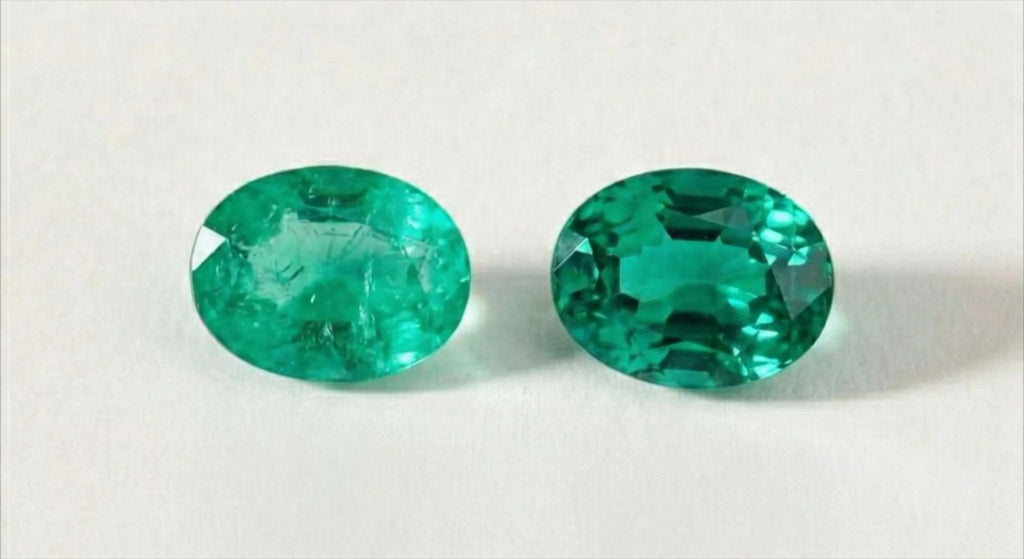
Visual comparison between a Colombian emerald and a Zambian emerald
How do Emeralds form in nature?
The Emerald is a beryl, a beryllium aluminium silicate with the formula Be₃Al₂Si₆O₁₈. Its green colour comes from minute traces of chromium and sometimes vanadium, two elements rarely found alongside beryllium in the Earth's crust. It is this extraordinary geochemical coincidence that explains why Emerald deposits are so rare and so scattered across the globe.
Two main formation processes produce the emeralds we know today. The first is hydrothermal formation, characteristic of Colombia: hot fluids rich in beryllium circulate through veins of black limestone (lutite) and encounter chromium. This is a unique case in the world; Colombian Emeralds form within sedimentary rock, whereas elsewhere they emerge from metamorphic environments. The second process is metamorphic or metasomatic formation, observed in Zambia, Brazil, Ethiopia, and most other deposits. Here, beryllium-rich granite pegmatites meet chromium-rich basic rocks, such as mica schists and amphibolites, under the effect of heat and pressure.
In both cases, conditions must align in a very specific way: a temperature between 300 and 600°C, considerable pressure, and the simultaneous presence of beryllium and chromium or vanadium. This fundamental difference in formation explains why Colombian Emeralds are chemically distinct from Zambian or Brazilian ones, and why each origin has its own unique character.
Colombia: the birthplace of the Emerald
Colombia is the world's leading producer of emeralds by value, accounting for 50 to 60% of the global market. The department of Boyacá, nestled in the eastern range of the Andes, is home to the three great historic mines that have built the legend of the Colombian Emerald.
Muzo is the most celebrated mine in the world. Its emeralds display a deep, intensely saturated green, with a unique optical phenomenon that gemologists call "gota de aceite", literally "drop of oil." This soft, oily luminescence gives the stone a velvety radiance found nowhere else. The Muzo green is, quite simply, Muzo is the undisputed global reference for emeralds. The neighbouring Roselure mines produce stones of a similar character.
Chivor, to the east of Boyacá, produces emeralds that are slightly bluer and often more transparent than those of Muzo. Historically, it was the first mine worked by the Spanish conquistadors, as early as 1537. Its stones are recognisable by their characteristic pyrite inclusions, small golden crystals trapped within the green.
Coscuez completes the historic trio with a significant output, though of variable quality, ranging from light green to intense green depending on the veins being worked.
What truly sets Colombian emeralds apart are their three-phase inclusions: a mixture of liquid, gas, and a salt crystal (halite) trapped within the stone. No other origin produces these inclusions so consistently; it is a unique diagnostic signature that gemologists use to identify Colombian provenance.
In terms of price, high-quality Colombian stones reach record figures. The "Rockefeller Emerald," an 18.04-carat stone from Muzo, sold for $6.5 million at Christie's in 2017. Gem-quality emeralds from Colombia command a premium of 20 to 50% over Zambian stones of equivalent quality.
Most Colombian emeralds are treated with cedar oil due to their natural network of inclusions. Stones graded "No Oil" or "Insignificant Oil" are exceptionally rare and costly.
Eye-clean Colombian emerald showcasing the pure green typical of the Muzo mine
Zambia: the African rival
Zambia is the world's second-largest emerald producer, thanks primarily to the Kagem mine in the Kafubu emerald belt, near Ndola. Operated by Gemfields (75%) and the Zambian government (25%), Kagem is simply the highest-volume emerald producer in the world.
The story of Zambian emeralds is a relatively recent one. Deposits were discovered in the 1920s, but commercial mining did not truly begin until the 1970s. It was Gemfields' acquisition in 2008 that transformed Kagem into a modern mining operation, with standards of traceability and ethical practice unprecedented in the industry.
The Zambian colour palette is defined by a vivid blue-green, often described as "cooler" than its Colombian counterpart. This bluish hue stems from a different chrome/vanadium/iron ratio, linked to the stone's metamorphic formation. Some gemologists and collectors prefer this livelier tone; it is a matter of personal taste, not objective quality.
Zambian emeralds generally display fewer inclusions than Colombian ones, yielding cleaner stones at equivalent sizes. Their typical inclusions, mica (phlogopite), tremolite, and actinolite, differ from the three-phase inclusions found in Colombian stones. As a result, Zambian emeralds often require less oil treatment, and a higher proportion are graded "Minor Oil" or even "No Oil."
In terms of price, Zambian stones sit 20 to 40% below their Colombian counterparts at equivalent colour quality, making them an excellent value proposition. That said, the finest Zambian emeralds, intensely coloured, exceptionally clean, and above 2 carats, can reach very significant prices.
Gemfields is a pioneer in traceability and ethical sourcing. Each lot is sold at public auction, certified, and the proceeds directly fund local communities. The Kagem mine employs around 1,200 people and finances schools and healthcare centres in the Ndola region.
It is precisely for all these reasons that Mayuri sources its emeralds primarily from Zambia: consistent quality, vibrant colour, minimal treatment, traceable and ethical sourcing.
Zambian emerald displaying the blue-green hue typical of the Kagem deposits
Brazil: diversity and volume
Brazil is the world's third-largest emerald producer, with deposits spread across three main states covering a remarkably wide spectrum of quality.
The state of Bahia, with the districts of Carnaíba and Nova Era, provides substantial production of variable quality, yielding many commercial-grade stones as well as some beautiful surprises. Minas Gerais, with the districts of Itabira and the celebrated Belmont mine, produces some of Brazil's finest emeralds: a deep, rich green that can rival Colombian stones in saturation and depth. Finally, Goiás (Santa Terezinha de Goiás) is known for good commercial-quality stones with a consistent medium green.
The Brazilian colour is generally described as a lighter, slightly more yellow-toned green than Colombian or Zambian stones. Yet this generalisation conceals a more nuanced reality: the finest stones from Minas Gerais achieve a deeply saturated green that often surprises buyers accustomed to underestimating Brazilian origin.
The characteristic inclusions, biotite, tremolite, and dolomite crystals, reflect the metamorphic formation common to Brazilian deposits. Treatment levels vary and are, on average, comparable to those of Zambian stones.
In terms of price, the range is extremely broad. Brazilian commercial-grade stones rank among the most accessible on the market. At the other end of the spectrum, fine stones from Belmont or Itabira trade at prices approaching those of quality Zambian emeralds. Brazil experienced a production peak in the 1980s and 1990s, and while output is lower today, it remains a major player, particularly as a cutting and international trading hub, where emeralds from all origins are cut and brought to market.
Other origins: Ethiopia, Afghanistan, Madagascar
Beyond the three major producers, several emerging sources deserve the attention of gemstone enthusiasts.
Ethiopia is the most exciting discovery of recent years. Deposits unearthed in 2016 in the Shakiso region (Oromia) yield good-quality stones with a rich green sometimes compared to Zambian emeralds. This is a source to watch closely; it could become a major player within the next decade.
Afghanistan and its celebrated Panjshir Valley are home to emeralds known since antiquity. The green is intense, often of remarkable purity, though the stones are generally small in size. Extraction remains artisanal, carried out under extreme conditions, which limits overall production.
Madagascar (Mananjary) offers generally lighter stones and modest production. Its potential remains largely unexplored. The Russia (Ural Mountains, Malysheva mine) played an important historical role in the 19th century; the emeralds of the tsarist collections are legendary, but current production remains limited. The Pakistan (Swat Valley) produces small quantities of stones sometimes compared to Colombian emeralds due to a similar hydrothermal formation.
For a clearer overview, here is a summary table of the main origins. Price ranges are indicative and refer to faceted stones of fine quality (1–3 carats); they vary considerably depending on the colour, clarity, cut, and treatment of each individual stone.
Emerald Origins Compared
Colour, inclusions, treatment and price by provenance
Criterion
Colombia
Zambia
Brazil
Ethiopia
Afghanistan
Dominant colour
Deep, warm green (yellow undertone)
Blue-green, vivid, "cool" ⭐ MAYURI SOURCE
Medium green, slightly yellow
Rich green, close to Zambia
Intense green, slightly blue
Typical inclusions
Three-phase (liquid + gas + halite)
Mica, tremolite, actinolite
Biotite, tremolite, dolomite
Mica, tremolite
Mica, pyrite
Inclusion level
High (abundant jardin)
Moderate
Variable
Moderate
Variable
Typical treatment
Moderate to significant
Minor to moderate
Moderate
Minor to moderate
Variable
Indicative price (£/ct, 1–3 ct, fine quality)
£2,500 - £13,000+
£1,250 - £6,800
£425 - £4,250
£680 - £3,400
£850 - £5,100
Share of world production
~50–60% (by value)
~20%
~10–15%
~2–3%
< 1%
Geological formation
Hydrothermal (sedimentary)
Metamorphic
Metamorphic
Metamorphic
Hydrothermal
Colombia
The historic home of the Emerald
Colour
Deep, warm green (yellow undertone)
Inclusions
Three-phase (liquid + gas + halite), high level
Treatment
Moderate to significant (oiling)
Indicative price (£/ct, fine quality)
£2,500 - £13,000+
World share
~50–60% (by value)
Zambia
Africa's finest rival
⭐ MAYURI SOURCE
Colour
Blue-green, vivid, "cool"
Inclusions
Mica, tremolite, actinolite, moderate level
Treatment
Minor to moderate
Indicative price (£/ct, fine quality)
£1,250 - £6,800
World share
~20%
Brazil
Diversity and volume
Colour
Medium green, slightly yellow
Inclusions
Biotite, tremolite, dolomite, variable level
Treatment
Moderate
Indicative price (£/ct, fine quality)
£425 - £4,250
World share
~10–15%
Ethiopia
An emerging source
Colour
Rich green, close to Zambia
Inclusions
Mica, tremolite, moderate level
Treatment
Minor to moderate
Indicative price (£/ct, fine quality)
£680 - £3,400
World share
~2–3%
Afghanistan
The Panjshir Valley
Colour
Intense green, slightly blue
Inclusions
Mica, pyrite, variable level
Treatment
Variable
Indicative price (£/ct, fine quality)
£850 - £5,100
World share
< 1%
One essential point to keep in mind: price ranges overlap considerably. An exceptional Zambian emerald can cost more than an average-quality Colombian one. Origin is one pricing factor among many, and certainly not the only one.
Does origin determine quality?
This is the question every buyer should ask, and the answer is nuanced.
The origin premium is very real: at equal quality, a Colombian emerald sells for 20 to 50% more than a Zambian one, and a Zambian emerald more than a Brazilian one. This is a market reality, rooted in history and reputation, but it is not necessarily an indicator of objective quality.
Quality varies enormously within each origin. Every mine produces both exceptional stones and mediocre ones. A gem-quality Zambian emerald, deep green, graded "Minor Oil," above 2 carats, far surpasses a pale, heavily included, and highly treated Colombian stone. Buying "an origin" makes no sense: it is the quality of the stone itself that should guide the choice. Origin is a bonus, for storytelling, for collectors, but never a substitute for the fundamental criteria: colour, clarity, treatment, and cut quality.
For high-value stones (above $6,000), an origin determination report issued by the GIA or the Gübelin provides reliable certification. For a piece of jewellery at $600, such a report is not necessary; it is better to invest the difference in a higher-quality stone.
Our advice at Mayuri: we prioritise the beauty of the stone, not its passport. If a Zambian emerald has the perfect colour, clarity, and brilliance, that is the one we select.
At Mayuri, we source our emeralds primarily from suppliers working with the Kafubu emerald belt in Zambia. Why this choice? Because Zambian emeralds offer a rare combination: consistent quality, vivid and deep colour, excellent value for money, minimal treatment (cedar oil only), and traceable sourcing through the Gemfields auction system.
For clients who specifically wish to have a Colombian Emerald, for a high-end engagement ring or a collector's piece, we offer dedicated sourcing with an additional lead time of 2 to 4 weeks for selection.
Our treatment policy is clear: cedar oil only, never synthetic resin (Opticon, Permasafe). Cedar oil is the most traditional and most respectful treatment for the stone, universally accepted by the international gemological trade.
Every Mayuri Emerald over one carat is accompanied by an indication of its origin and treatment level. For high-value stones, a full gemological certificate is available upon request.
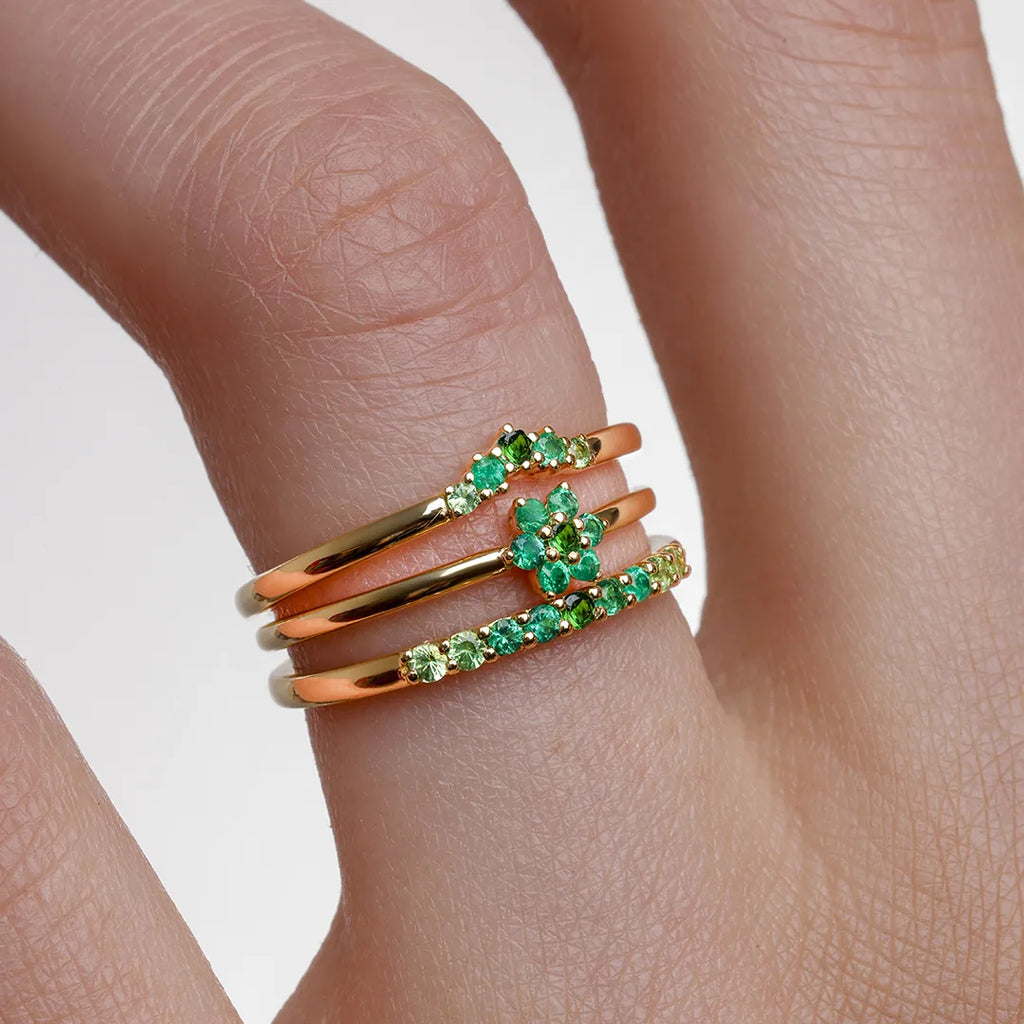
Our Canopée Emerald collection perfectly illustrates our approach: a gradient of green stones, deep tsavorite, Emerald, and light tsavorite, highlighting the nuances of Zambian green in unique compositions.
Stacking the Canopée emerald rings Surya, Anaya and Kiran by Mayuri in 18ct gold
Where do the world's most beautiful Emeralds come from?
Colombian emeralds from Muzo are considered the benchmark for their deep green colour and their "gota de aceite" effect. However, the finest Zambian emeralds rival them in beauty, with an intense blue-green hue and often superior clarity. The "best" Emerald is the one that presents the colour, clarity, and brilliance that moves you, regardless of its origin.
Why are Colombian Emeralds more expensive?
The Colombian premium is explained by three factors: a historic reputation (the oldest known mines), a "benchmark" colour (warm, deep green), and the rarity of gem-quality stones with minimal treatment. This premium represents 20 to 50% more than a Zambian stone of equivalent quality. This is, however, a market reality rather than an objective measure of superiority.
How can you identify the origin of an Emerald?
Gemologists identify origin through inclusions (three-phase for Colombia, mica for Zambia), chemical analysis (spectrometry), and absorption spectrum. An origin report from the GIA or the Gübelin is the only reliable method. To the naked eye, it is impossible for a non-specialist.
Are Zambian Emeralds good quality?
Excellent quality. Zambian emeralds from the Kagem mine (Gemfields) offer an intense blue-green colour, good clarity, and often require less treatment than Colombian stones. They represent the best value for money on the market today. This is Mayuri's primary source.
What is the difference between a Colombian and a Zambian Emerald?
The Colombian Emerald typically displays a warmer green, with yellow undertones, more inclusions, and a greater frequency of oil treatment. The Zambian Emerald tends toward a cooler, blue-tinged green, often with greater clarity and less treatment. In terms of pricing, Colombian stones command a premium of 20 to 50% at equivalent quality.
Does Ethiopia produce quality Emeralds?
Yes, the Ethiopian deposits discovered in 2016, in the Shakiso region, produce fine-quality Emeralds with a deep, rich green that is sometimes compared to Zambian stones. This is an emerging source with the potential to become a major player in the coming decade.
Are Brazilian emeralds worth it?
Brazil offers an exceptionally wide range of quality levels. Commercial-grade stones are accessible in price, though often pale in color. That said, fine Emeralds from Minas Gerais, particularly from the Belmont mine, or from Itabira, can achieve a remarkably saturated green at prices more accessible than their Colombian counterparts. For those working within a defined budget, a high-quality Brazilian Emerald is an outstanding choice.