Written by Johan Nel, Jewellery designer & goldsmith · trained in gemology · Mayuri ParisReading 4 min9 chapters
What the maison says
What to remember
"Your emerald has been treated with oil." This mention appears on the majority of gemological certificates and often causes concern among buyers. Yet there is no cause for alarm: more than 95% of emeralds on the market are treated with cedar oil, a process that has existed for millennia. Oil treatment consists of immersing the emerald in a natural oil to fill its micro-fractures and improve its transparency. It is neither a disguise nor a falsification; it is an age-old process, widely accepted and regulated by the entire international gemological trade. This article explains what each treatment mention on a certificate means, how to classify treatment levels (from "No Oil" to "Significant"), the real impact on price, and how we at Mayuri approach the subject.
Why are emeralds treated with oil?
The Emerald is a chromium-bearing beryl whose intense green colour comes from chromium and sometimes vanadium. Its geological formation, under conditions of high pressure and temperature, inevitably produces inclusions and micro-fractures that gemologists refer to as the emerald's "garden". Unlike diamonds, where inclusions are considered flaws, in emeralds they are expected and form part of the stone's identity. A natural emerald entirely free of inclusions is so rare it would raise suspicion. The problem arises when these fractures reach the surface: light no longer passes through correctly, and the emerald loses its natural brilliance. The solution is to fill these micro-fractures with a fluid whose refractive index is close to that of the emerald (1.56 to 1.60). Cedar oil, with an index of approximately 1.50, is the ideal natural candidate. The fracture "disappears" optically, and transparency improves in a spectacular way.
Comparison of two Colombian Emeralds showcasing differences in clarity and natural inclusions, the characteristic "jardin" of the stone
The oil treatment process, simply explained
Colombian merchants had already been using cedar oil for centuries to enhance their emeralds before sale. The process is as old as the trade in the stone itself. In antiquity, the Egyptians had already understood that a drop of oil could transform an ordinary stone into a royal jewel. Today, the process is more controlled: the emerald is first meticulously cleaned, then immersed in a cedar oil bath. The stone is then placed under vacuum or pressure to force the oil into the micro-fractures accessible from the surface. The process takes anywhere from a few hours to a few days, depending on the porosity of the stone. The oil penetrates only into open fractures. It neither modifies the chemical composition nor the crystal structure of the emerald. The stone remains 100% natural; only its transparency is optically enhanced. And above all, the treatment is entirely reversible: a professional re-oiling can restore the original transparency at any time.
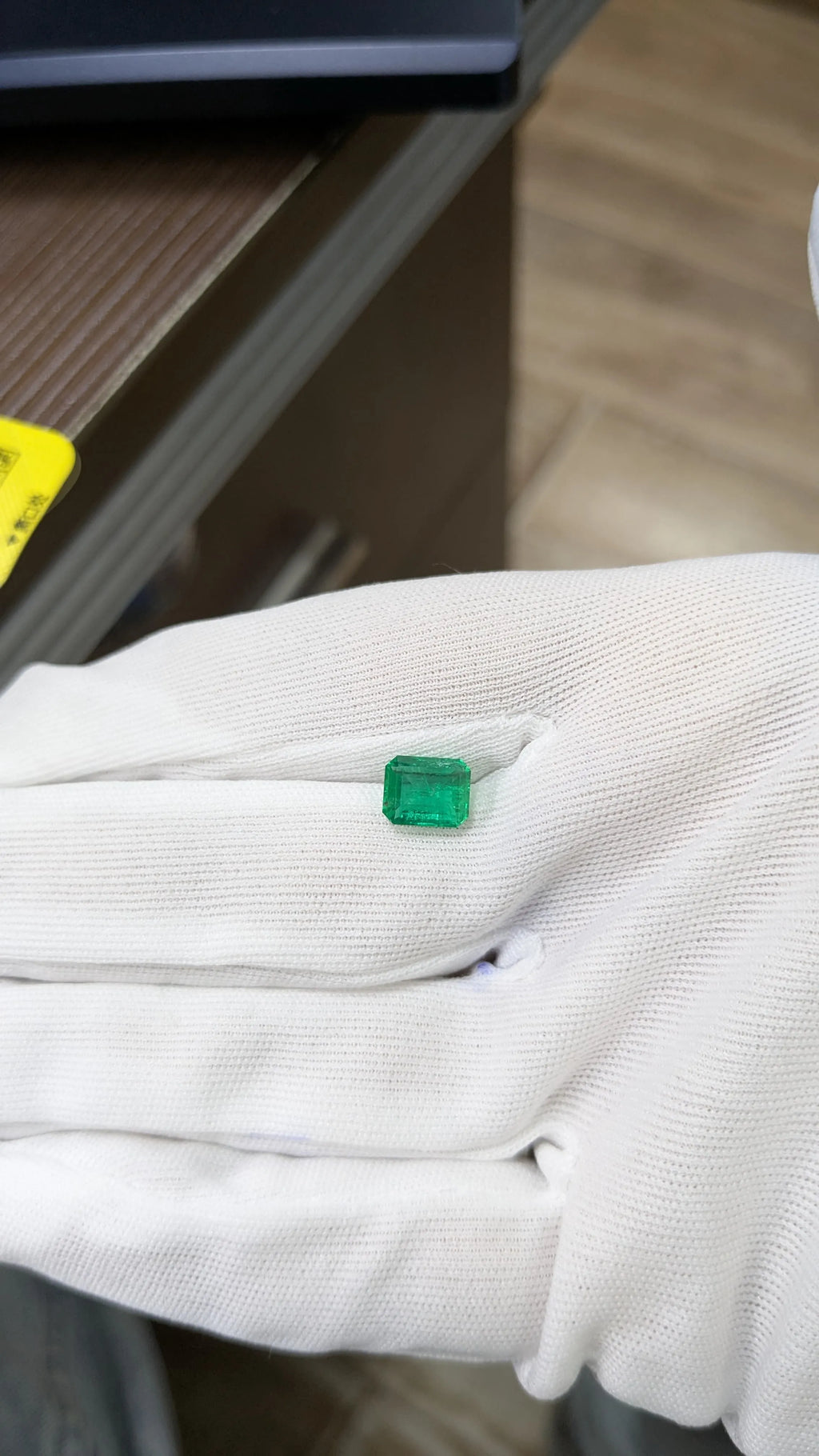
A Colombian Emerald cut emerald resting on a gemologist's glove, an eye-clean stone before setting
The different types of treatment agents
The industry today offers several types of agents to enhance the transparency of emeralds. Each has its own characteristics in terms of durability, reversibility, and market acceptance.
Cedar oil remains the standard in fine jewellery. A natural agent with a refractive index of approximately 1.50, it offers a lifespan of 5 to 20 years depending on wearing and care conditions. Fully reversible, it is the treatment most widely accepted by laboratories and the gemological trade. It is the treatment we use at Mayuri for all our emeralds.
Synthetic resins (Opticon, Permasafe) are polymers that harden within fractures. Their lifespan is longer (20 or more years), but they are difficult to remove without risk to the stone. Some laboratories (Gübelin, SSEF) downgrade resin-treated emeralds compared to those treated with oil. For equivalent apparent quality, a resin-treated emerald is generally worth 10 to 30% less.
Synthetic and tinted oils are a warning sign. Tinted oils ("green oil") simultaneously alter both the transparency and the colour of the stone. Laboratories systematically disclose this, and the impact on value is severely negative. This type of treatment goes beyond the legitimate enhancement of transparency.
Emerald Treatment Comparison Guide
Everything you need to know about the different methods used to enhance emeralds
Treatment Type
Description & Method
Durability
Price Impact
Industry Acceptance
Pros / Cons
Reversibility
Traditional Oiling Cedar oil, jojoba
Immersion in clear natural oils (capillary action into open fractures). A time-honoured method.
Optimal (85%) Protection and revealed beauty
-10 to -20% vs untreated stone
Universally Accepted ⭐ MAYURI'S CHOICE
✅ Ideal balance of beauty and resilience ✅ Reveals natural beauty while protecting the stone ✅ A respectful, centuries-old tradition ❌ Simple re-oiling every 5 to 10 years
Leading gemological laboratories (GIA, Gübelin, SSEF) classify the level of treatment in emeralds using a standardised scale. Each level has a direct impact on the price of the stone.
None / No Oil: the rare and precious exception
No trace of oil or resin detected by Raman spectroscopy and FTIR. This level represents less than 5% of emeralds on the market. The price multiplier is considerable: x2 to x5 compared to an equivalent "Minor Oil" emerald. Exceptional-quality "No Oil" emeralds, particularly Colombian "gota de aceite" stones, achieve record prices at auction.
Insignificant / Minor Oil: the best value for your investment
Minimal to slight traces of cedar oil. The stone naturally has very few accessible fissures, which is a sign of intrinsic quality. This is the most sought-after level among discerning buyers: a beautiful balance between natural quality and accessible pricing, with a price premium of +30 to +50% compared to "Moderate".
Moderate Oil: the market standard
A moderate level of treatment, accepted across the entire trade. The majority of jewellery-grade emeralds fall within this category. It serves as the reference standard for price calculations and represents a quality choice for a jewellery purchase.
Significant Oil: what to know before you buy
Significant treatment, sometimes visible under a loupe as oily reflections within the fissures. The transparency of the stone is heavily dependent on the treatment, with a price impact of -30 to -50% compared to "Moderate". Should the oil evaporate over time, transparency will diminish noticeably and re-oiling will be required more frequently.
Level
Description
% of market
Price impact (vs Moderate)
Recommendation
No Oil
No treatment detected
< 5%
x2 to x5
Investment piece, high jewellery
Insignificant / Minor
Light traces
~15%
+30 to +50%
Excellent choice for fine jewellery
Moderate
Standard treatment level
~50%
Reference
Great value for money
Significant
Heavy treatment
~30%
-30 to -50%
Check stability; re-oiling is likely over time
How to read the treatment notation on a gemological certificate
Each leading gemological laboratory notes emerald treatment on its certificates, though the terminology varies. On a GIA certificate, the standard mention reads "Clarity enhancement: Type A filler, degree F1" — Type A refers to a natural oil, and degree F1 indicates a minor treatment. In December 2024, the GIA reintroduced the identification of filler type (Type A vs. Type B for resins). On a Gübelin or SSEF certificate, the scale reads None / Insignificant / Minor / Moderate / Significant, with the type of agent specified: "oil" (widely accepted) or "resin" (less valued). The LFG (Laboratoire Français de Gemmologie) uses French terminology with a similar scale. Our recommendation: always request a certificate that specifies both the type of agent and the degree of treatment. A certificate that mentions only "treatment" without further detail is insufficient to properly assess the true value of the stone.
The impact of treatment on price: key benchmarks
The level of treatment is one of the most important factors in determining the price of a quality emerald. For a Colombian emerald with fine colour (1 carat, comparable quality), here are the general price ranges. These figures apply to Colombian emeralds; Zambian emeralds are typically priced 20 to 40% lower. Prices increase exponentially with carat weight: a 3 ct "Minor Oil" emerald can be worth five to ten times the price of a 1 ct stone.
Treatment Level
Price Range (1 ct, good quality)
Why
No Oil
$3,500 - $18,000+
Extreme rarity, investment-grade
Minor Oil
$1,800 - $6,000
High natural quality, minimal treatment
Moderate Oil
$950 - $3,000
Market standard, excellent value for quality
Significant Oil
$350 - $1,200
Clarity depends on treatment, re-oiling to be expected
Caring for a treated emerald: the essential steps
The cedar oil in your emerald is not permanent. Over time, exposure to heat, chemicals, and ultrasonic cleaning can cause the oil to evaporate or degrade. Our key recommendations: wear your emerald regularly (skin contact does not harm the treatment), clean it with a soft damp cloth and mild soap, store it in an individual jewellery case away from direct heat, and have it inspected by a gemologist every three to five years.
On the other hand, always avoid ultrasonic cleaners (vibrations dislodge the oil from fissures), steam cleaners, sudden temperature changes, and chemical products such as solvents, acetone, and alcohol. If the transparency of your emerald visibly diminishes, a professional re-oiling will restore its original transparency. This non-destructive process involves immersing the stone in a cedar oil bath under vacuum. Indicative cost: $60 to $175, depending on the size of the stone.
"An oil-treated emerald is a fake emerald" — false. Oil treatment alters neither the chemical composition nor the crystal structure of the stone. It remains a natural emerald whose transparency has been enhanced. The entire international gemological trade accepts this treatment, and CIBJO standards govern it precisely. "All emeralds are treated" — almost true. More than 95% of emeralds on the market have undergone oil treatment. "No Oil" emeralds exist but are extremely rare and very expensive. "The treatment disappears overnight" — false. Cedar oil remains stable for 5 to 20 years depending on wearing conditions, and re-oiling can restore transparency. "A Moderate Oil emerald is of poor quality" — false. It is the market standard. Most fine jewellery emeralds fall into this category. What matters is the overall beauty of the stone: its colour, transparency, and brilliance.
Mayuri's quality commitment for its emeralds
At Mayuri, our emeralds come primarily from Zambia, selected for their deep green hue and transparency. For bespoke orders, we also offer Colombian emeralds from Muzo or Chivor origins. All our emeralds are treated exclusively with cedar oil, the standard of high jewellery. We do not use synthetic resins such as Opticon or Permasafe, which are less valued by the market and less reversible. Each stone is individually selected by our gemologists, and the treatment level is communicated to our clients upon request. We set our emeralds in 18K yellow gold and Vermeil mountings, a rare combination on the market that unites genuine precious stones with noble materials.
Mayuri Canopée Emerald rings, stacking Surya, Anaya and Kiran in 18K yellow gold, with a tsavorite and emerald gradient
Almost all of them: more than 95% of emeralds sold worldwide have undergone cedar oil treatment or a similar agent. This is a standard practice, accepted by all leading gemological laboratories, including the GIA, SSEF, and Gübelin. "No Oil" emeralds exist but represent less than 5% of the market and are significantly more expensive.
How can you tell if an emerald has been treated?
Raman spectroscopy and FTIR analysis (infrared spectroscopy) allow laboratories to detect and identify the type of treatment agent used. To the naked eye, a well-executed treatment is invisible. This is why a gemological certificate is essential: it specifies the type and degree of treatment.
What is the difference between an oiled and an untreated emerald?
The difference lies in the presence or absence of oil within the stone's natural micro-fractures. At equal colour and cut quality, a "No Oil" emerald is rarer and more expensive, ranging from two to five times the price of a "Minor Oil" emerald. Visually, the two can appear very similar when the untreated stone has few accessible fractures.
Does oil treatment reduce the value of an emerald?
No, oil treatment is the market standard and is not considered a flaw. What affects value is the degree of treatment: "Minor Oil" is worth more than "Significant Oil." A "No Oil" emerald commands a significant premium due to its rarity.
How long does oil treatment last?
Cedar oil remains stable for 5 to 20 years depending on wearing and care conditions. Avoid ultrasonic cleaners, steam, and chemical products, as these degrade the oil. When transparency diminishes, a professional re-oiling treatment restores the stone's original appearance, typically priced between $60 and $180.
What does "minor oil" mean on a certificate?
"Minor Oil" means the laboratory has detected a small quantity of oil within the emerald's fractures. This is an excellent treatment level, indicating a stone that is naturally low in fractures. "Minor Oil" emeralds offer an outstanding quality-to-value ratio: high natural quality at a price significantly below that of "No Oil" stones.
What is the difference between oil and resin treatment for an emerald?
Cedar oil, being natural, is reversible and more widely accepted within the fine jewellery market. Resins such as Opticon and Permasafe are synthetic, more durable, but less reversible. At equal apparent quality, an oil-treated emerald is generally worth 10 to 30% more than a resin-treated one.