Identify a real emerald with 8 simple tests: inclusions, UV, density, treatments. Avoid the pitfalls.
Written by Johan Nel, Jewellery designer & goldsmith · trained in gemology · Mayuri ParisReading 4 min11 chapters
What the maison says
What to remember
At a gem market in Thailand, a vendor hands me an emerald of deep, almost unreal green. "Colombian, madame. Exceptional quality." The surprisingly low price would have been enough to convince a hasty buyer. Two minutes with a 10x loupe revealed the deception: no natural inclusions, a green far too uniform. It was a hydrothermal synthetic.
Emerald is the third most expensive precious stone after Diamond and Ruby. Counterfeits have multiplied in recent years, driven by increasingly high-quality synthetics and an online market where photographs replace physical examination.
A point few jewellers mention: unlike Diamond, there is no universal grading system for Emeralds. The GIA (Gemological Institute of America) issues an identification report, not a "quality grade." Each laboratory uses its own evaluation criteria. This is why knowing how to examine an Emerald yourself remains a valuable skill.
OurEmerald ringsare set with AAA-quality Zambian stones, individually selected by our gemologists and treated with cedar oil (market standard). Here are the 8 tests we use ourselves to evaluate our stones.
1. The "garden": the natural signature of the Emerald
The term "jardin" comes from French and refers to the characteristic network of inclusions found in natural Emerald. Unlike Diamond, where inclusions are flaws, in Emerald they are a sign of authenticity and sometimes an aesthetic asset.
Inclusions vary according to geographic origin. Colombian Emeralds often contain so-called "three-phase" inclusions — a cavity simultaneously containing a liquid, a gas bubble, and a crystal of halite. Long considered exclusive to Colombia, research published by the GIA in 2014 showed that similar inclusions also exist in Zambian and Afghan Emeralds.
Under a 10x loupe, a natural Emerald shows growth traces, trapped crystals, and partially healed fractures. A synthetic Emerald will either be too clean (no visible inclusions) or marked by "veil" or regular chevron inclusions, betraying a controlled manufacturing process.
2. The UV reaction: a telling behaviour
Under a long-wave UV lamp (365 nm), Emeralds behave differently depending on their origin and nature:
Natural Colombian Emerald: generally weak or no fluorescence, sometimes a deep red
Natural Zambian Emerald: no fluorescence
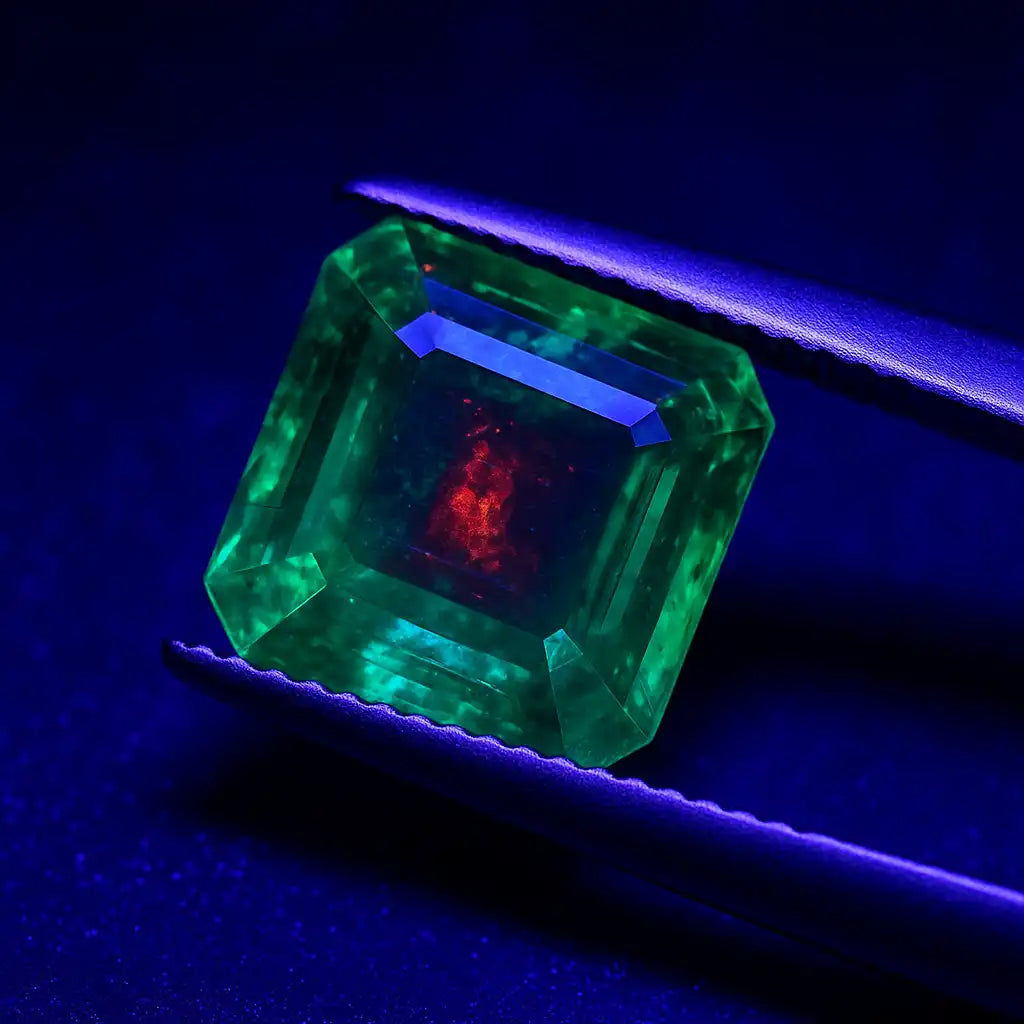
Hydrothermal synthetic Emerald: vivid red fluorescence, highly characteristic
Glass or doublet: variable fluorescence, often greenish
This test is quick and requires only a portable UV lamp (available from £18). The vivid red fluorescence of a hydrothermal synthetic is one of the most reliable indicators for a non-specialist.
UV fluorescence test on a natural Emerald under a 365nm ultraviolet lamp
3. The weight that doesn't lie
The density of natural Emerald ranges between 2.67 and 2.78 g/cm³. A lead glass imitation is often heavier (3.0 g/cm³ and above), while zirconium oxide (CZ), sometimes tinted green, displays a density of 5.6 to 6.0 g/cm³.
In a laboratory, a gemologist measures density by hydrostatic weighing: the stone is weighed in air, then immersed in water. The difference allows density to be calculated with precision. At home, without a hydrostatic balance, remember that a stone that feels "too heavy" for its size compared to a known Emerald deserves closer examination.
4. The breath test: simple yet effective
Breathe on the stone as you would on a mirror. On a natural Emerald, the condensation dissipates in 1 to 2 seconds thanks to the thermal conductivity of the beryl crystal. On glass or resin, the condensation persists for 4 to 5 seconds.
Note: this test does not distinguish a natural Emerald from a synthetic one, as both share the same chemical composition and thermal conductivity. It is a first filter to eliminate crude imitations (glass, resin, plastic), not a definitive verdict.
5. Hardness: resistant but fragile
Emerald rates 7.5 to 8 on the Mohs scale. It scratches glass (hardness 5.5) but not Sapphire (9). Caution: this test can damage the stone. Never perform it on a mounted piece of jewellery.
A paradox: Emerald is the most fragile of the "big four" precious stones (Diamond, Ruby, Sapphire, Emerald). Its natural inclusions create internal planes of weakness. It is precisely for this reason that the emerald cut — rectangular with cropped corners — was invented. The bevelled corners protect the stone from impacts that would cause it to shatter.
6. Dichroism: when colour shifts with the angle
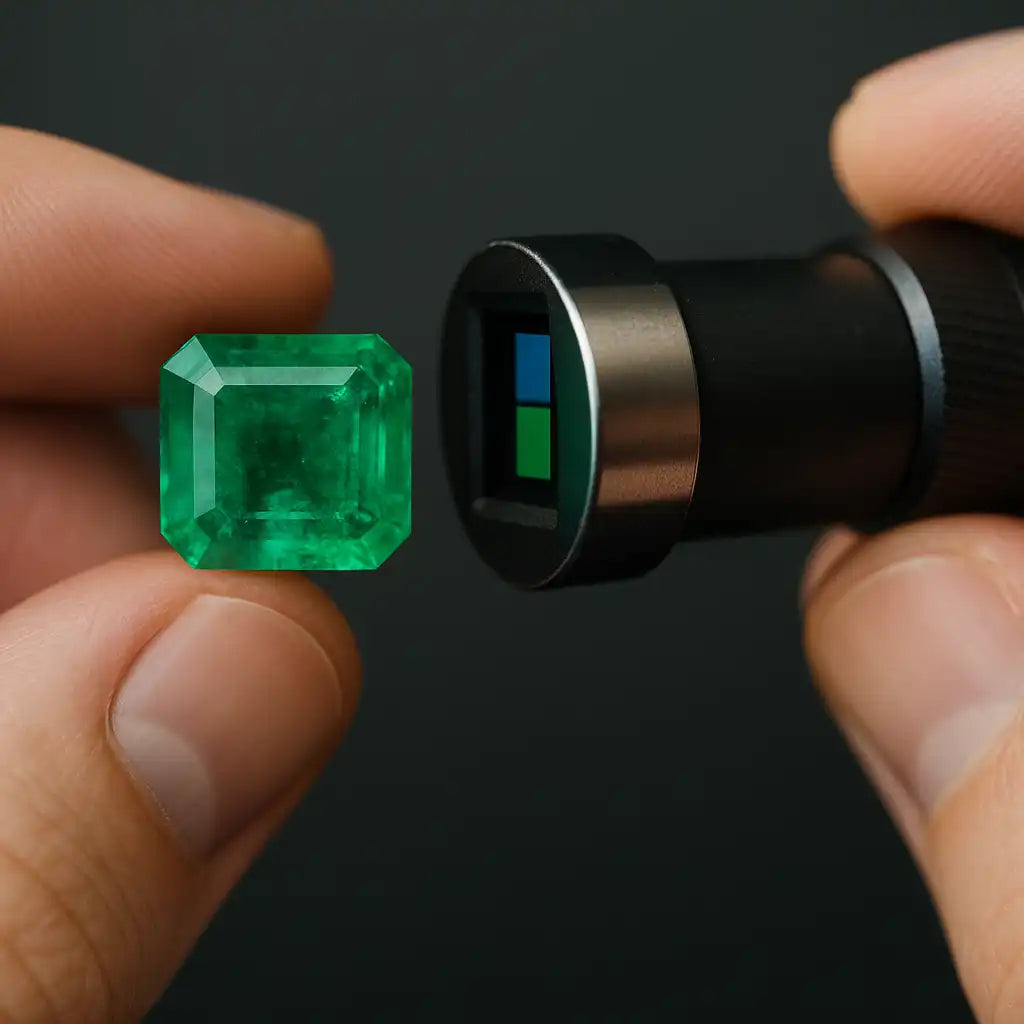
Emerald is dichroic: it displays two distinct hues depending on the angle of observation, typically a bluish green and a yellowish green. A dichroscope, a small optical tool available for around £25, allows both colours to be seen simultaneously.
Glass is not dichroic. Green tourmaline is, but with different hues (dark green / light green, without the bluish component). This is a quick test that eliminates many common imitations.
Natural Emerald analysed with a dichroscope revealing two distinct shades of green
7. The refractive index: the optical signature
The refractive index of Emerald ranges between 1.565 and 1.602, with a birefringence of 0.005 to 0.009. A gemmological refractometer (laboratory instrument) allows a precise measurement in a matter of seconds.
Peridot (1.64–1.69), green tourmaline (1.62–1.64), and glass (~1.50) have distinctly different indices. This is the most reliable instrumental test after full laboratory analysis, and the one our gemologists perform first on every incoming lot.
8. Treatments: what you need to know
Around 99% of natural Emeralds on the market have undergone a clarity treatment. This is standard practice, accepted across the entire gemological trade for centuries.
The most common treatment is cedar oil impregnation, which fills superficial micro-fractures and improves transparency. Other substances exist (Opticon resin, polymers), with varying impacts on the value and durability of the stone.
Since December 2024, the GIA has reintroduced filler-type identification on its Emerald reports: Type A (oil, wax, natural resin), Type B (artificial resin), with a degree scale ranging from F1 (minor) to F3 (significant).
To understand in detail the impact of treatments on value, consult our guide onEmerald oil treatments.
Natural Emerald vs synthetic vs imitation
This table summarises the main measurable differences between a natural Emerald and its common imitations:
Criterion
Natural
Synthetic (lab-grown)
Glass
Doublet
Composition
Be₃Al₂(Si₆O₁₈)
Identical
SiO₂ + colorants
Garnet + coloured glass
Inclusions
"Garden", three-phase, crystals
Veils, regular chevrons
Air bubbles
Visible adhesive layer
Hardness (Mohs)
7.5 – 8
7.5 – 8
5 – 6
Variable
Density (g/cm³)
2.67 – 2.78
2.65 – 2.75
2.3 – 4.0
Variable
UV 365 nm
Weak / none
Strong red (hydro.)
Greenish
Variable
Dichroism
Yes (2 hues)
Yes
No
No
Price (1 ct)
£450 – £4,250
£25 – £170
< £5
£18 – £85
A useful clarification: a synthetic Emerald is chemically identical to a natural one. It is not a "fake Emerald" — it is a laboratory-created Emerald. The difference lies in origin, not composition.
How Mayuri selects its Emeralds
At Mayuri, our Emeralds come primarily from Zambia, selected for their deep green and transparency. Each stone is individually checked by our gemologists before setting.
Our Canopée Emerald collection uses a signature gradient: dark tsavorite, Emerald, light tsavorite. Three shades of green that blend into a natural ombre inspired by tropical canopies.
Mayuri Canopée collection Emerald rings — Surya, Anaya and Kiran stacking rings in 18ct Yellow Gold with a tsavorite and Emerald gradient
All our Emeralds are treated with cedar oil, the market standard treatment. For bespoke orders, we also offer Colombian Emeralds of Muzo or Chivor provenance.
The 8 tests above allow you to rule out the most common imitations. However, only a fully equipped gemological laboratory (Raman spectrometer, microscopy, refractometer) can confirm with certainty the authenticity and origin of an Emerald.
The internationally recognised reference laboratories: GIA (United States), SSEF and Gübelin (Switzerland). In Europe, the LFG (Paris) and the IDL (Antwerp) also issue reports widely recognised within the trade.
Be wary of prices that seem too good to be true: a natural Emerald of good quality does not sell for less than £250 to £450 per carat.
A gemological certificate is most relevant for stones of a certain size, from approximately 0.5 carat: solitaires, bespoke pieces, and Emeralds purchased individually. For a piece set with small Emeralds, as is the case with most of our designs, individual certification of each stone is neither common practice nor economically justified. It is the jeweller's reputation and the traceability of their sourcing that serve as the true guarantee.
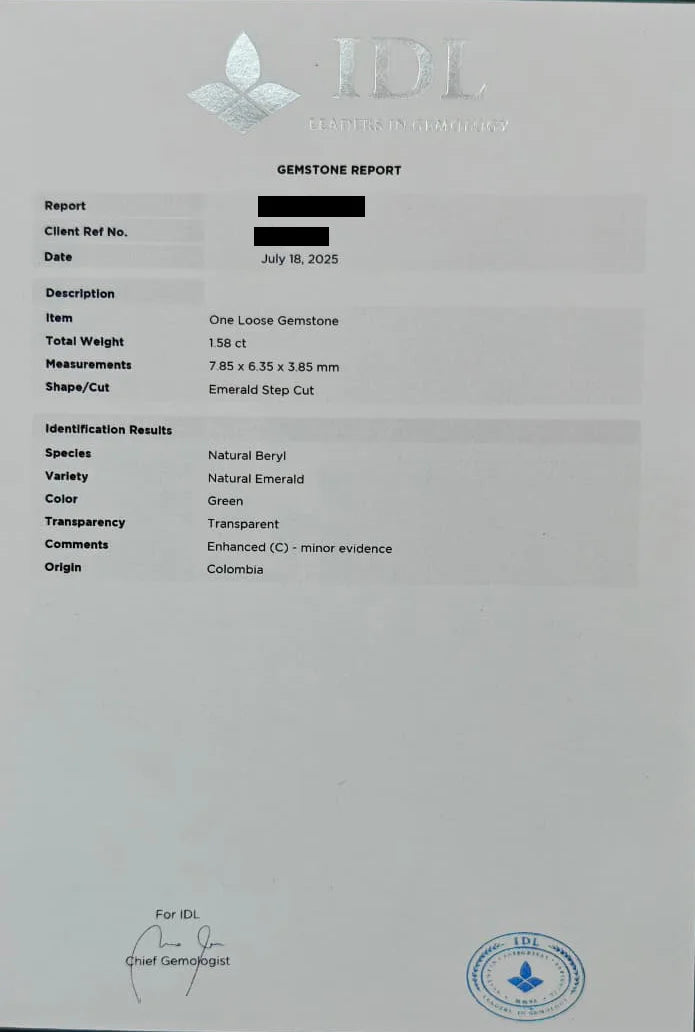
Here is an example of a gemological report issued by the IDL (International Diamond Laboratories, Antwerp) for a Colombian Emerald we sourced for a client:
IDL gemological certificate for a natural Colombian Emerald of 1.58 carat certified Natural Beryl
How can I tell if my Emerald is real without any tools?
Three quick tests: observe the inclusions against the light (a natural Emerald reveals a "garden" of inner imperfections), breathe on the stone (condensation dissipates within one to two seconds on a genuine gem), and check the price. Below £250 per carat for a stone presented as natural and of good quality, caution is strongly advised.
What is the difference between a natural and a synthetic Emerald?
The chemical composition is identical (chrome-bearing beryl). The difference is origin: a natural Emerald formed over millions of years within rock; a synthetic one is produced in a laboratory in a matter of weeks. Inclusions are the primary indicator — irregular and varied in a natural stone (the "jardin"), appearing as veils or regular chevrons in a synthetic.
Do inclusions reduce the value of an Emerald?
Not necessarily. Unlike Diamond, inclusions are accepted and expected in Emeralds. A stone that is too clean is even suspicious (likely synthetic). The most prized Emeralds have discreet inclusions that do not compromise transparency. The "jardin" is part of their character.
How much does a genuine Emerald cost?
Prices vary according to colour, clarity, weight, and origin. For a natural Emerald of good quality: £450 to £1,700 per carat (Zambia), £850 to £4,250 per carat (fine Colombian). Exceptional stones, such as Colombian gota de aceite Emeralds of over 5 carats, can exceed £8,500 per carat.
Where can I get an Emerald certified?
The leading international laboratories are the GIA (United States), the SSEF and Gübelin (Switzerland). In Europe, the LFG (Paris) and the IDL (Antwerp) are also widely recognised. A certificate typically costs between £70 and £250, depending on the laboratory and the analyses requested. This investment is worthwhile for significant stones, including solitaires and individual Emeralds above 0.5 carat. For jewellery set with smaller stones, the traceability of the jeweller remains the most reliable assurance.