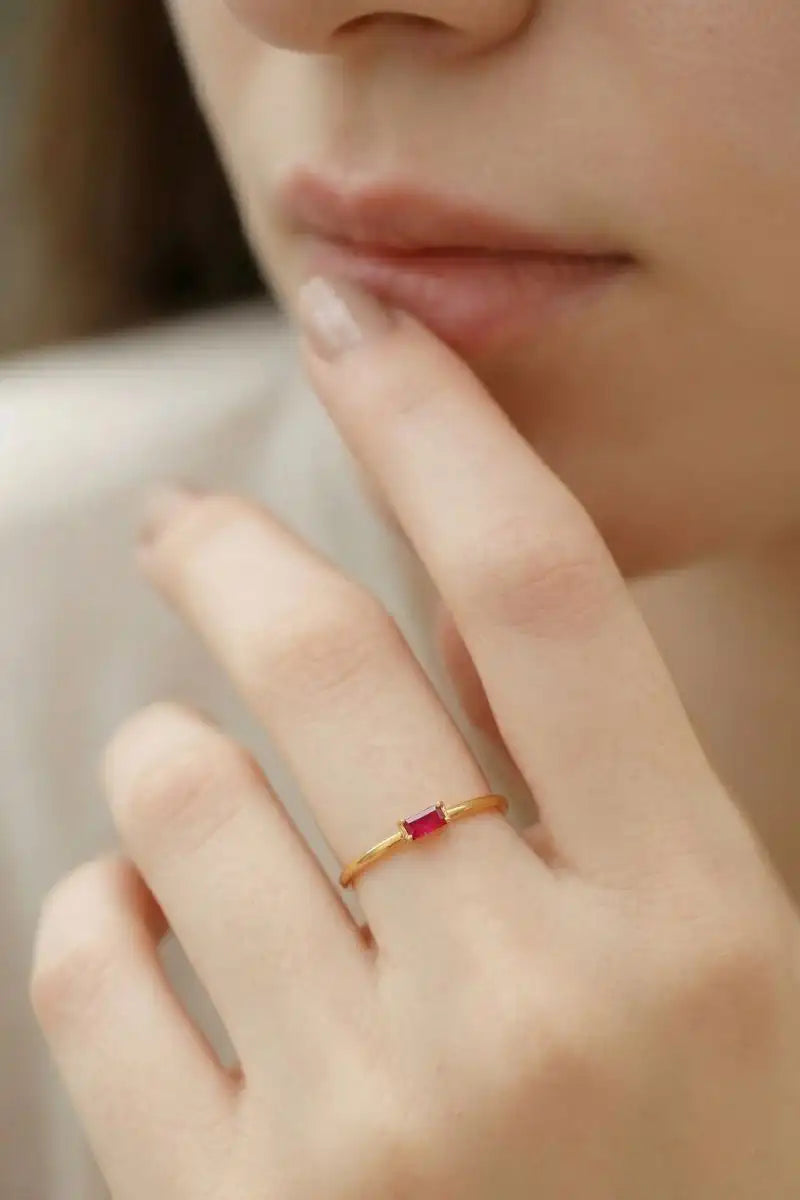
Ruby engagement ring: the complete guide to a one-of-a-kind choice
The ruby engagement ring: symbolism, stone quality, metal choice and Mayuri advice.
Written by Déborah Baid, Founder · Mayuri ParisReading 10 min9 chapters
What the maison says
What to remember
Choosing a ruby for an engagement ring is choosing a stone steeped in history and passion. Its intense, irreplaceable red embodies ardent love in a way no other precious stone can equal: neither the diamond, nor the Emerald, nor the Sapphire carries that particular red.
Beyond the symbolism, the ruby is also a remarkably practical choice. With a hardness of 9 on the Mohs scale, it ranks just behind the diamond, resists everyday scratches, and retains its brilliance year after year. It is a stone for life.
This guide walks you through every step of the selection process: symbolism, durability, cuts, metals, settings, treatments, and care.
Mayuri 18ct yellow gold ruby engagement ring, worn on the hand
Why choose a Ruby for an engagement ring?
The engagement ring market has been dominated for decades by the diamond solitaire. Choosing a ruby is a deliberately different choice, rich in meaning.
The stone of romantic passion: since antiquity, the ruby has been associated with inner fire, intense love, and unwavering fidelity. In Vedic India, it was offered to the gods to seal the most sacred unions. The red of the ruby speaks a universal language that every culture has recognised.
An instantly memorable ring: in a sea of diamond solitaires, a ruby engagement ring is distinctive, personal, and unmistakable. It says something singular about the person who wears it.
Uncompromising durability: unlike certain coloured stones of lesser hardness, the ruby withstands the demands of daily life. It does not tarnish, does not scratch easily, and does not lose its brilliance over the years. This is a decisive criterion for a ring worn for a lifetime.
A lasting shift: since 2015, leading international jewellers have recorded a significant rise in demand for engagement rings featuring coloured stones. The ruby, alongside the Emerald and the blue Sapphire, is at the forefront of this evolution.
The ruby is not a recent trend. It has accompanied some of the most memorable unions in history.
Catherine of Aragon received a ruby and gold ring from Henry VIII in the sixteenth century. At that time, the ruby was considered the stone of royalty and fidelity, prized above the diamond for sealing a commitment.
On the contemporary side, celebrities have revived this tradition. In 2019, Orlando Bloom proposed to Katy Perry with a flower-shaped engagement ring centred on an intense red ruby surrounded by white diamonds: a spectacular, deeply personal, and instantly recognisable piece. Eva Longoria wore, at her wedding to José Bastón in 2016, a ring featuring a central Ruby surrounded by Diamonds, a style that many fine jewellery houses have since revisited in their own collections.
No argument illustrates the value of a high-quality Ruby more eloquently than the world record. In 2015, the "Sunrise Ruby" a 25.59-carat Burmese "pigeon's blood" Ruby set by Cartier, was sold for $30.3 million at Sotheby's Geneva. It remains, to this day, the most expensive coloured gemstone ever sold at auction.
These references are not here to dazzle; they speak to a consistency spanning several centuries. The Ruby has always been chosen to mark the strongest unions, by those who wanted their ring to express something beyond convention.
The durability of Ruby for an engagement ring worn every day
For an engagement ring, hardness is far from a minor detail. It is a fundamental criterion: a ring worn daily for decades will be exposed to friction, impact, and contact with other surfaces.
Gemstone
Hardness (Mohs)
Suitable for daily wear
Diamond
10
Excellent
Ruby / Sapphire
9
Excellent
Emerald
7,5
Moderate (care required)
Tanzanite
6,5
Careful handling recommended
Opal
5,5-6
Occasional wear
Only a Diamond, or another stone with a hardness of 9 or above, can scratch a Ruby. Under normal daily wear, it retains its perfectly polished surface for generations.
One important precaution deserves to be mentioned: lead-glass filled Rubies (lead-glass filling). This treatment, used on certain low-grade Rubies, deeply compromises the stone's resilience when exposed to ultrasonic cleaning, steam, and household chemicals. A standard professional cleaning can irreparably destroy a Ruby treated in this way. According to data published by the GIA, this type of filling represents a significant alteration to the stone's natural composition.
At Mayuri, our Rubies are natural and never lead-glass filled. The only treatment we accept is heat treatment, a centuries-old and stable technique that does not affect the durability of the stone.
Choosing the cut of your engagement Ruby
The cut of a Ruby directly influences how its colour is perceived. For an engagement ring, it is often the deciding factor between an ordinary stone and one that truly captivates.
Cut
Effect on colour and style
Oval
Maximises red saturation and visually elongates the finger. The most sought-after cut for Ruby.
Cushion
Warm and romantic, beautifully suited to vintage or milgrain styles. Truly timeless.
Round brilliant
Maximum sparkle and brilliance. Ideal for a highly transparent Ruby in a classic solitaire setting.
Emerald (rectangle)
Modern and refined, highlighting the stone's transparency. A natural choice for a contemporary setting.
Pear
Elegant and elongating, the hallmark of a ring with true character.
Marquise
Graceful and rare, with a visually lengthening effect. For a truly one-of-a-kind piece.
The oval cut is the most sought-after for a Ruby engagement ring: it maximises the perception of red saturation and creates an elegant effect on the finger. The vast majority of celebrity Ruby rings photographed in the press feature an oval cut.
The cushion cut is the second classic choice: its warm, rich rendering suits vintage, milgrain, and Art Deco settings beautifully, complementing the Ruby's historic character with great refinement.
Which metal for a Ruby engagement ring?
The choice of metal radically transforms how a Ruby ring is read. It is not simply a matter of taste; it is a question of how best to showcase the stone.
18ct Yellow Gold: the choice of great jewellers for centuries. The warmth of gold amplifies the Ruby's red rather than working against it. This is the historic combination favoured by Mughal maharajas and the masters of the great European jewellery tradition. It remains the most flattering for Ruby without question.
18ct Rose Gold: complementary and warm. The rose of the gold enters into dialogue with the red of the Ruby for a romantic overall effect, less traditional than yellow gold but equally elegant.
18ct White Gold: a bold contrast, a contemporary reading. The rhodium plating of white gold makes the red stand out through chromatic opposition. It is a more modern interpretation, closer to contemporary fine jewellery. Worth noting: depending on the lighting, a Ruby set against a white background may appear slightly more pink than when set against yellow gold.
The advice shared by traditional jewellers and our gemologists alike: yellow gold or rose gold remain the first choices for a Ruby engagement ring meant to last a lifetime.
The setting determines how the stone sits in space, how light reaches it, and what visual story the ring tells.
Ruby solitaire: a single stone, set high, with a 4 or 6-prong claw setting. The most direct approach: the Ruby is the centrepiece, with nothing to distract from it. Its red is maximised. A timeless, clear, and striking style.
White diamond halo: a central Ruby surrounded by a row of round or baguette cut diamonds. The contrast of red and white is striking, almost regal. This is the style worn by the majority of famous Ruby engagement rings, and for good reason: it amplifies the presence of the Ruby while lending it additional brilliance.
Milgrain and vintage style: fine bead detailing along the edges of the setting, inspired by Art Deco and Edwardian styles. Ruby, a stone of deep historical significance, lends itself beautifully to this treatment, which adds a timeless dimension to the piece.
Multi-stone ring: Rubies combined with blue Sapphires or Emeralds, inspired by the Vedic Navaratna, the nine sacred stones. A truly individual style, deeply personal, and very Mayuri.
A pave setting around a central Ruby is a perfectly valid aesthetic choice. The micro-prongs can accumulate residue over time; regular cleaning with lukewarm water keeps them in perfect condition.
Natural, heated, or filled Ruby: what to check before buying
This is undoubtedly the most important information in this guide for anyone purchasing a Ruby outside of a trusted house.
The vast majority of Rubies on the market have undergone heat treatment. Heating is an age-old technique, practised since antiquity in Burma and Sri Lanka, which improves the colour and clarity of the stone in a stable and permanent way. All major gemological laboratories, including the GIA and the GRS, consider a heated ruby as a fully natural ruby in its own right.
In contrast, lead-glass filled rubies (lead-glass filling) represent an entirely different category. This treatment, used to enhance very low-quality stones at minimal cost, weakens the internal structure of the ruby. Ultrasonic cleaning can destroy it. Steam can alter it. Household chemicals can degrade it irreversibly.
At Mayuri, our rubies are natural. Thermal heating is the only treatment we permit. We never use lead-glass filled rubies.
If the budget is more limited and a natural ruby of acceptable quality is not within reach, our recommendation is to consider a beautiful natural red garnet rather than a ruby of compromised quality. A red garnet with a fine colour will always be a better choice than a non-standard treated stone.
For a solitaire stone from 1 carat and above, a certificate from an independent laboratory is recommended: GIA, GRS, Gübelin or SSEF. It guarantees the colour classification, the origin, and above all, the complete list of treatments.
Caring for a Ruby engagement ring
An engagement ring worn daily deserves regular care. The good news: ruby is one of the easiest gemstones to maintain.
At-home cleaning: once a week, soak the ring for 10 minutes in lukewarm water with a few drops of mild liquid soap. Gently scrub with a soft brush (an old toothbrush works perfectly), rinse thoroughly under running water, and leave to air dry or pat dry with a soft, lint-free cloth.
At the jeweller: always mention the ruby's treatment before any professional intervention. Without a certificate confirming that the stone has simply been heat-treated, always request cleaning with lukewarm water rather than ultrasonic methods. A lead-glass filled ruby can be destroyed in seconds by an ultrasonic bath.
Remove your ring for: sports, gardening, swimming (chlorine gradually damages gold), cooking, and household cleaning with chemical products.
Our ruby rings are designed for fine jewellery: each ruby is individually selected by our gemologists for the quality of its red, neither too pink nor too deep, a frank, rich red that endures over time.
All our rings are available in 18ct yellow, white, or rose gold, made to order in your size. Our rubies are natural: heat treatment is the only process we accept. We never use lead-glass filled rubies.
For exceptional pieces, Burmese rubies of several carats with GRS or Gübelin certification, we can source stones on request. Contact us directly to access our private selection.
Yes, without reservation. With a hardness of 9 on the Mohs scale, ruby is the second hardest mineral after diamond. It resists everyday scratches, maintains its polish and brilliance for decades without any exceptional upkeep. The only precaution concerns lead-glass filled rubies, a treatment that weakens the stone. With a natural ruby (simply heat-treated), there are no particular constraints for everyday wear.
Do you need a certified Ruby for an engagement ring?
For a solitaire stone from 1 carat upward, a certificate from a recognised laboratory (GIA, GRS, Gübelin, or SSEF) is strongly recommended. It guarantees three essential things: confirmation that the stone is a genuine natural ruby (and not a spinel or glass), a full list of any treatments applied (heating, filling), and a possible indication of origin (Burma, Mozambique, Sri Lanka). For smaller stones or accent settings, a certificate is less essential, but purchasing from a trusted house remains indispensable.
Can Ruby replace Diamond in an engagement ring?
Absolutely. In terms of durability, ruby is virtually the equivalent of diamond for everyday wear. In terms of symbolism, it carries an emotional and historical weight that a white diamond simply does not. Choosing a ruby over a diamond is increasingly common among those who want a ring that is unique, memorable, and different. It is a choice of meaning as much as a choice of aesthetics.
Which Ruby cut should you choose for an engagement ring?
The oval cut is the most sought-after for ruby: it maximises the perceived red saturation and elegantly elongates the finger. The cushion cut is the second great classic, perfect for vintage or milgrain settings. The round brilliant suits a classic solitaire with high brilliance. Emerald, pear, and marquise cuts are rarer choices, reserved for truly singular rings. In all cases, the cut should be chosen according to the stone itself: our gemologists select the shape that best showcases the colour of each ruby.