Ruby or pink sapphire? Two corundums, one color boundary. How to tell them apart and choose wisely.
Written by Johan Nel, Jewellery designer & goldsmith · trained in gemology · Mayuri ParisReading 12 min7 chapters
What the maison says
What to remember
Faced with a pink-red corundum, even an experienced gemologist may pause. This is not a matter of ignorance: it is a question of colour threshold, international classification, and sometimes a difference of several thousand pounds. Ruby and pink Sapphire are two names for the same mineral, corundum, whose colour alone determines the designation. Yet this colour boundary is one of the most debated in gemology.
There is a well-known joke in gemological circles. When an expert is asked: "Is it a Ruby or a pink Sapphire?", the answer is often: "It depends whether you are the buyer or the seller." For the seller, it is better to be a Ruby: it commands a higher price. For the buyer, it is better to be a pink Sapphire: it costs less to acquire. Behind the humour lies a concrete reality: a borderline stone certified as "ruby" by a recognised laboratory can be worth two to five times the same stone certified as "intensely saturated pink sapphire". The word "ruby" on a certificate is far more than an administrative detail.
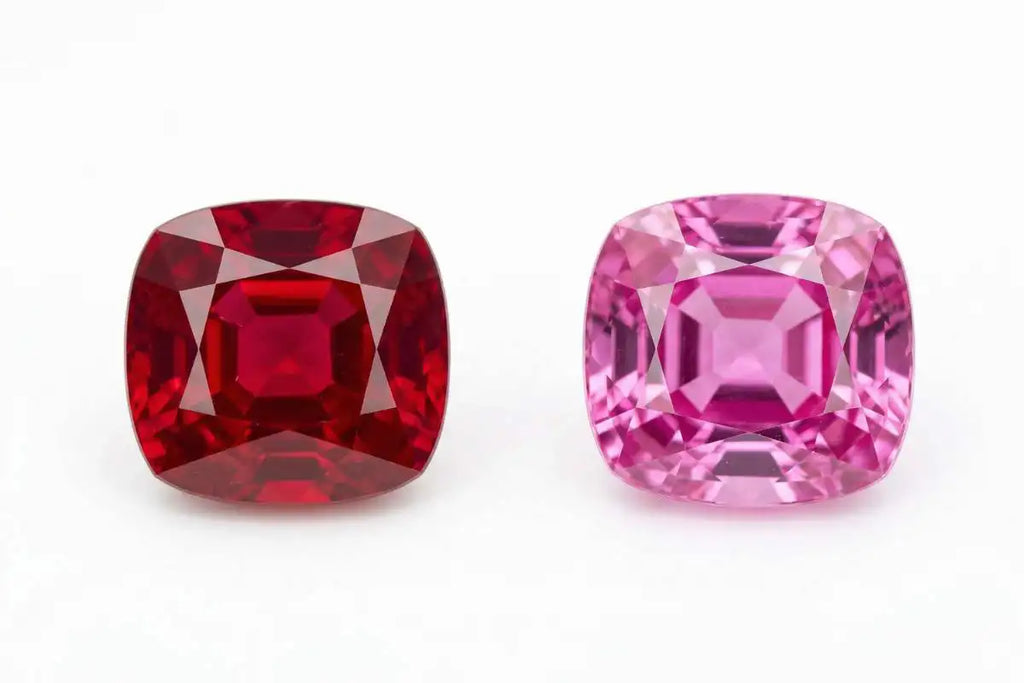
Side-by-side comparison of intense red Ruby and pink Sapphire, two corundums from the same mineralogical family
Ruby and pink Sapphire: two names, one single mineral
Ruby and pink sapphire both belong to the corundum family (crystallised aluminium oxide, Al₂O₃). They are rigorously the same mineral: the same hardness of 9 on the Mohs scale, the same density of approximately 3.99 g/cm³, the same refractive index between 1.762 and 1.770. The same care requirements, the same vulnerabilities. If you close your eyes and analyse both stones by spectroscopy, you obtain the same base spectrum.
What distinguishes the two is the presence and concentration of a single element: chromium (Cr³⁺). Chromium in solution within the crystalline structure of corundum absorbs certain wavelengths of light and reflects others. At high concentrations, it produces a deep red: this is ruby. At low concentrations, the colour remains in the pink range: this is pink sapphire.
A useful mnemonic: iron colours corundum blue (it is the element responsible for blue sapphires); chromium colours it red or pink. With neither iron nor chromium, corundum remains colourless, which is known as white sapphire or leuco-sapphire.
This confusion among red stones has a long history. For centuries, all red gemstones were indiscriminately called "rubies": garnets, spinels, pink tourmalines. The famous "Black Prince's Ruby" set into the British Imperial Crown, one of the most celebrated jewels in the world, turned out to be a red spinel, not a ruby at all. Modern analytical tools have transformed the way we name these stones, yet the confusion persists in everyday language. The line between ruby and pink sapphire, however, is a recent distinction, and one that remains hotly debated.
The colour boundary: where does Ruby begin, where does pink Sapphire end?
This is the million-dollar question, sometimes quite literally. The boundary between "ruby" and "pink sapphire" is defined by the major gemological laboratories, and their definitions, while closely related, are not identical.
The GIA definition (Gemological Institute of America) is the most widely cited: a ruby is a corundum in which red is the dominant colour, to the exclusion of any modifier such as pink, orange, or violet. When pink or orange is dominant, the stone is classified as a pink sapphire or padparadscha. In practice, the GIA evaluates the dominant colour using the Munsell system, an international colour reference system that objectively quantifies hue, tone, and saturation.
The GRS (Gem Research Swisslab, Zurich) takes a similar approach but has pushed formalisation further with the "pigeon blood" designation: a ruby whose red is pure, with no perceptible modifier, and whose red fluorescence under UV is at its maximum. This designation is reserved for exceptional-quality Burmese rubies and has become a prestigious certification in its own right. No pink Sapphire can obtain it.
To visualise the boundary, imagine a continuous spectrum running from pure pink (pink Sapphire, 0% red dominance) to pure red (the ideal ruby, total red dominance). The threshold falls somewhere around 50 to 60% red dominance, the point at which red ceases to be the primary colour. This threshold is not a fixed figure: it is an expert judgement, made in a laboratory setting using precision instruments.
A direct consequence: a borderline stone may receive the designation "ruby" from GRS and "intensely saturated pink Sapphire" from GIA. Both laboratories are correct according to their own criteria. This is not an error on either side; it reflects the reality of a boundary that remains subjective despite the instruments involved. This is why, for any significant purchase, it is essential to specify which certificate you require and to understand its implications.
The cultural debate: Asia and the West do not agree
The GIA/GRS classification is relatively recent, dating from the twentieth century and the professionalisation of gemology as a codified scientific discipline. The gemological traditions of South-East Asia, by contrast, span thousands of years.
In the Burmese, Thai and Sri Lankan traditions, the term equivalent to "ruby" encompasses a broader spectrum of colours than Western standards recognise. What European jewellers classify as "intense pink sapphire", merchants in Mogok or Chanthaburi may authentically call "pink ruby" or "light ruby". This is not an attempt to deceive; it is a different nomenclature, rooted in centuries of local practice.
The practical consequence is significant for buyers in the UK: a Ruby purchased without a certificate in an Asian market, even in good faith on the seller's part, may well be classified as "pink sapphire" by the GIA once analysed in a Western laboratory. The quality of the stone is not in question: it is the definition that changes. A beautiful stone remains beautiful, whatever the label.
For the European fine jewellery market, the reference standards are those of the GIA, GRS, Gübelin Gem Lab and SSEF. These laboratories have established rigorous protocols that the industry recognises as neutral, international benchmarks. For any purchase of a solitaire stone from £850 upwards, a certificate from one of these laboratories is not a luxury: it is a guarantee.
Ruby and pink Sapphire: what is identical, what differs
Criterion
Ruby
Pink Sapphire
Mineral
Corundum (Al₂O₃)
Corundum (Al₂O₃)
Hardness (Mohs)
9
9
Density
~3.99 g/cm³
~3.99 g/cm³
Refractive index
1.762 – 1.770
1.762 – 1.770
Colouring element
Chromium (Cr³⁺), high concentration
Chromium (Cr³⁺), low concentration
Colour
Dominant red
Dominant pink
UV fluorescence
Often strong (vivid red)
Weak to none
Common treatment
Heating, glass filling
Heating, glass filling
Relative price (fine stone)
Significant premium
More accessible
"Pigeon blood" designation
Yes (GRS only)
No
Two points are worth highlighting. First, UV fluorescence: ruby contains enough chromium to produce an intense red emission under ultraviolet light. This fluorescence contributes to the vibrancy of the red in natural light. Pink Sapphire, with less chromium, shows little or no fluorescence. This is, in fact, one of the criteria gemologists use during an initial examination.
Then, heat treatments: more than 95% of natural corundums (rubies and Sapphires alike) have been heated before reaching the market. This treatment improves clarity and colour, and is universally accepted within the trade. A certified "unheated" ruby commands an additional premium, just as an unheated pink Sapphire does.
Price impact: does the "ruby" certificate truly make a difference?
Yes. And the difference can be considerable.
Consider a concrete example: a pink-red stone, 1 carat, fine jewellery quality, good clarity. Certified by the GIA as "pink sapphire, intensely saturated": expect approximately £700 to £1,300 per carat. The same stone, submitted to the GRS and certified as "ruby, red": £2,100 to £4,250 per carat. Should the GRS add the "pigeon blood" designation: £4,250 to £8,500 per carat, or more for exceptional quality.
This is not manipulation. It is the market value of rarity and classification. Truly red rubies, conforming to GIA standards, are rarer than pink Sapphires. Institutional buyers, including high jewellery houses, collectors and investors, pay a premium because the designation "ruby" on a trusted certificate guarantees a precise colour quality.
For the private buyer, there are two situations to watch for. First situation: a seller offers a clearly pink "ruby" at a price well below market value. Always request the certificate. Without a recognised certificate, the designation "ruby" guarantees nothing Second scenario: you own a "pink sapphire" that appears distinctly red to your eye. It is worth having it examined by a laboratory; if it receives a Ruby classification, its value could increase several times over.
How to choose between a Ruby and a pink Sapphire for a piece of jewellery?
The choice is not a matter of prestige; it is a matter of colour, budget, and symbolism.
The Ruby carries a powerful and ancient symbolism: love, passion, royal protection. It is the stone of engagement rings across many cultures, from ancient Rome to the Mughal courts. Its rarity makes it a sound investment. For a solitaire engagement ring, a certified Ruby of at least 1 carat brings lasting heritage value. Allow a minimum budget of £1,250 to £2,500 for jewellery-grade quality with a GIA certificate.
The pink Sapphire offers a romantic, luminous colour very much in keeping with the times, ever since Lady Diana's ring, now worn by Kate Middleton, brought Sapphire to the forefront. The advantage: a colour quality comparable to a Ruby, at a significantly gentler price point. For the same budget, you can often obtain a larger stone or superior clarity.
Our practical advice: do not choose based on the word printed on the certificate. Choose the colour that moves you, ensure it is beautiful in both natural and artificial light, and confirm that a certificate attests to its nature. A magnificent pink Sapphire will always surpass a dull Ruby.
At Mayuri, both collections live side by side: Rubies selected for the quality of their natural red, Sapphires selected for the beauty of their hues, all crafted in 18K yellow gold in keeping with our contemporary Indian aesthetic.
The leading laboratories for gemstone classification
The question "is it a Ruby or a pink Sapphire?" can only be answered reliably when it is put to one of the four leading independent gemological laboratories.
The [GIA](https://www.gia.edu) (Gemological Institute of America) is the global benchmark in terms of recognition and reach. A GIA certificate is understood and accepted worldwide, from Geneva to Dubai.
The [GRS](https://www.gemresearch.ch) (Gem Research Swisslab, Zurich) is the definitive authority on colour quality designations, "pigeon blood" for Rubies and "royal blue" for blue Sapphires. Its rigour on the Ruby/pink Sapphire boundary is renowned for its strictness.
The [Gübelin Gem Lab](https://www.gubelingemlab.ch) (Lucerne) and the [SSEF](https://www.ssef.ch) (Swiss Gemmological Institute, Basel) complete the Swiss quartet. These four laboratories are the only ones whose certificates are accepted without reservation by the international high jewellery market.
The cost of a certificate ranges from £130 to £350 depending on the laboratory, the size of the stone, and any additional analyses requested, such as geographic origin or treatment detection. Weighed against the risk of paying the wrong price for a stone, the cost of a certificate is always negligible. For any solitaire stone of 1 carat or more, or valued above £450, this is a non-negotiable step.
Frequently asked questions
Are Ruby and pink Sapphire the same mineral?
Yes, entirely. Both are corundums, meaning crystallised aluminium oxide (Al₂O₃). They share the same hardness of 9 on the Mohs scale, the same density, the same refractive index, and the same colouring agent: chromium. The only difference is the concentration of chromium, which determines whether the dominant tone is red (Ruby) or pink (pink Sapphire). Changing the name does not change the stone.
How do you distinguish a Ruby from a pink Sapphire with the naked eye?
In clear-cut cases, it is straightforward: a true Ruby is a deep, warm red, often with slightly violet undertones, and it "glows" in natural light thanks to its fluorescence. A pink Sapphire is distinctly pink, sometimes close to candy pink, sometimes more peachy in tone. The difficult cases, the borderline stones, are precisely those that the eye cannot resolve. They require laboratory examination with colorimetric measuring instruments. Do not attempt to make the call yourself for a stone of value.
Can you trust a seller who says "it's a ruby" without a certificate?
No, for any stone of value. A verbal designation of "ruby" from a seller, even one acting in good faith, provides no legal or financial guarantee. The seller may themselves be misinformed, working to different standards (Asian versus Western), or simply mistaken. For any stone valued at £450 or more, insist on a certificate from a recognised laboratory: GIA, GRS, Gübelin, or SSEF. It is your only objective protection.
Can a pink Sapphire become a Ruby if it is recertified?
The stone itself does not change. A laboratory evaluates its colour objectively. That said, a borderline stone may receive different results depending on the laboratory's criteria: the same stone can be graded "ruby" by GRS and "pink sapphire" by GIA. This is not a paradox; both laboratories simply apply slightly different thresholds. If you wish to maximise the value of a borderline stone, it is entirely legitimate to submit it to several laboratories to see which designation you obtain. This practice is legal and common in the fine gemstone trade.
Is pink Sapphire less beautiful than a Ruby?
Not at all. The beauty of a stone is a matter of colour, clarity, brilliance, and the emotion it evokes, not its name. A high-quality pink Sapphire, luminous, with a warm and deep rose hue, is absolutely magnificent. Some jewellers and collectors even prefer pink Sapphire over Ruby for its softer, more versatile colour palette. Do not rank stones by their designation; judge them by what you see.