The virtues of Ruby: meaning, symbolism and traditions through the ages
The ruby's virtues and symbolism: fire, passion, vitality. Its place in tradition and fine jewelry.
Written by Déborah Baid, Founder · Mayuri ParisReading 11 min9 chapters
What the maison says
What to remember
The red of a Ruby is no ordinary colour. It is the colour of fire, of vital blood, of the heart. Ever since the first miners of Mogok extracted the earliest gems from Burmese marble, people have projected onto this stone their most fundamental aspirations: love, life, strength, power. No civilisation that has ever held a Ruby in its hands has failed to read something essential within it.
What is striking is the consistency of these projections across time and cultures. Vedic India, imperial Rome, medieval Myanmar, the Europe of cathedrals: all have said the same thing about the Ruby, in different words. The symbolism of the Ruby is rooted in millennia-old traditions that converge on one essential truth: it is an exceptional stone, for exceptional moments.
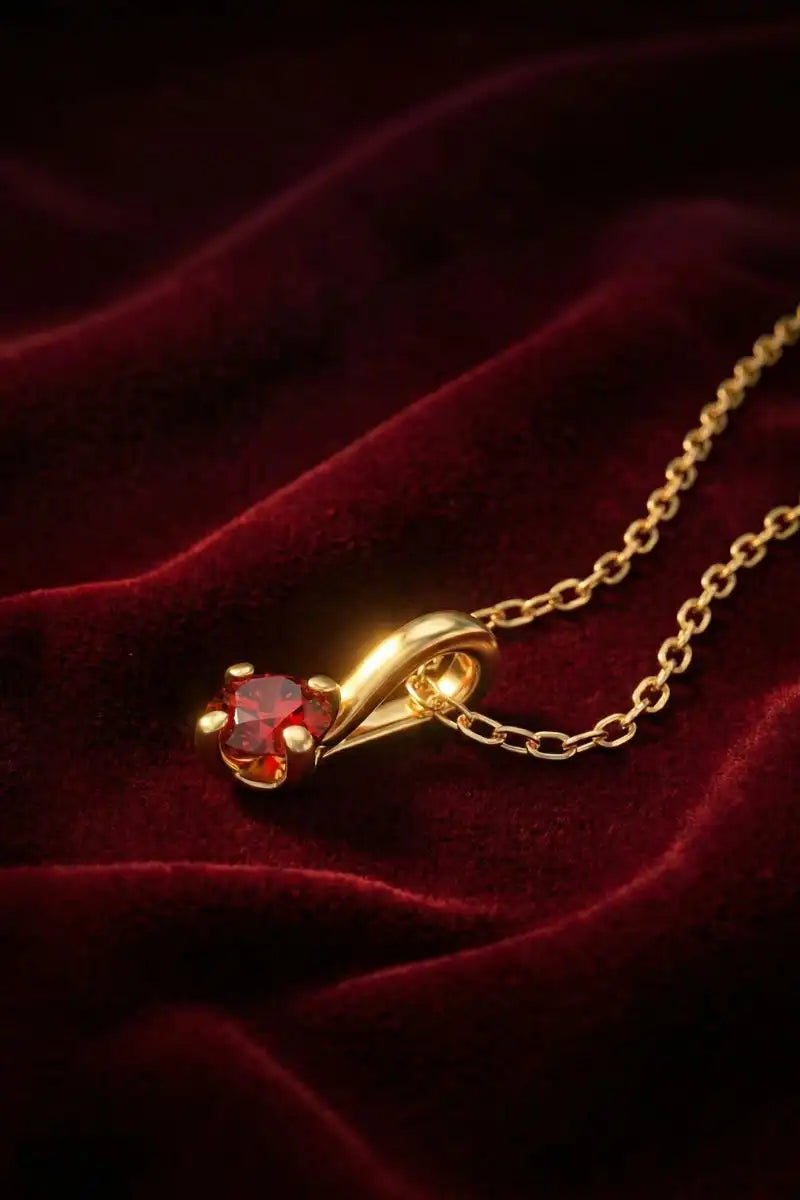
Mayuri ruby pendant necklace in yellow gold on red velvet, a symbol of passion and royalty
Ratnaraj: "the king of precious stones" in Sanskrit
The Ruby is called Manikya in Sanskrit. Yet it is its title that reveals its place in the Vedic imagination: Ratnaraj, "king of precious stones." This title is not merely metaphorical. In the Vedic tradition, the Ruby holds the foremost position among the nine stones of the Navaratna, the nine sacred gems. The other eight, pearl, coral, Emerald, topaz, Diamond, Sapphire, hessonite, and blue Sapphire, orbit around it like planets around a star.
The Navaratna is both a gemological and cosmological composition: each stone corresponds to a celestial body. The Ruby corresponds to the Sun (Surya), the star of power, life, prestige, and will. To wear a Ruby, in this tradition, is to align oneself with solar energy.
The oldest text dedicated to Vedic gemological expertise, the Ratna Pariksha (9th century), describes the Ruby as "the eldest of stones, the one that illuminates the darkness." This phrase is both poetic and gemologically precise: the Ruby fluoresces under natural light, emitting a characteristic red glow that the ancients observed without understanding its physics. What they described as an inner light, science confirmed centuries later as chromite fluorescence.
Our jewels bear Sanskrit names: Agni (fire), Urja (vital energy), Shanti (peace), Kali, Devi, Surya, Kiran. This is not an arbitrary aesthetic choice; it is a conscious reference to the tradition that was the first in the world to recognise the singular nobility of the Ruby and to give it a name worthy of its place.
The Vedic tradition: Ruby, stone of the Sun
In Vedic astrology (Jyotish), each planet corresponds to a precious stone. The Ruby (Manikya) is the stone of Surya, the Sun. It is recommended for those whose Sun is weakened in their birth chart, to strengthen vitality, leadership, health, mental clarity, and social prestige.
This system is not frozen in the past. It is still very much alive today in India, Sri Lanka, and Myanmar, where certified gemologists work alongside astrologers to recommend stones of a specific quality and carat weight. The tradition has adapted over time: GIA or Gübelin certificates are now required, yet the cosmological reasoning remains.
What is essential to understand is that these prescriptions are not rooted in naive superstition. They represent the legacy of over 2,000 years of empirical observation: which stones, worn by which individuals in which circumstances, produced which symbolic and psychological effects? The Vedic tradition is, in its own way, a form of anthropology of the precious stone.
The foundational text, the Brihat Samhita (compiled between the 5th and 6th centuries), describes the properties of Ruby with a precision that reflects genuine gemological knowledge, interwoven with a cosmological reading of the world.
Ruby across the great civilisations
The same stone, converging meanings: the history of Ruby across civilisations is a lesson in anthropology.
Burma (Myanmar). Burmese warriors did not simply wear Ruby as jewellery: they would sew it beneath the skin, typically in the arm or thigh, before going into battle. The Ruby was quite literally embodied as protection in combat, not symbolically, but physically incorporated. This practice is documented by Arab and European merchants of the Middle Ages who visited the Mogok mines. The region remained, for centuries, the world's primary source, which explains why Burmese Ruby became the absolute benchmark of the species.
The Roman Empire. Ruby was associated with Mars, god of war. Its blood-red colour symbolised both the strength of soldiers and victory over the enemy. Roman legates and generals wore rubies as talismans of courage and military power. In the Roman imagination, the colour red was not the colour of death: it was the colour of life at its fullest force.
Medieval India. Rubies were classified according to their "maturity": the ripe Ruby (deep red) was considered "masculine," while the unripe Ruby (pale pink) was considered "feminine." This classification was far from incidental: it influenced both the price and the symbolic use of the stone. Mughal maharajas collected rubies as emblems of power, having them engraved with their names and their conquests.
Medieval Europe. Ruby adorned the crowns and reliquaries of kings and bishops. Its red colour evoked the blood of Christ, redemption, sacrifice, salvation, as well as royal courage. The kings of England, France and the Holy Roman Empire wore rubies in their crowns. The Black Prince's Ruby, set in the British Imperial Crown, is in fact a red spinel; yet this confusion speaks volumes about how thoroughly the ruby embodied the ideal of the royal gemstone.
Imperial China. Rubies adorned the insignia of high-ranking mandarins. Red was the imperial colour above all others, associated with the sun, prosperity, and dynastic power. Wearing ruby red signalled membership in the ruling elite.
Ruby, the stone of love and passion
If the ruby is the stone of war and protection, it is equally the stone of ardent love. Red, the universal colour of romantic passion, combined with the luminous intensity of the ruby, has made it the quintessential stone of love since Antiquity.
In India, rubies were offered to the gods at royal weddings to seal the union and invite divine favour. In Europe, ruby rings served as pledges of conjugal fidelity. Catherine of Aragon received a ruby ring from Henry VIII in the sixteenth century, and the intention was clear: a commitment as ardent as the colour of the stone itself.
The concept of Burmese "pigeon's blood" is deeply telling. This term describes the ideal ruby colour: pure, intense red with a subtle pink fluorescence that "warms" the stone without weighing it down. Not too dark, which would be its undoing. Not too pink, which would speak only of gentle tenderness. A vivid, living, ardent red: love in its fullest force. Over the centuries, this colour has become the symbol of ideal romantic passion within the gemological tradition.
What is truly remarkable about the cultural attributes assigned to the ruby is their consistency across civilisations with no contact between them. Rome had not read the Ratna Pariksha. Medieval Myanmar exchanged no symbolic treatises with the France of Saint Louis. And yet, all attributed the same fundamental virtues to the ruby. This is evidence that such attributions arise from the universal symbolism of the colour red and the exceptional rarity of the stone, rather than from culturally specific beliefs.
Courage and strength. It imparts the physical and moral fortitude to face life's trials. The association between war and the ruby across three distinct civilisations, Rome, Burma, and medieval Europe, confirms this with a striking consistency.
Vitality and health. The ruby is associated with blood, the heart, and life itself. It "warms," symbolically, the vital energies. In the Vedic tradition, it is the stone of the Sun, the source of all vital energy.
Leadership and prestige. The stone of kings and leaders, associated with the Sun in Jyotish astrology. Wearing the ruby has always signalled status and authority, from Mughal maharajas to medieval bishops.
Love and fidelity. The stone of the heart, of enduring passion, of romantic commitment. The Ruby ring as a pledge of union is no modern invention.
Protection. Against danger, enemies, and evil, a universal talisman, from the skin of Burmese warriors to European reliquaries.
An important note is in order: we present these virtues as the cultural and historical heritage of the stone, not as proven therapeutic properties. The beauty of the Ruby, its singular colour, its millennia-long history, are in themselves a source of emotion and meaning, requiring no further justification.
Ruby in literature and myth
The Ruby runs through the great works of civilization like a crimson thread, quite literally.
The Bible invokes it as the ultimate measure of value: "wisdom is more precious than rubies" (Proverbs 8:11). This verse does not say that rubies are without worth; it says that wisdom is the one thing that surpasses them. The Ruby, the absolute reference for all that holds true worth.
In the One Thousand and One Nights, Sinbad the Sailor brings back rubies from his legendary voyages, the quintessential stone of Eastern treasure. The gem represents here all that the Orient holds that is precious, mysterious, and desirable in the eyes of the West.
Shakespeare, in A Midsummer Night's Dream, alludes to the Ruby as a symbol of beauty and royal passion. For the Elizabethan audience, the reference was immediate: the Ruby embodies intense love, the love of princes and poets.
Christopher Columbus believed he had discovered rubies in the Americas during his first voyage; they were, in fact, spinels and garnets. This misidentification reveals just how deeply the Ruby was embedded, in the European imagination of the 15th century, as the absolute reference for precious stones. When one sought treasure, one sought rubies.
In ancient Greece, the stone was called anthrax, meaning "burning coal", for the way it seemed to burn from within. An empirical observation that predates our physical understanding of fluorescence by several centuries.
Behind the symbolism of the Ruby lies the symbolism of red. The most emotionally intense colour in the visible spectrum: it quickens the heartbeat, draws the eye faster than any other colour, and signals danger and love, death and life, all at once. The Ruby, with its saturated, intense, luminous red, is the mineral embodiment of everything humanity projects onto this colour.
In contemporary crystal healing, the Ruby is associated with the root chakra (Muladhara), the centre of vital energy, of groundedness in body and earth, of physical strength. This attribution converges, by another path, with the historical virtues of vitality and protection documented over millennia. What was once called "the energy of the Sun" in Jyotish, or "the strength of warriors" in Burma, crystal healing reformulates in the contemporary language of chakras.
The "pigeon's blood" Ruby, pure red with a subtle pink fluorescence that warms the stone without weighing it down, is the perfect embodiment of this vivid, ardent, vital colour. This is why it remains the absolute gemmological reference for the species.
Giving a Ruby: for which occasion?
The symbolism of the Ruby lends itself naturally to life's most significant shared milestones.
The Ruby Anniversary marks 40 years of marriage. The French tradition of "anniversary years" pairs each wedding anniversary with a specific material. The 40th is the Ruby Anniversary, a love that has burned for forty years without ever fading. A Ruby jewel for this anniversary is not simply a gift: it is a symbol.
Valentine's Day. The Ruby is the most meaningful of all romantic gifts. More significant than a Diamond (too standard, too expected), more passionate than the Sapphire. A ring, a pendant, or Ruby Earrings for Valentine's Day expresses a deep, unmistakable emotion.
The July birthstone. To give a Ruby jewel to someone born in July is to offer them their lucky stone, a thoughtful gesture that says: I was thinking of you, specifically.
The engagement ring. For a truly extraordinary gesture, the Ruby is the alternative to the Diamond, rich with passion and meaning. Where the Diamond speaks of eternity, the Ruby speaks of ardour, a commitment as vibrant as the colour of the stone itself.
The wedding anniversary. Beyond the Ruby Anniversary, any significant milestone can be marked with a Ruby. The colour of enduring love, of an intensity that never dims.
Mayuri jewellery and the Sanskrit heritage
Our jewels bear names in Sanskrit: Agni (fire), Urja (vital energy), Shanti (peace), Kali, Devi, Surya, Kiran. This is not an arbitrary aesthetic choice. It is a conscious reference to the Vedic tradition, which was the first to name the Ruby "Ratnaraj" and to bestow upon it the status of stone of fire and the Sun.
In Vedic cosmology, the Ruby naturally embodies the spirit of these names: intensity, passion, ardent life. This connection between ancient Indian gemology and contemporary fine jewellery is what gives these pieces a depth that transcends mere formal beauty.
Every Ruby in our collection is selected by our gemologists for the quality of its red, because we know that behind each stone, there is a story to give. A story that traces back to the mines of Mogok, to the Vedic texts, to the royal weddings of medieval India. That story is held in one's hands when one holds a Ruby.
The Ruby is historically associated with courage, vitality, ardent love and protection. These qualities are remarkably consistent across cultures with no contact between them: Rome, medieval Myanmar, Vedic India and medieval Europe all attributed the same fundamental virtues to the stone. In the Vedic tradition, it is the stone of the Sun (Surya), a symbol of leadership, health and prestige. These attributions belong to a centuries-old cultural heritage, not to any proven therapeutic properties.
What is the significance of Ruby in crystal healing?
In contemporary crystal healing, Ruby is associated with the root chakra (Muladhara), the centre of vital energy, physical grounding, and bodily strength. These associations echo, by a different path, the historical virtues of vitality and protection documented over millennia in Vedic and Burmese traditions. Crystal healing reframes very ancient symbolism in a contemporary language.
Why is Ruby called "the king of precious stones"?
The title "Ratnaraj" comes from Sanskrit and the Vedic tradition, where Ruby holds the first place among the Navaratna, the nine sacred stones. It corresponds to the Sun (Surya), celestial body of power, life, and prestige. This title is documented as early as the 9th century in the Ratna Pariksha, the oldest Vedic gemological treatise. The eight other stones of the Navaratna orbit symbolically around it.
What does it mean to give a Ruby?
Giving a Ruby expresses ardent love, enduring passion, and deep respect. It is the traditional gift for the Ruby anniversary (40 years of marriage), as well as a July birthstone and a passionate alternative to Diamond for an engagement ring. The symbolism of red, universal in its resonance, says it all: intensity, life, and unequivocal commitment.
Is Ruby a protective stone?
Yes, across many historical traditions. Burmese warriors would sew Rubies beneath their skin before battle to achieve invulnerability. Roman legionaries wore it as a talisman of victory. Medieval kings set it into their crowns as a form of divine protection. This protective dimension is one of the most enduring throughout the history of Ruby, transcending cultures and eras alike.