How to care for ruby jewellery: the complete guide
How to care for ruby jewellery: cleaning, storage, prong checks and everyday precautions.
Written by Déborah Baid, Founder · Mayuri ParisReading 9 min8 chapters
What the maison says
What to remember
With a hardness of 9 on the Mohs scale, identical to Sapphire and just below Diamond, the Ruby is one of the most resilient stones you can wear every day. A rare privilege in the world of fine jewellery. But "resilient" does not mean "indestructible," and caring for a Ruby goes far beyond a simple wipe with a cloth.
What many people overlook: care depends on a single factor, often left unmentioned at the time of purchase: the treatment the stone has undergone. A heat-treated Ruby, which represents the vast majority of the market, and a lead-glass-filled Ruby cannot be cleaned in the same way. Confusing the two can irreversibly damage your stone, sometimes within minutes.
This guide gives you precise, section-by-section guidance for caring for your Ruby jewellery with complete confidence.
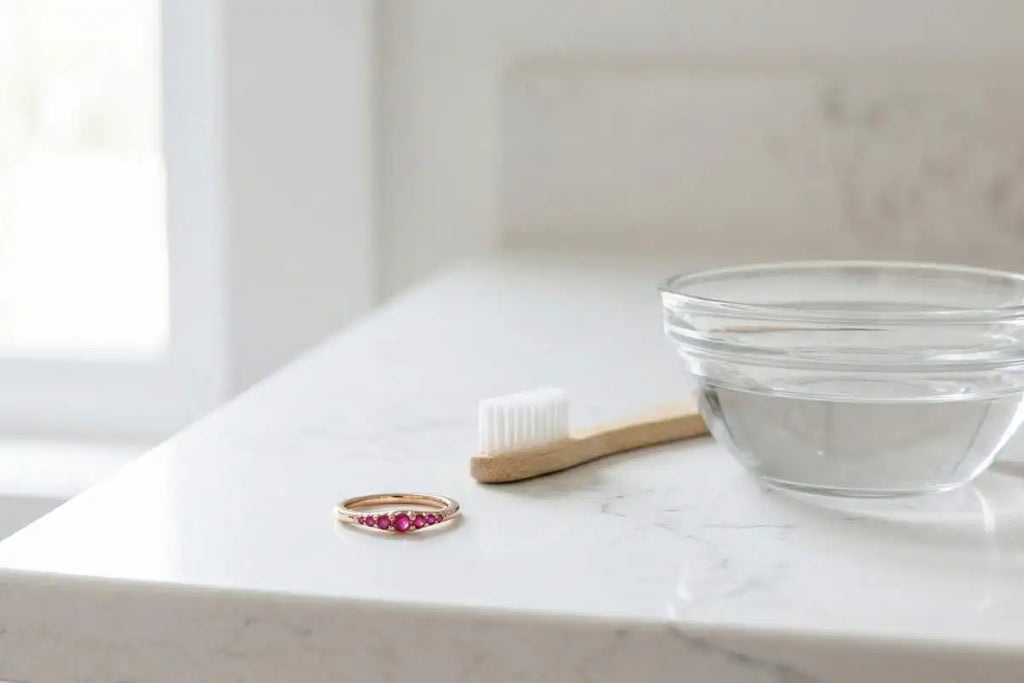
Caring for a ruby ring at home, with a soft brush and warm soapy water
Ruby: a durable stone, with specific care requirements
Ruby belongs to the corundum family, the same mineral as Sapphire. Its hardness of 9 on the Mohs scale makes it one of the most scratch-resistant stones available; only a Diamond or another stone of equal or greater hardness can mark it. In everyday wear, this means it holds up exceptionally well against accidental contact with ordinary surfaces.
What Ruby handles without issue: moderate impact, daily wear, tap water, mild soap, and cosmetic creams. It is a stone made to be worn, not kept in a jewellery case.
Gemstone
Mohs Hardness
Everyday Wear
Diamond
10
Excellent
Ruby / Sapphire
9
Excellent
Topaz
8
Good
Emerald
7,5
Moderate, sensitive to impact
Tanzanite
6,5
Handle with care
Opal
5,5 - 6
Occasional wear recommended
Where things become more complex: ultrasonic cleaners, steam, and chemical products are not governed by hardness. They depend on the treatment the stone has undergone. And that is where everything changes.
The three types of treatment and their care implications
The vast majority of Rubies on the market have been subjected to thermal or physical treatment to enhance their colour or clarity. These treatments are legitimate and widely accepted within the trade, but they fundamentally change the rules of care.
Treatment
Market prevalence
Ultrasonic
Steam
Soapy water
Notes
Untreated (no heat)
5 - 10 %
OK
OK
OK
The most durable, and the rarest
Standard heated (heated)
80 - 85 %
OK
OK with care
OK
Relatively durable; a standard method with no major risk
Lead-glass filled (lead-glass filling)
10 - 15 %
NOT PERMITTED
NOT PERMITTED
OK lukewarm water only
Risk of irreversible damage if exposed to ultrasonic or steam cleaning
In the absence of a certificate: assume that any commercial-quality Ruby acquired for less than $600 per carat may have undergone filling treatment. Caution costs nothing. A gemologist can also observe, under a loupe, the characteristic "blue flashes" of lead glass within fractures, a quick empirical test that requires no sophisticated equipment.
The absolute rule: ultrasonic cleaners and lead glass-filled Rubies
Here is the critical information that 90% of jewellers in France do not pass on to their clients, sometimes because they are unaware of it themselves: a lead-glass filled Ruby should never be placed in an ultrasonic cleaner.
Why? The so-called "lead-glass filling" treatment involves injecting, into the natural fractures of a Ruby, a lead-based glass whose refractive index is close to that of corundum. This technique makes the stone more transparent and improves its appearance, but introduces a fundamentally different material inside the stone. The thermal expansion coefficient of lead glass is very different from that of corundum. Under ultrasonic treatment, high-frequency vibrations generate heat. This glass can melt, crack, or detach from the corundum, and the damage is irreversible.
Steam poses the same problem: the heat from steam causes differential expansion between the corundum and the filling glass. The result is identical.
Consider this: you own a Ruby ring purchased without a certificate a few years ago. You bring it to a jeweller for its annual service. They place it in the ultrasonic cleaner for five minutes, as they would with any ring. If the Ruby is lead-glass filled, the fractures become visible, the transparency is lost, the stone is destroyed. Neither you nor the jeweller has made a mistake; you simply did not know.
Prevention is straightforward. Before any professional service, mention the treatment your Ruby has undergone. If you are unsure, say so clearly: "I have no certificate; please avoid the ultrasonic cleaner as a precaution." A skilled jeweller will clean it with lukewarm water, and that is entirely sufficient.
Cleaning at home: a safe method for all Rubies
Good news: the method below works for all types of Ruby, regardless of treatment. No risk, no ambiguity.
What you will need:
Lukewarm water (not hot; avoid boiling water even for heat-treated Rubies)
Neutral liquid soap (liquid Marseille soap without alcohol, or a gentle washing-up liquid)
A soft brush (a new soft-bristled toothbrush, reserved for this purpose)
A clean, soft cloth (microfibre or cotton)
A five-step process:
Prepare a bowl of lukewarm water with a few drops of gentle soap
Soak the piece for 5 to 10 minutes to loosen any buildup
Gently brush underneath and around the stone: cream and soap residue tend to accumulate around the prongs and beneath the table of the stone
Rinse thoroughly under clean, lukewarm water
Pat dry with a soft cloth or allow to air dry; avoid rubbing vigorously
Recommended frequency: once a week for a ring worn daily. Once a month is sufficient for pendants and Earrings.
When should you entrust your jewellery to a professional?
A professional deep clean once a year is recommended for any ring worn on a daily basis. It also allows for a thorough inspection of the prongs and setting, two critical safety points that are not easily detected by the untrained eye.
Before any work is carried out, inform your jeweller of the treatment your Ruby has undergone. Depending on the situation:
With a certificate: "This Ruby has been certified heated / no heat by the GIA": your jeweller will know how to proceed
Without a certificate: "I don't have a certificate; as a precaution, please avoid using ultrasonic cleaning"
If your jeweller downplays the risk or insists that "ultrasonic cleaning is suitable for all stones," treat this as a warning sign. A thorough understanding of Ruby treatments is a mark of genuine expertise in its own right.
Regarding the setting: re-polishing a yellow gold setting carries no risk to the Ruby. Do take care with rhodium plating on white gold, however, as it slightly alters the appearance of the ring. It is always best to approve the result before collecting the piece.
With a hardness of 9, Ruby is highly resilient. That said, the gold setting and the mount are far more vulnerable than the stone itself.
Remove the ring for:
Sport and physical activities: risk of impact, bent prongs, or a deformed setting
Gardening: soil and small stones can scratch the gold and damage the prongs
Household cleaning products: bleach and acidic solutions will not harm the Ruby itself, but they degrade gold and can damage the glass filling used in treated Rubies.
Swimming pools and hot tubs: chlorine gradually attacks gold over time, particularly rhodium-plated white gold
Intensive cooking: knocks against utensils can bend a prong or wear down the setting.
Sleeping: avoid wearing a claw-set ring to bed, as it can catch on sheets and put strain on the settings.
What Ruby can handle without any issue: rain, brief sea exposure, soap, moisturisers, and perfume. For the latter: wiping the piece after application is a good habit to adopt.
Storage and preservation
A few simple principles to keep your jewellery looking its best over time.
Store separately from other jewellery: Ruby, with a hardness of 9, can scratch softer stones and be scratched by a Diamond. Each piece in its own pouch or individual box.
Keep away from direct light: UV rays will not alter the Ruby itself, but they can yellow certain adhesives used in treatments, or fade the fabric lining of a jewellery case.
Individual felt-lined box: the ideal solution. A compartmentalised jewellery box lined with felt protects against both scratches and impact. Avoid airtight plastic bags: condensation can build up inside over time, which is particularly harmful for filled Rubies.
For travel: use a rigid felt pouch, never loose in a bag or toiletry kit.
Rubies at Mayuri: what treatments are used?
Transparency about treatments is part of our gemological commitment. Every Ruby selected by our gemologists is fully documented, and its treatment is identified before it enters our atelier.
Our Ruby jewellery features natural, heat-treated stones: thermal treatment is the industry standard, a technique practised since antiquity in Burma and Sri Lanka. It enhances colour saturation without weakening the stone, A heated Ruby is just as durable as a natural, untreated Ruby for everyday wear.
What you will never find at Mayuri: lead-glass filling. This treatment is incompatible with our commitment to lasting quality, and makes long-term jewellery care considerably more demanding. This is a deliberate choice in our selection process, not a coincidence.
For any questions about the treatment of a specific Mayuri piece, our customer care team can provide full details. A well-documented jewel is easier to care for, and will stand the test of time.
It depends on the treatment of the stone. A heated Ruby: yes, ultrasonic cleaning presents no particular concern. A lead-glass filled Ruby: no. The vibrations generate heat that can melt or crack the filling glass, causing irreversible damage to the stone. If there is any doubt about the treatment, the cautious approach is clear: warm water and mild soap only.
How do you clean a ruby ring at home?
The universal method, safe for all Ruby types: a bowl of warm water with a few drops of neutral liquid soap, 5 to 10 minutes of soaking, then a soft toothbrush to clean beneath and around the stone, followed by a thorough rinse and gentle drying with a soft cloth. Simple, effective, and risk-free regardless of the nature of the Ruby.
Can a Ruby be steam-cleaned?
The same logic applies as with ultrasonic cleaning: a heated Ruby withstands steam with no issue. For a lead-glass filled Ruby, steam is strictly to be avoided. The heat causes differential expansion between the corundum and the filling glass, which can permanently destroy the stone's transparency.
How can you tell if your Ruby is lead glass-filled?
The most reliable method is a certificate from a recognised gemological laboratory (GIA, GRS, Gübelin, SSEF): these consistently specify the type of treatment. Without a certificate, a gemologist can examine the stone under a loupe for characteristic bluish reflections within the fractures. In the absence of certainty, the precautionary principle applies: avoid ultrasonic and steam cleaning, and favour warm water rinsing.
Can household products damage a Ruby?
The Ruby itself is highly resistant to common chemicals. However, bleach and acidic products will gradually degrade the metal setting over time. For Rubies treated with lead-glass filling, certain chemicals may also attack the filling glass. The simple rule: remove the ring before any household cleaning.