The virtues and meanings of diamonds across civilisations: a symbol of eternity, strength and truth.
Written by Déborah Baid, Founder · Mayuri ParisReading 10 min7 chapters
What the maison says
What to remember
Throughout history, only a handful of civilisations had access to diamonds. Each one, without exception, attributed extraordinary powers to them, independently of one another, without ever having been in contact.
The Greeks believed the gods had bones made of diamond. Warriors in ancient India would sew fragments of rough stone beneath their skin as talismans. Mughal emperors adorned their turbans and thrones with them. Tibetan lamas made diamonds the central metaphor of their spiritual path. And today, we slip a diamond onto the finger of the person we love forever.
Why did so many cultures, separated by millennia and thousands of kilometres, converge on the same meanings for the same stone? It is no coincidence. It is the universal response to something objectively extraordinary: an indestructible, transparent material, capable of capturing light and transforming it. For the gemological properties of diamonds (the 4Cs, cut, quality, and selection), explore our complete diamond guide.
The word "diamond" comes from the Greek "adamas," formed from the privative prefix a- and the verb damazô (to tame, to master). Adamas: that which cannot be tamed. The untameable, the invincible. This etymology is not a poetic metaphor; it is a technical description. The Greeks had identified that this stone resisted everything known to them, and they turned that observation into a concept.
Theophrastus (372–287 BC), a disciple of Aristotle and the founder of botany, is the first Greek author to describe the diamond as a mineral, in his treatise On Stones, the earliest mineralogical text in Western history. He notes its absolute hardness and its Indian origins.
In Hesiod, the gods have bones made of adamas, the divine material par excellence, the only one worthy of immortal bodies. Plato, in the Timaeus, describes the stars as composed of diamond: the most perfect celestial bodies deserve the hardest stone. Greek warriors carried fragments of rough diamond as talismans of courage and protection.
This concept has travelled through the centuries without losing its force. "Adamantine" is still used in modern chemistry to describe the strongest bonds. In popular culture, Wolverine's Adamantium claws carry the same root. Three thousand years of history, a single word.
The Vedic Tradition: Vajra, the Weapon of Divine Lightning
In Sanskrit, a single word denotes both lightning and diamond: vajra (वज्र). This double meaning is no accident of language. It is a cosmology.
In the Rigveda, one of humanity's oldest religious texts, transmitted orally since around 1500 BCE, Indra is the king of the gods and the god of thunder. His weapon, the vajra, is forged from the hardest material in existence. Indestructible, capable of destroying all things, it is a symbol of divine power, royal protection, and supreme authority. It was not the diamond that was compared to lightning; it was lightning that took the name of the stone.
The Vedic tradition gives the diamond a second name: heera (हीरा), which refers to the precious stone in its secular and jewellery context. But it is vajra, the thunderbolt, the indestructible, that captures its spiritual essence.
The Charaka Samhita (c. 400 CE), one of the founding texts of Ayurveda, describes vajra bhasma, a preparation based on diamond that has been painstakingly purified and calcined over the course of months, as a remedy for longevity and vitality. The logic is that of classical Ayurveda: to draw near to the indestructible, one incorporates the indestructible. A gemological and medicinal tradition that lives on through our collections, in names such as Shanti, Agni, and Nadi, Sanskrit words rooted in this very vision of the world.
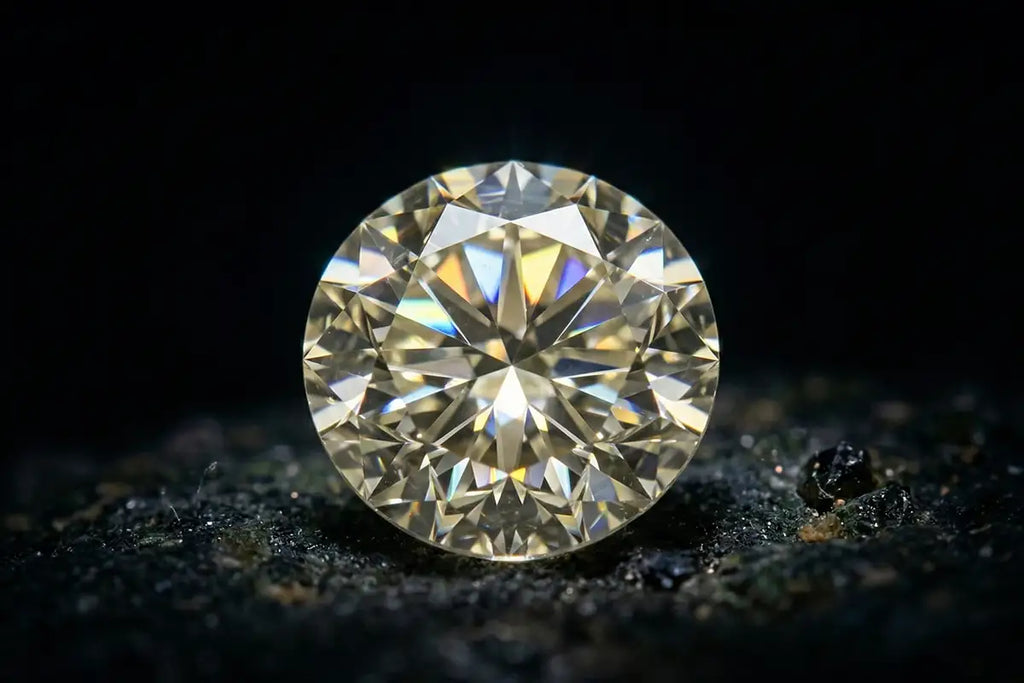
Natural brilliant cut diamond, light playing across the facets
The Tibetan Dorje: the Adamantine Vehicle
In Tibetan, dorje is the direct translation of vajra. It is the central ritual object of Tibetan Buddhism: a double-headed sceptre held in the right hand by lamas during ceremonies. It symbolises the indestructible nature of the awakened mind, the clarity of absolute reality, the spiritual force that dissolves all illusions.
An entire branch of Tantric Buddhism bears this name: Vajrayana, the "diamond vehicle" or "adamantine vehicle," practised in Tibet, Bhutan, Mongolia, and Japan (the Shingon school). The metaphor is precise: just as the diamond cuts through all other stones, the path of the Vajrayana "cuts through" illusions on the journey toward enlightenment.
According to the Tibetan tradition, the diamond symbolises both absolute clarity (the transparency of reality) and permanence (the indestructibility of the awakened mind). Two qualities that Western gemologists also recognise in it, though in an entirely different register.
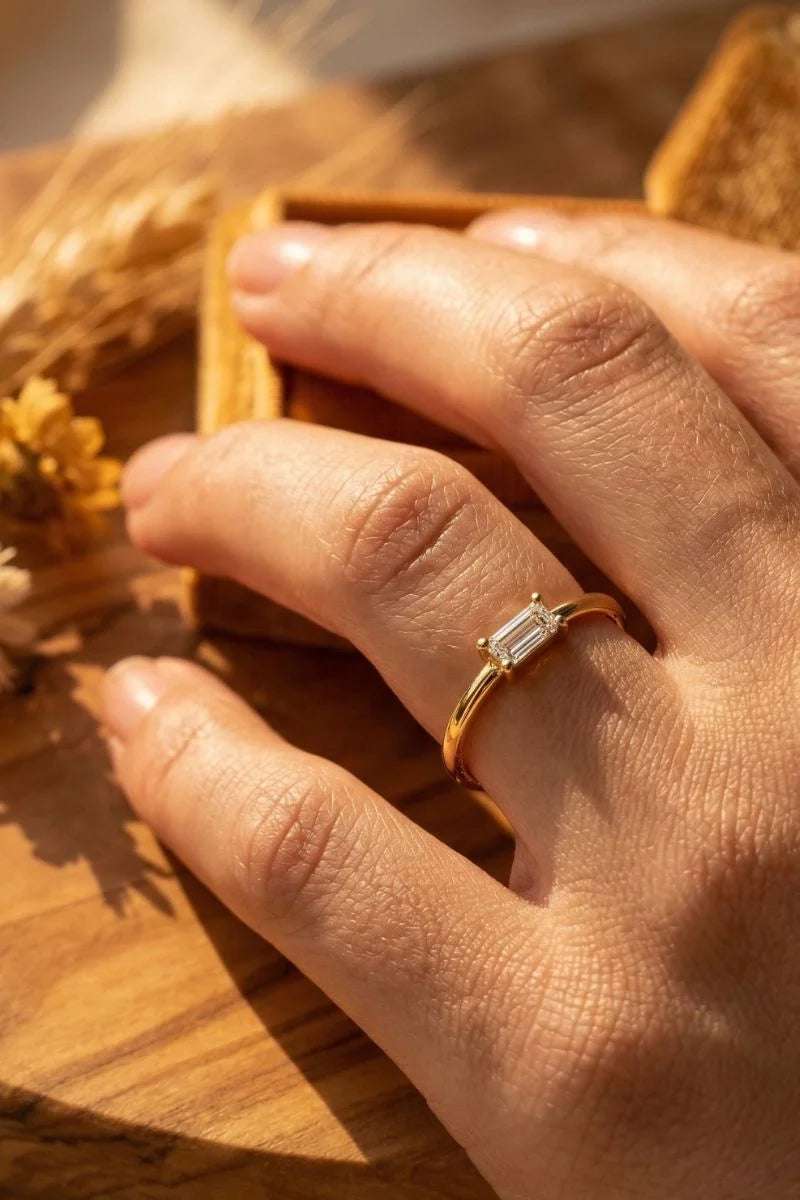
Mayuri diamond ring in 18ct yellow gold worn on the skin, natural light
The Navaratna: the Diamond's Place in Vedic Astrology
In the cosmology of Vedic astrology, Jyotish, still practised by millions in India, Nepal, and the diaspora, each planet governs a domain of life and is associated with a stone that concentrates its energy. The assembly of the nine planetary stones forms the Navaratna ("nine gems" in Sanskrit): the sacred jewel par excellence in the Indian jewellery tradition.
The diamond is the stone of Shukra, Venus in Vedic cosmology. Shukra governs love, the arts, beauty, luxury, and material prosperity. According to Jyotish, wearing the stone of one's favourable planet strengthens its positive influence in the wearer's life.
Gemstone
Planet (Jyotish)
Domain
Ruby
Sun (Surya)
Authority, vital energy
Pearl
Moon (Chandra)
Emotions, intuition
Red Coral
Mars (Mangala)
Courage, energy
Emerald
Mercury (Budh)
Intellect, communication
Yellow Topaz
Jupiter (Guru)
Wisdom, spirituality
Diamond
Venus (Shukra)
Love, arts, beauty
Blue Sapphire
Saturn (Shani)
Discipline, karma
Hessonite (Gomed)
Rahu
Ambition, desire
Cat's Eye Chrysoberyl
Ketu
Spiritual intuition
This Navaratna table appears in our articles on the virtues of the Emerald and the virtues of the Ruby, each stone occupying its own planetary position within this cosmology.
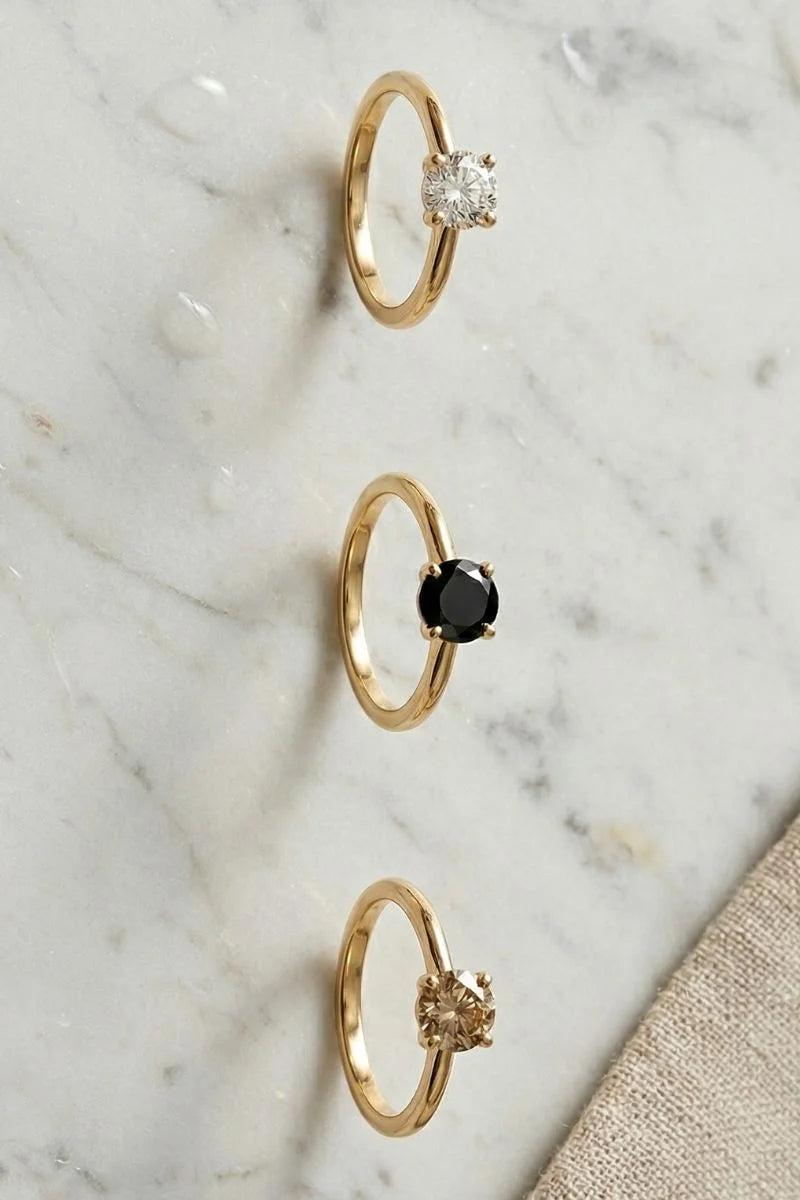
Three solitaire rings in yellow gold: white diamond, black diamond and champagne diamond
April Birthstone and Western Astrology
In the West, the diamond is the official birthstone for April according to the AGTA (American Gem Trade Association) list, formalised in 1912 and revised in 2002. It is associated with the signs of Aries (March 21 – April 19) and Taurus (April 20 – May 20): inner strength, clarity, and fulfilment.
But the symbolism of the diamond in April is far older than this list. April is the month of spring renewal, of light returning after winter. The diamond, which captures and reflects light better than any other stone, is its natural symbol: it takes the available light and multiplies it, much as spring takes the returning sun and transforms it into something radiant.
For a complete guide to the diamond as the April birthstone, including its meaning, a buying guide, and jewellery for those born in April, discover our dedicated article.
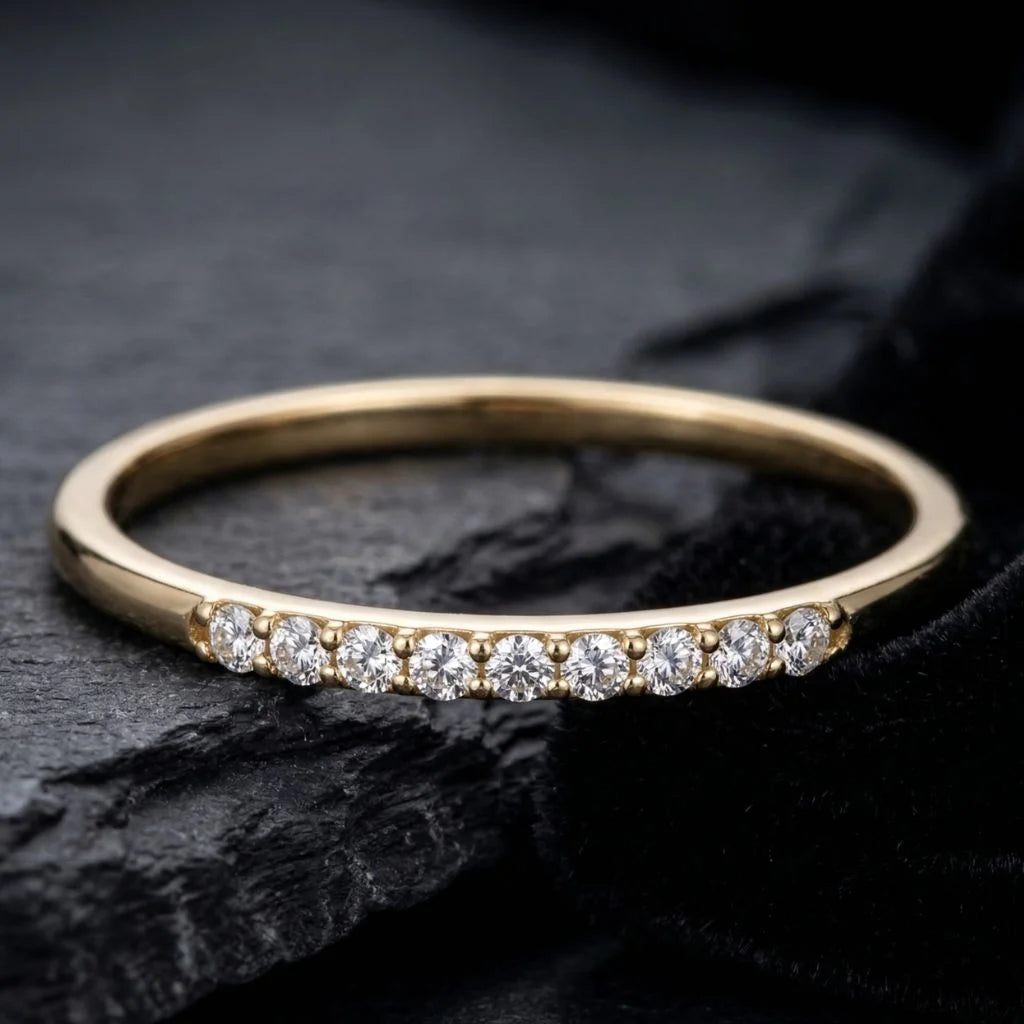
Half-eternity band set with diamonds in yellow gold, on a slate background
Eternity and Love: an Association Far Older than De Beers
Many believe that the diamond-love-eternity association dates to 1947, when De Beers launched the slogan "A Diamond is Forever." This is a misconception worth correcting.
The Romans were already wearing iron rings on the left ring finger, the "digitus annularis", in reference to the vena amoris, the vein the Ancients believed to be connected directly to the heart. The wealthiest Romans would set a diamond on it: the indestructible stone to symbolise a love that nothing could destroy.
In 1477, Archduke Maximilian of Austria presented Mary of Burgundy with a diamond ring, the first documented diamond engagement ring in history, 470 years before De Beers. The symbolism existed, the practice existed, the tradition existed.
What De Beers accomplished in 1947: standardising and globalising an aristocratic tradition that was already centuries old, making it accessible to the middle class, and enshrining it in a memorable commercial formula. The depth of the symbol itself, however, predates this by far.
The enduring power of the symbol rests on a physical truth: the Diamond is the hardest naturally occurring substance known to exist (10 on the Mohs scale). Nothing scratches it; nothing destroys it under normal conditions. The metaphor of a love that withstands everything is literally encoded in the crystalline structure of the stone.
Crystal Healing: What Tradition Has to Say
Contemporary crystal healing associates the Diamond with the crown chakra (Sahasrara), at the top of the head. According to this tradition, a personal spiritual practice with no recognised medical basis, it symbolises mental clarity, connection to an expanded consciousness, and the ability to "amplify the energy of other stones."
Our position: these uses belong to personal spirituality and cultural traditions, each with their own legitimacy. We make no therapeutic claims. What we do is document these traditions for what they are: a testament to three millennia of universal fascination with a stone that has captivated every civilisation it has touched. For everything relating to the gemological properties of the Diamond, explore our dedicated guide.
The Diamond symbolises strength, eternity, and indestructible love across the vast majority of cultures that have known it. Its Greek name "adamas," meaning the unconquerable, encapsulates this symbolism in a single word. In the Vedic tradition, it is the stone of Venus, embodying love and beauty. In medieval European tradition, it was believed to ward off evil. In contemporary culture, it stands as the ultimate emblem of enduring love.
What is the Vajra?
The Vajra (Sanskrit: वज्र) signifies both "lightning" and "diamond" within the Hindu tradition. It is the divine weapon of Indra, king of the gods in the Rigveda, forged from the hardest substance in existence. This dual meaning, lightning and indestructibility, makes the vajra one of the most eloquent concepts in lapidary symbolism, later adopted in Tibetan Buddhism under the name dorje.
On which hand should a Diamond be worn according to Vedic tradition?
According to Jyotish tradition, the Diamond is worn on the index or middle finger of the right hand (or the left hand for left-handed individuals), set in a noble metal in direct contact with the skin. The precise recommendation depends on one's personal astrological chart: a jyotishi (Vedic astrologer) can advise on the optimal placement based on the position of Shukra (Venus) in the natal chart.
Does the Diamond attract good fortune?
According to Vedic tradition, the Diamond, as the stone of Shukra (Venus), is said to enhance luck in love, in the arts, and in material prosperity for those whose astrological chart is favourable to Shukra. These beliefs belong to tradition, not to science. They nonetheless bear witness to several millennia of faith in the properties of this stone, across vastly different cultures.
What is the meaning of a Diamond given as a gift?
To give a diamond is to offer a symbol carrying three thousand years of history: strength, eternity, indestructible love. It is the perfect gift for life's great occasions: engagements, wedding anniversaries, the birth of a child, or simply to express something that goes beyond words.
Why is the Diamond the birthstone for April?
The association of the diamond with the month of April has been formalised since the AGTA list of 1912. Yet its roots run deeper: April is the month of rediscovered light after winter, of spring's renewal. The diamond, which reflects and multiplies light more beautifully than any other stone, is its natural symbol. It is also the birthstone of Aries and Taurus in Western astrology.