GemologyThe Mayuri Journal26 March 2026
Enriched on 19 August 2026
Gemology
Colour Sapphires: Pink, Yellow, Orange, Violet and White, the Complete Guide
The color sapphire guide: blue, pink, yellow, violet, green. Shades, rarity and buying advice.
Written by Johan Nel, Jewellery designer & goldsmith · trained in gemmology · Mayuri ParisReading 18 min13 chapters
What the maison says
What to remember
In the Vedic tradition of the Navaratna (the nine planetary gemstones), three of the nine stones are Sapphires: the blue Sapphire (Neelam, Saturn), the yellow Sapphire (Pukhraj, Jupiter) and the orange Sapphire (sometimes associated with Rahu). This trilogy illustrates, better than any discourse, what the ancients already knew: a Sapphire is not a colour, it is a family.
Most people picture a Sapphire as a single blue stone. In reality, Sapphires exist in almost every hue: from the most delicate pink to golden yellow, from the orange padparadscha to plum violet, from bicolour teal to immaculate white. The same mineralogical family, an infinite spectrum of possibilities. At Mayuri, coloured Sapphires are not a catalogue of varieties but a palette. Each piece of jewellery is a chromatic composition crafted the way one composes a score. Our collection names (Surya, Shanti, Agni) are drawn from Sanskrit, a natural bridge to this ancient tradition of planetary stones. This guide covers gemology, colours, treatments and our approach to each variety. If you are looking specifically for blue Sapphire, our dedicated complete guide is available for you.
Composition of coloured sapphires in various shades, pink, yellow, orange, violet, and teal, on a white background
1. What is a coloured sapphire?
A Sapphire is a variety of corundum (Al₂O₃, aluminium oxide). The gemological rule is simple and absolute: if the corundum is red, it is a Ruby. If it is any other colour, it is a Sapphire. Pink, yellow, orange, violet, green, white, teal: all are Sapphires.
" Fancy sapphire " is the official English term used by the GIA to designate all Sapphires that are not blue. In French, the term is "saphir de couleur" or "corindon de couleur." This term encompasses an extraordinary diversity of stones that share the same crystal structure, the same physical properties and the same level of excellence for fine jewellery. The hardness of corundum is 9 on the Mohs scale, just below Diamond at 10. This exceptional hardness makes all coloured Sapphires excellent for everyday wear: rings, bracelets, necklaces, Earrings.
Its mineralogical relatives are close: its cousin the Ruby is also a corundum, coloured red by chromium. The boundary between Ruby and pink Sapphire is one of the classic debates in gemology. The blue Sapphire is the birthstone for September; coloured Sapphires share the same family and the same mineralogical nobility.
2. Where do the colours come from? The chemistry of trace elements
Pure corundum is colourless. It is the "impurities" (a few foreign atoms substituted within the crystal lattice) that give rise to all colours. A minute proportion of trace elements is enough to transform everything. Each colour corresponds to one or more specific elements. Iron alone produces yellow, since without titanium the Fe²⁺→Fe³⁺ charge transfer absorbs in the blue range. Iron combined with titanium produces the classic blue. Chromium in small quantities produces pink; in greater quantities, red: this is the boundary with the Ruby. The combination of chromium and iron produces orange. Vanadium produces violet. The complete absence of trace elements produces white.
Trace element
Resulting colour
Example
Iron (Fe) alone
Yellow
Yellow Sapphire, "Pukhraj"
Iron (Fe) + Titanium (Ti)
Blue
Classic blue Sapphire
Chromium (Cr) low concentration
Pink
Pink Sapphire
Chromium (Cr) high concentration
Red
Ruby
Chromium (Cr) + Iron (Fe)
Orange
Padparadscha, orange Sapphire
Vanadium (V)
Violet
Violet Sapphire
No trace elements
White/colourless
White Sapphire (leuco-sapphire)
Variable Fe/Ti/Cr combinations
Teal, bicolour, colour-change
Teal Sapphire, alexandrite-like Sapphire
Geological origin also shapes the range of colours available. Sapphires from Sri Lanka (an alkaline environment, low in iron) are naturally rich in chromium, which favours pinks, yellows, and padparadschas. Sapphires from Australia (a basaltic environment, rich in iron and titanium) tend to produce stones that are too dark or too greenish for fine jewellery. Madagascar today encompasses both geological contexts, yielding a remarkable diversity of colours.
Origines des saphirs de couleur dans le monde
USAMontana
KENYA
TANZANIASongea, Tunduru
MADAGASCARIlakaka
MYANMARMogok
VIETNAMLuc Yen
AUSTRALIAQueensland, NSW
SRI LANKA
Richest in varieties (6 colors)
Sri Lanka
Richest in varieties (6 colors)
Madagascar
Ilakaka
Tanzania
Songea, Tunduru
Myanmar
Mogok
Vietnam
Luc Yen
USA
Montana
Australia
Queensland, NSW
Kenya
Rose Padparadscha Jaune Orange Violet Teal Vert Bleu
Sri Lanka is the only country producing all six major families of colored sapphires.
3. The pink sapphire: from powder pink to fuchsia
Pink sapphire covers a remarkably wide spectrum: from an almost translucent powdery blush to an intense fuchsia pink, taking in violet-tinged rose and warm "hot pink" tones. All these shades are produced by chromium, whose concentration determines the depth of colour.
The boundary with ruby is defined by the dominant hue: if red dominates, it is a ruby. If pink dominates, it is a pink sapphire. This boundary, established by the GIA and the SSEF, is in practice a subtle one; only a laboratory report carries definitive authority.
The benchmark origins: Sri Lanka produces pink sapphires with milky, lightly pearlescent tones and a characteristic softness. Madagascar offers brighter pinks, often more transparent, with a more pronounced saturation. Reference prices for a gem-quality pink sapphire: between £700 and £2,500 per carat (Sri Lanka or Madagascar, 1 carat, certified unheated). A fine-coloured heated pink sapphire can be found between £250 and £1,300 per carat. With a hardness of 9 on the Mohs scale, it is an ideal stone for rings worn every day.
Ring set with a pink sapphire in 18ct white gold, close-up on the stone
4. The padparadscha: the rarest sapphire in the world
Padparadscha takes its name from the Sanskrit "padma raga": the colour of the Ceylon lotus. It is the rarest, most coveted and most valuable variety of all colour sapphires. Its definition can be expressed in a single phrase: a perfect balance between pink and orange, in pastel to medium tones. Neither pink enough to become a pink sapphire, nor orange enough to become an orange sapphire.
This definition, which appears simple, is in reality one of the most debated in gemology. The 2018 LMHC definition brought together seven major international laboratories around a shared set of criteria. Requiring an SSEF or Gübelin certificate is non-negotiable for a padparadscha of genuine value. Rarity is geographically concentrated: almost exclusively Sri Lanka. A small number of stones come from Madagascar, but Ceylon padparadscha remains the absolute benchmark. Prices reflect this rarity: from £4,500 to £25,000 per carat for a specimen certified by the SSEF or GIA. Beyond 3 carats, certain pieces have exceeded £42,000 per carat at auction.
Padparadscha sapphire from Sri Lanka, salmon-pink-orange colour, on a snow-grey background
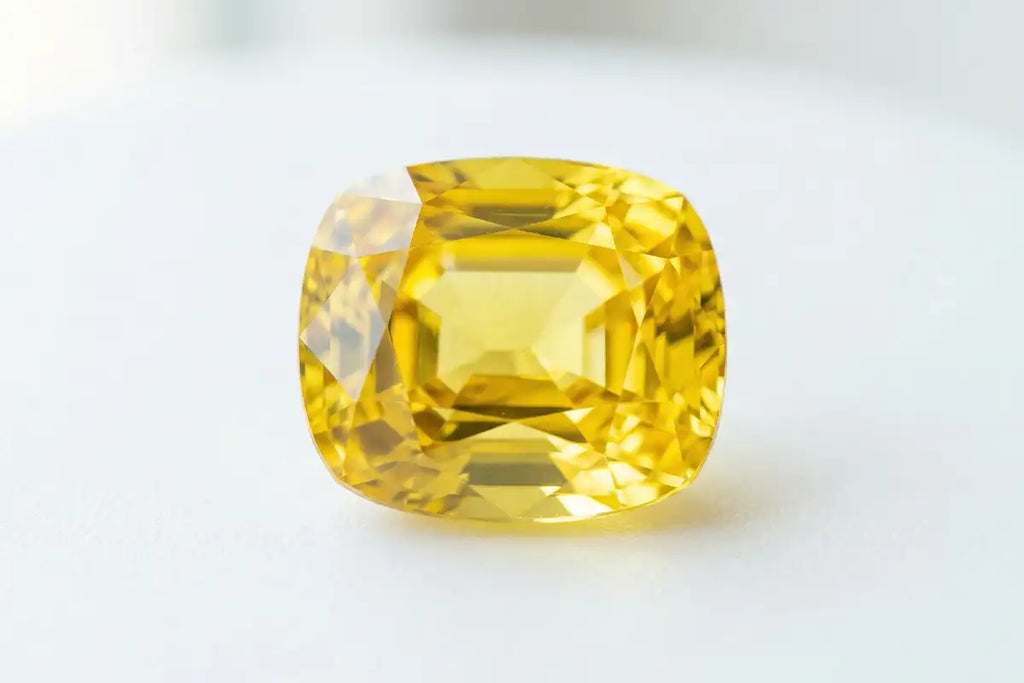
Yellow sapphire owes its colour to iron alone, without titanium: the absence of titanium prevents the charge transfer that creates blue. The spectrum ranges from pale, nearly colourless lemon to intense golden yellow, passing through warm amber tones close to honey. Medium to deep tones of pure golden yellow are the most prized in fine jewellery.
In the Vedic tradition, yellow sapphire is the "Pukhraj", the stone of Jupiter (Guru Graha), the planet of wisdom, prosperity and fortune. It is one of the nine stones of the Navaratna. A crucial point of vigilance: treatments are very common in yellow sapphires. Standard heating is widespread, but beryllium diffusion (Be) is the treatment to watch for specifically. Beryllium, diffused at high temperature into the crystal, can profoundly alter the colour of a low-quality stone to create an artificially attractive yellow. Only laboratory spectroscopy can detect this treatment. A GIA or SSEF certificate is essential for any serious acquisition. Yellow sapphire pairs naturally with 18ct yellow gold: the two warm tones reinforce one another to create a piece of remarkable chromatic harmony.
6. The orange sapphire: between mandarin and peach
The orange Sapphire owes its colour to a combination of chromium and iron in significant proportions. Its spectrum ranges from vivid mandarin orange to softer peach orange, passing through deep rust. The chromatic boundaries are blurred: toward red it approaches Ruby, toward yellow it meets Yellow Sapphire, and toward pastel pink-orange tones it enters the territory of the padparadscha.
Unheated stones are exceptionally rare on the orange Sapphire market. Primary sources include Sri Lanka, Tanzania, and Vietnam. Our Sunset Sapphire collection explores precisely this spectrum: from deep orange close to padparadscha to golden honey yellow, passing through every intermediate shade of orange. Each piece is a sequence of stones selected one by one to create a coherent progression of hue. Sunset Sapphire explores precisely this spectrum: from deep orange close to padparadscha to golden honey yellow, passing through every intermediate shade of orange. Each piece is a sequence of stones selected one by one to create a coherent progression of hue.
The Mayuri Sunset Sapphire collection, a jewel showcasing its characteristic orange-to-yellow gradient
7. The violet sapphire: from lilac to plum
The violet Sapphire is coloured by vanadium (V): in small quantities it produces a delicate lilac, almost lavender, of remarkable lightness; in greater quantities it yields an intense plum violet that can verge on purple. This spectrum is among the most nuanced in the entire family of colour Sapphires.
A distinction must be made between the violet Sapphire and the colour-change Sapphire: both can appear violet under certain lighting conditions, but the colour-change Sapphire displays a pronounced metameric phenomenon, whereas the violet Sapphire remains stable regardless of the light source. Sri Lanka is the primary source of quality violet Sapphires, with Myanmar also producing notable stones. These gems are experiencing a marked resurgence of interest in contemporary fine jewellery: their character, at once soft and assured, far removed from the most familiar colours, appeals to a clientele seeking distinction without ostentation.
Earrings and ring in yellow gold set with baguette cut violet sapphires
8. The green sapphire and the teal sapphire
The green Sapphire owes its colour to a combination of iron, titanium, and chromium in particular proportions. The main sources of gem-quality stones are Madagascar and Montana (United States). Green Sapphire should not be confused with tsavorite (a green garnet) or with Emerald: the shade of green is different, cooler and more mineral in the Sapphire. Teal Sapphire is undoubtedly the strongest trend in the fine gemstone market since 2018. Oscillating between blue and green, produced by iron and titanium in balanced proportions, it carries within it something of the ocean and the forest simultaneously. Colour zoning, the visible alternation of blue and green areas within the stone, is not a flaw but a defining characteristic. The principal deposits are found in Australia (Queensland), Montana, and Madagascar. Australian teal Sapphires tend to be darker and more contrasted; those from Madagascar offer more balanced, translucent hues.
Bicolour teal sapphire illustrating blue-green colour zoning on a white background
9. The white sapphire: pure corundum and colourless light
White Sapphire, also known as leuco sapphire, is a corundum entirely free of trace elements: pure aluminium oxide, colourless. Its brilliance is distinct from that of Diamond: the refractive index of corundum (1.762–1.770) is lower than that of Diamond (2.42), resulting in less "fire" (that rainbow chromatic dispersion characteristic of Diamond), but a more vitreous, more mineral, more understated brilliance. In fine jewellery, White Sapphire is frequently used in pave settings, as accent stones surrounding a central gem, or as an alternative for refined, luminous rings. Our collection Horizon Sapphire features the white Sapphire as its final destination: the progression begins with the deepest royal blue, moves through soft blue, then near-colourless blue, and concludes with immaculate white. The white Sapphire is the zero point of the spectrum, light before colour.
White sapphire, leuco-sapphire, round cut, on beige fabric
10. The colour-change sapphire
The colour-change Sapphire is one of the most fascinating phenomena in mineralogy. In natural light (daylight, with a blue dominant), it appears blue-violet. In incandescent light (bulb, candlelight, with a red dominant), it shifts to violet-purple. This phenomenon is known as metamerism: the same stone absorbs light differently depending on the incident light spectrum. The chemistry behind it involves vanadium combined with iron or chromium in very specific proportions. Sri Lanka is the primary source; Tanzania also produces a number of quality specimens. The value of a colour-change Sapphire depends directly on its contrast ratio: the more distinct and pronounced the colour shift (from light blue-green to intense red-violet, for example), the more sought-after the stone. A subtle, barely perceptible change diminishes both its gemological interest and its market value. Not to be confused with alexandrite, which is a chrysoberyl (a different mineral) exhibiting a similar phenomenon but with distinct colours.
Colour-change sapphire appearing blue-violet in daylight and violet-purple under incandescent light
11. Treatments: what to know before you buy
The vast majority of fancy colour Sapphires available on the market have undergone one or more treatments. Heat treatment applies to approximately 95% of commercially available colour Sapphires. The stone is heated to temperatures between 1,600 and 1,800°C for several hours or several days. This treatment enhances colour, dissolves certain inclusions, and improves clarity. It is stable, permanent, and universally accepted by all laboratories and markets. It must nonetheless be disclosed by the seller: this is both an ethical obligation and, in many countries, a legal requirement.
A certified "no heat" (unheated) Sapphire is worth 30 to 200% more than a heat-treated equivalent. Beryllium diffusion is the most problematic treatment. Beryllium (Be) is diffused into the crystal at very high temperatures, altering the colour throughout or at the surface. This treatment can transform a worthless stone into an apparently magnificent yellow or orange Sapphire. Only LIBS or LA-ICP-MS spectroscopy carried out in a laboratory can detect it. It must be disclosed, yet it is sometimes concealed. For yellow and orange Sapphires, the utmost vigilance is required.
Fracture filling Fracture filling is rare for sapphires but does exist. The leading certifications are: GIA (international, rigorous), SSEF (Swiss, the absolute reference for padparadscha and no-heat stones), Gübelin (Swiss, high jewellery). A practical rule: a laboratory report is essential for any stone exceeding 0.5 ct. For a padparadscha, insist on SSEF or Gübelin, without exception.
12. How to choose a coloured sapphire: colour comes first
Unlike diamonds, where clarity and carat weight dominate the evaluation, colour is the single most important criterion for a coloured sapphire. Colour breaks down into three dimensions: hue (the base colour; a pure yellow is more prized than a greenish yellow), tone (from light to dark; the ideal sits between medium light and medium dark), and saturation (intensity; the ideal is a vivid and uniform saturation).
Variety
Ideal Hue
Ideal Tone
Saturation
Pink Sapphire
Vivid pink, "hot pink"
Medium
Strong
Padparadscha
Balanced pink-orange
Light to medium
Low to moderate
Yellow Sapphire
Golden yellow
Medium
Strong
Violet Sapphire
Pure violet
Medium
Moderate to strong
Teal Sapphire
Balanced blue-green
Medium
Moderate
White Sapphire
Pure colourless
Very light
None
Clarity comes second: fine inclusions that are invisible to the naked eye are acceptable. A laboratory certificate is non-negotiable for any significant purchase. It confirms the stone's natural origin, the presence or absence of treatment, and for certain varieties such as padparadscha and colour-change Sapphire, it provides the official gemological classification. Without a certificate, value cannot be verified.
13. The Mayuri approach: composing a sapphire palette
At Mayuri, we do not sell sapphires in isolation. We compose palettes. Each piece of jewellery is a carefully chosen sequence of colours selected the way one chooses the notes of a score, or the shades of a watercolour. This approach has been at the heart of our identity since our very first creations.
The Sunset Sapphire collection explores the warm palette: from deep orange, almost padparadscha, to golden honey yellow. The Horizon Sapphire explores the cool palette: deep royal blue, medium blue, light blue, near-colourless blue, immaculate white. Each stone is individually selected by our gemologists for its precise place in the chromatic progression. Our Sanskrit design names, Surya (the Sun), Shanti (peace), Agni (fire), weave a natural connection with the Navaratna tradition. For those who wish to go further, our atelier offers bespoke sourcing across the full chromatic spectrum of sapphire: fuchsia pink, SSEF-certified padparadscha, canary yellow, bicolour teal, plum violet. Our team will be delighted to guide you in composing your unique palette, stone by stone.
Sunset Sapphire and Horizon Sapphire collections side by side, the dual palette of Mayuri jewellery
Padparadscha is a sapphire whose colour is a balanced combination of pink and orange, in pastel to medium tones. Its name derives from Sanskrit, meaning the colour of the Ceylon lotus. It is the rarest and most valuable variety of colour sapphire, with prices that can exceed £25,000 per carat for SSEF- or GIA-certified stones originating from Sri Lanka.
How do you choose a coloured sapphire?
Colour is the foremost criterion: assess the hue (the exact shade), the tone (light or dark), and the saturation (intensity). For each variety, certain colour profiles are more sought after than others. Always request a recognised laboratory report for any stone of value. Clarity comes second; fine inclusions invisible to the naked eye are generally acceptable.