GemologyThe Mayuri Journal26 March 2026
Enriched on 19 August 2026
Gemology
What is padparadscha? The rarest sapphire in the world
Padparadscha: a rare sapphire with unclassifiable pink-orange hues. Origin, rarity, and singular character.
Written by Johan Nel, Jewellery designer & goldsmith · trained in gemmology · Mayuri ParisReading 11 min10 chapters
What the maison says
What to remember
Among all the sapphires that exist, blue, pink, yellow, green, there is one that belongs to no category. Its colour is that of a sunset over the Indian Ocean: neither pink nor orange, but both at once, in perfect suspension. Gemologists call it padparadscha.
Its name comes from the Sanskrit padmaraga, "colour of the lotus," the national flower of Sri Lanka, pink-orange, blooming at dawn on the calm waters of Ratnapura, the "City of Gems." This is no coincidence: the padparadscha comes from Sri Lanka, and nowhere else is this geological generosity quite so remarkable.
To understand what the padparadscha is, is to understand why certain stones can reach $60,000 per carat, and why this precise colour has captivated collectors, gemologists, and fine jewellery enthusiasts for centuries.
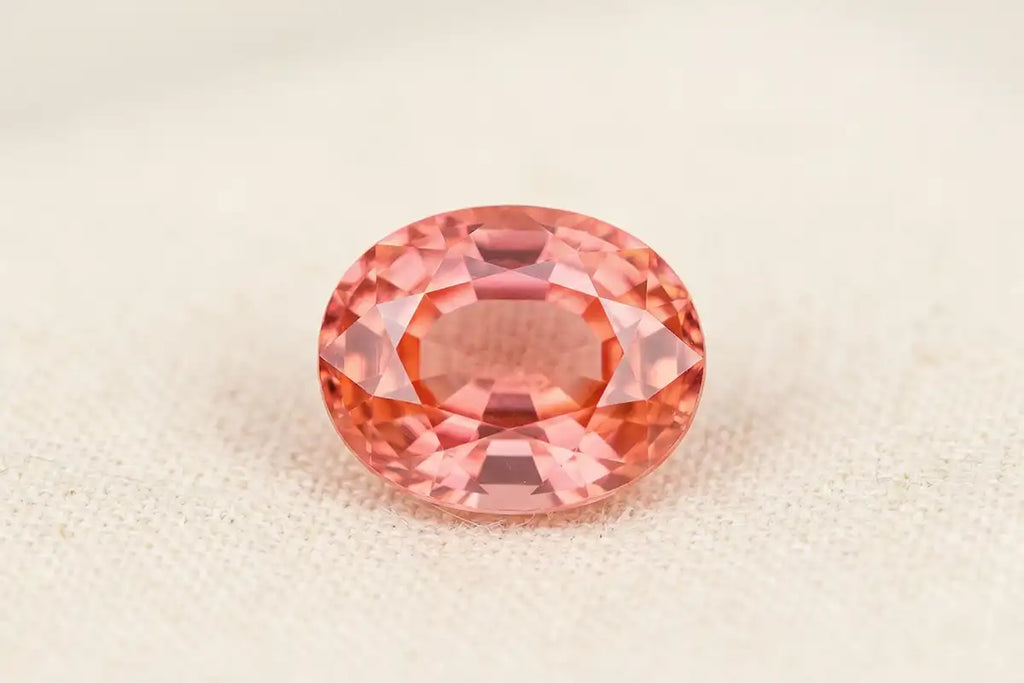
Natural padparadscha sapphire from Sri Lanka, displaying the rose-orange hue typical of the lotus flower
Etymology: "padmaraga", the colour of the lotus flower
The word "padparadscha" is a variation of the Sinhalese term padmaraga, itself derived from Sanskrit: padma (lotus) and raga (colour). Literally: the colour of the lotus.
The lotus flower chosen as a reference is not the white bloom of Buddhist illustrations. It is the pink-orange lotus flower (Nelumbo nucifera) that grows on the lakes and waterways of Sri Lanka, the country's national flower. Its petals shift from vivid pink to pale orange, exactly like the stone.
This association is far from incidental. The lotus carries deep symbolic meaning in Indian and Sinhalese traditions: purity, rebirth, light born from dark water. To give this name to a sapphire was to bestow upon it a cultural dignity that few other stones possess. As established by the GIA in its gemological archives, the term appears in Western gemological texts as early as the 19th century, though its roots are far more ancient.
The image of the lotus at sunrise on a still lake is the founding vision of the padparadscha. It is not merely poetic: it is gemological, and this is precisely what laboratories seek to capture when they define this extraordinary colour.
The padparadscha colour: between pink and orange
The padparadscha colour is the most difficult to define in gemology. Not because it is vague, but because it demands something rare: two hues coexisting in perfect balance.
The absolute condition is that pink and orange must be present simultaneously, with neither dominating the other. A simply pink sapphire is not a padparadscha. Nor is a simply orange sapphire. The "padparadscha zone" corresponds, in GIA notation, to the hues pinkish orange and orangy pink, with a contribution from each colour ranging between 30% and 70%. Low to moderate saturation, light to medium tone: the balance is as delicate as it is precise.
This definition, which appears straightforward on paper, has been a source of debate among major laboratories for forty years. The 2018 LMHC definition brought stability to the criteria: a harmonisation across seven international laboratories, SSEF, Gübelin, GIA, CGL, CISGEM, DSEF, and GIT, established a shared reference point. Since that date, any corundum of any origin whose colour is a subtle blend of pinkish orange to orangy pink, in pastel tones, viewed under standard daylight, may receive the padparadscha designation.
The "padparadscha zone" is narrower than it may appear. Stones that are slightly too pink, too orange, too saturated, or too dark are excluded from it. This is precisely why a certificate from an independent laboratory is essential: no human eye, however expert, can make that determination alone.
Fewer than 1% of the sapphires produced worldwide are true padparadschas. This figure reflects a profound geological reality: the padparadscha colour is not a fortunate accident; it is the product of an exceptionally precise chemical coincidence.
The colour of a corundum depends on the trace elements present during its crystallisation. In the case of the padparadscha, two elements must be present simultaneously, in balance: chromium, which produces the pink as in ruby, and iron, which produces the yellow-orange as in yellow sapphire. If one dominates, the stone becomes pink or orange. When both are present in precise proportions, the result is the pinkish orange of the padparadscha.
This combination is only possible in specific metamorphic rocks, principally pegmatites and gneisses, where both elements occur together in the right concentrations. The geological conditions that unite all of these factors exist in only a few places in the world, and Sri Lanka is, by far, the foremost among them.
Cut is a compounding factor: most padparadschas weigh under 2 carats. Finding a stone of over 5 carats with the right colour is considered a gemological event in itself. Beyond 10 carats, one enters the realm of auction records, with per-carat prices that can exceed $100,000.
Sri Lanka: the birthplace of the padparadscha
While padparadscha can technically originate from Madagascar (Ilakaka), Vietnam (Quy Chau), or Tanzania (Umba Valley), only one origin truly matters in the eyes of collectors and laboratories: Sri Lanka.
Ratnapura, "City of Gems" in Sinhalese, is the geological heart of this tradition. Its alluvial terrain has yielded Sapphires for over 2,000 years. Miners work by hand, sifting through sediments in rivers whose geological composition produces, more than anywhere else, the conditions for padparadscha.
The term "Ceylon padparadscha" is used by laboratories as an additional quality notation on certificates. An SSEF-certified padparadscha of Sri Lankan origin commands a premium of 20 to 40% on the market compared to a specimen of identical colour but of Madagascan or undetermined origin.
Artisanal sapphire mining in the alluvial deposits of Ratnapura, Sri Lanka
The connection between Sri Lanka and Sapphires goes far beyond padparadscha. The island has supplied some of the greatest coloured stones in history. Padparadscha is simply the rarest gem among those this land produces. To explore the history of Ceylon Sapphires further, our guide on the September Sapphire revisits this geographical tradition spanning more than two millennia.
SSEF, Gübelin, GIA certifications: how to read a padparadscha certificate
Buying a padparadscha without a certificate from a recognised laboratory means buying a colour without any guarantee. The issue is that several laboratories do not share the same definition, and the boundaries of the "padparadscha zone" remain subjective even among experts.
The SSEF (Basel) and Gübelin (Zurich) are the two most rigorous laboratories. Their distinction: beyond colorimetric analysis, they require a fading test, during which the stone is exposed to intense UV light for several hours. If the colour fades without returning to its original state, the stone is rejected. This test verifies that the padparadscha colour is stable over time and is not the result of an unstable treatment. An SSEF certificate bearing the mention "padparadscha" is the ultimate seal of approval in the luxury market.
The GIA (USA) has used a slightly broader definition since joining the LMHC in 2018. The GIA does not systematically require a fading test, but its certificate is recognised as reliable across American and Asian markets.
One decisive point: the certificate must explicitly mention the word "padparadscha" in the colour description. A certificate that reads only "orangy pink sapphire" or "pinkish orange sapphire" is not a padparadscha certificate, regardless of the laboratory's reputation.
SSEF laboratory certificate confirming the padparadscha colour of a Sri Lankan sapphire
Laboratory
Fading test
FR/CH market reputation
Market value
SSEF (Basel)
Yes, mandatory
Maximum
+20-30% premium
Gübelin (Zurich)
Yes, mandatory
Maximum
+20-30% premium
GIA (USA)
Not systematic
Very good
International standard
GRS (Bangkok)
Variable
Good in Asia
Common in Thailand
Heated or unheated: the criterion that doubles the value
Like the majority of Sapphires on the market, many padparadschas are heat-treated to enhance their clarity or even out their colour. Heating is an accepted and disclosed practice in gemology, provided it is noted on the certificate.
The difference in value is considerable: a padparadscha certified "no heat" (unheated) is worth 2 to 3 times more than a specimen of the same size and colour that has undergone heat treatment. The reason is straightforward: a natural colour, achieved without intervention, confirms the chemical integrity of the stone and its absolute rarity, in the most literal sense of the term.
A point that few guides mention: certain more invasive treatments, notably beryllium diffusion (beryllium diffusion), which artificially introduces chromium and iron into the surface layer of the corundum, can simulate the padparadscha colour. This treatment can only be detected in a laboratory. It is one more reason to purchase only with an SSEF or Gübelin certificate, both of which test specifically for these processes.
The certificate explicitly states the thermal status: "No indications of heating," "Indications of heating," or in serious cases, "Fracture filling/beryllium diffusion." These three designations are not equivalent, and the price difference between them can reach a factor of 3 to 5.
Padparadscha pricing: why so much value?
Padparadscha is one of the most expensive gemstones in the world, surpassed only by certain Mogok rubies and a handful of exceptional Colombian Emeralds. The reason is simple: supply is structurally outpaced by demand, and rarity only increases with size.
Size
Thermal status
Estimated price (USD/ct)
~1 ct
Heated
5,500 – 8,500
~2 ct
Heated
8,500 – 12,000
~3 ct
Heated
10,000 – 15,000
~3 ct
Unheated
15,000 – 20,000
> 5 ct
Unheated
25,000 – 50,000+
> 10 ct, perfect colour
Unheated
> 100,000 (auction)
Rarity compounds exponentially with size: finding a padparadscha of more than 5 carats with the precise colour is, in itself, a gemological event. By way of comparison, a pink Sapphire of equivalent quality costs 5 to 20 times less. This is the premium of the double colour, pink and orange together, which cannot be reproduced artificially without detection.
For a first purchase, the ideal size falls between 0.5 and 1.5 carats: the colour is easier to assess within this range, prices remain accessible, and a secondary market exists.
Padparadscha vs pink Sapphire: where is the boundary?
Confusion between padparadscha and pink Sapphire is the most common mistake on the market, and the most costly for uninformed buyers. The boundary between the two is real, yet it lies precisely within that colour zone where pink begins to meet orange.
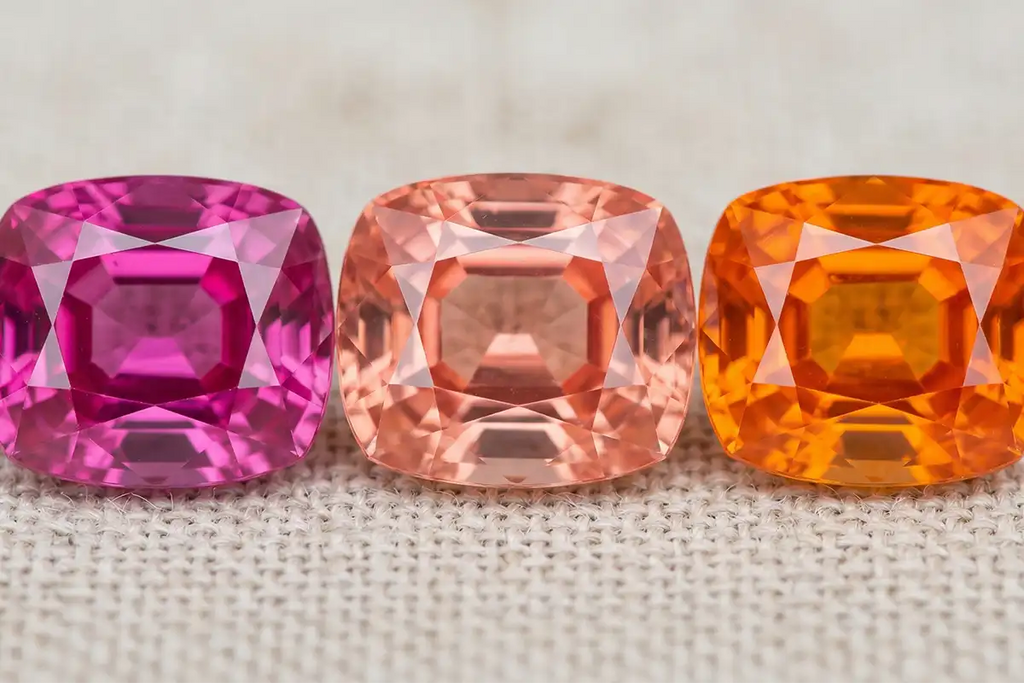
The rule is simple in theory: a pink Sapphire has only one dominant hue, pink. Padparadscha requires that both components, pink and orange, be visible simultaneously, without either one overpowering the other. A slightly orangey pink Sapphire remains a pink Sapphire. A slightly rosy orange Sapphire remains an orange Sapphire. It is only when the two are in balance that the stone enters the padparadscha zone.
The boundary is subjective in borderline cases, which is precisely why the debate lasted forty years among laboratories. And it is for this reason that a certificate from a recognised laboratory is the only reliable answer.
The impact on pricing is direct: a certified pink sapphire of 2 carats is valued at $1,000 to $3,000 per carat. A certified padparadscha of the same size: $10,000 to $14,000 per carat. The colour nuance represents a multiplying factor of 5 to 15, one of the most striking asymmetries in all of gemology.
Padparadscha in jewellery: bespoke creations at Mayuri
The padparadscha is a stone so rare and so personal that it does not lend itself to a permanent collection. Each specimen is unique in its colour, cut, and origin, making it a naturally ideal candidate for a bespoke jewellery project.
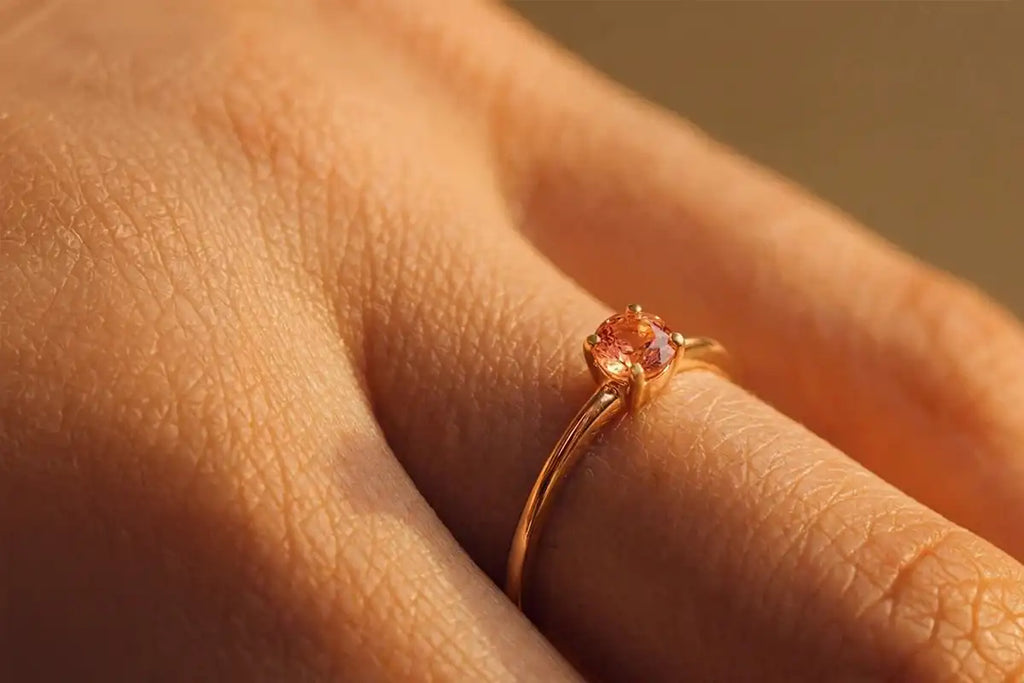
Mayuri jewel featuring a natural orange sapphire, with warm tones evoking the padparadscha colour
At Mayuri, we occasionally create jewellery featuring genuine padparadschas for custom commissions. If this singular colour, that rose-orange suspended between two lights, inspires a project in you, our team can source the stone and have it certified (SSEF or Gübelin), and create your jewellery piece from start to finish. Ring, pendant, Earrings: the piece is built around the stone, never the other way around.
For lovers of coloured sapphires, we believe the most beautiful stones are not always the most visible. Beyond blue sapphires and rubies, there exists an entire spectrum of corundums of extraordinary chromatic richness. The padparadscha stands at its absolute pinnacle.
How to purchase a padparadscha with complete confidence
Purchasing a padparadscha follows a clear logic: the certificate takes precedence above all else. Before the cut, before the price, before the aesthetics, verify that the stone carries an SSEF or Gübelin certificate with the explicit mention of "padparadscha" in the colour description.
The four key points to verify on a padparadscha certificate:
The mention "padparadscha" in the colorimetric description, not merely "orangy pink"
Declared origin: Sri Lanka as the priority, Madagascar acceptable
Thermal status: "no heat" for an investment, "heated" acceptable for a pleasure jewel
Fading test noted: present on SSEF and Gübelin certificates; its absence reduces the guarantee of colour stability over time
Avoid stones sold without a certificate, even at an attractive price. The difference between an "orangy-pink sapphire" and a certified padparadscha can represent a factor of 10 in price, and no human eye can make that determination alone This is the golden rule of this market: no certificate, no padparadscha.
Padparadscha is a corundum (the same family as sapphire and ruby) whose colour is a simultaneous blend of pink and orange, in perfect balance, with neither one dominating the other. Its name comes from the Sanskrit padmaraga: "colour of the lotus." It is the rarest sapphire in the world, representing less than 1% of global production.
What is the exact colour of the padparadscha?
Neither pink nor orange, but both at once, at low to moderate saturation. The 2018 LMHC definition specifies: a subtle blend of pinkish-orange to orangey-pink, in pastel tones, as seen under standard daylight. The "padparadscha zone" corresponds to a pink and orange contribution each ranging between 30% and 70%, a balance as rare as it is precise.
Why is the padparadscha so rare?
Its rarity is geological: the colour requires the simultaneous presence of chromium (pink) and iron (orange) within the corundum, in an exact ratio. This chemical coincidence is only possible in a handful of geological formations worldwide. Most padparadschas weigh under 2 carats, and large stones are an absolute rarity.
Where does the padparadscha come from?
Sri Lanka is the primary source; Ratnapura, the "City of Gems," is the historical and most prized origin. Madagascar (Ilakaka) has been a recognised alternative by laboratories since the 1990s. Vietnam and Tanzania are mentioned occasionally, in small volumes. A certified Sri Lankan padparadscha commands a market premium of 20 to 40%.
How much does a padparadscha Sapphire cost?
Between $6,500 and over $60,000 per carat for fine specimens certified by SSEF or Gübelin. A heated 1-carat padparadscha costs between $6,500 and $10,000 per carat; unheated, the price doubles. Beyond 5 carats with perfect colour, auction prices can exceed $120,000 per carat.
What is the difference between padparadscha and pink Sapphire?
A pink sapphire has a single dominant hue: pink. Padparadscha demands that pink and orange coexist in balance. A slightly orangey sapphire remains a pink sapphire; a slightly pinkish sapphire remains an orange sapphire. Only a laboratory certificate (SSEF, Gübelin, GIA) can confirm that a stone falls within the padparadscha zone. The price difference is typically in the range of five to fifteen times.
How do you certify a padparadscha?
By submitting it to a recognised laboratory: SSEF (Basel) and Gübelin (Zurich) are the most rigorous references, adding a UV stability test (fading test) to their colorimetric analysis. The GIA is globally recognised. The certificate must explicitly mention the word "padparadscha" in the colour description to be considered valid.
Can you find padparadscha jewellery at Mayuri?
Yes, through bespoke commission. As padparadscha is a rare and deeply personal stone, we do not offer it as part of our permanent collection. If the lotus-flower colour inspires a piece, whether a ring, pendant, or earrings, our team can source the stone, have it certified by SSEF or Gübelin, and create your piece from start to finish. Every padparadscha is a unique project.