GemologyThe Mayuri Journal26 March 2026
Enriched on 19 August 2026
Gemology
Yellow Sapphire: virtues, symbolism and Vedic tradition
The virtues and meaning of yellow sapphire: prosperity, wisdom, and its place in Asian tradition.
Written by Déborah Baid, Founder · Mayuri ParisReading 12 min10 chapters
What the maison says
What to remember
The yellow sapphire is one of the most symbolically rich gemstones in Asian tradition. In Sanskrit, it is known as Pukhraj: the stone of Jupiter, the gem of the Guru, a symbol of wisdom and prosperity in Vedic astrology, a practice spanning more than two millennia. This is no mere folkloric detail. This symbolic dimension has shaped, for centuries, the way lapidaries and goldsmiths of the Indian subcontinent select, cut, and wear these stones.
The colour itself tells a story. This luminous yellow, ranging from vivid citrus to warm amber gold, is produced by ferric ions trapped within the corundum structure over millions of years of geological formation. Each nuance corresponds to a precise mineral concentration, a signature of geographical origin.
Our gemologists have selected the finest yellow sapphires to compose the Saphir Sunset collection: a gradient that flows from burnt orange to solar yellow. Before going further, our complete guide to colour sapphires places the yellow sapphire within the broader corundum family.
The yellow sapphire belongs to the great family of corundum, a pure aluminium oxide (Al₂O₃). This mineralogical family brings together two of the most prized gemstones in the world: the Ruby, red, and the Sapphire, in all its other colours. Blue, pink, orange, violet, green, yellow: any corundum that is not red may bear the name sapphire. Yellow is one of the most coveted colours in South Asia, and one of the least recognised in French fine jewellery.
Its hardness is 9 on the Mohs scale, making it the most resistant mineral after the Diamond. This exceptional property makes it ideal for everyday jewellery: it withstands abrasion from ordinary surfaces without wearing down or scratching. A practical advantage that few jewellers highlight, yet one our gemologists consider fundamental when choosing a stone for a ring worn daily.
Sapphires form in metamorphic rocks, crystalline marbles, gneiss, or in certain basalts, under conditions of extreme pressure and temperature, over periods of several million years. This slow formation contributes to their relative rarity.
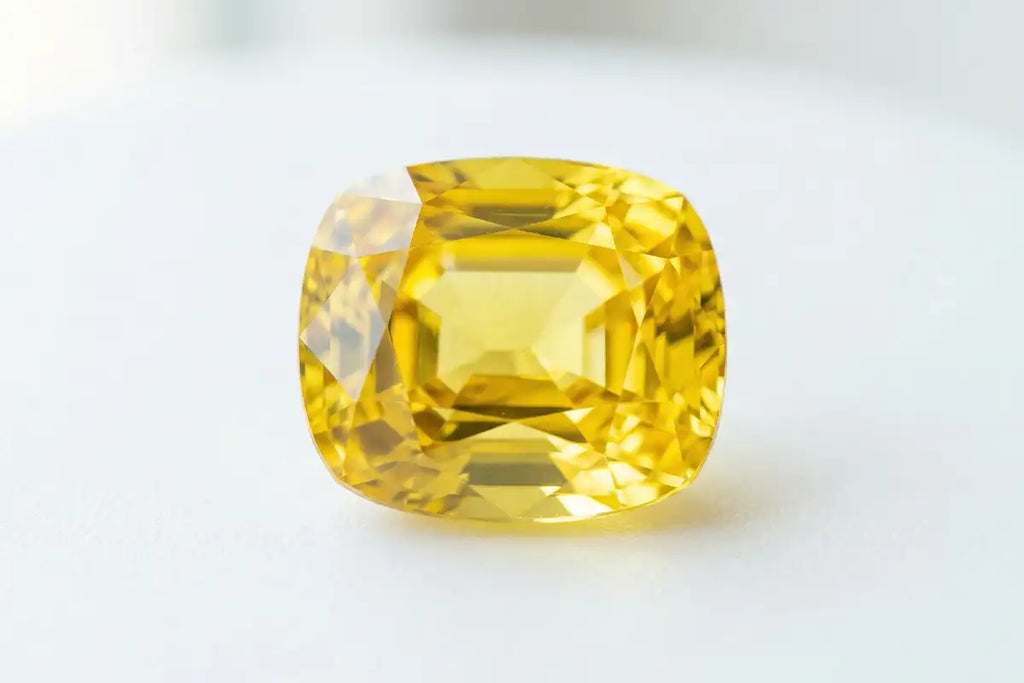
Natural cut yellow sapphire, canary colour, white background
The colour of yellow sapphire: from lemon to golden amber
The yellow colour of corundum results from a precise physicochemical process: ferric ions (Fe³⁺) absorb certain wavelengths of visible light and reflect yellow. The concentration of these ions determines the intensity and nuance of the colour. Research published by the GIA in Gems & Gemology in autumn 2023 identified two distinct chromophores: isolated Fe³⁺, responsible for pale and lemony yellows, and the h•-Fe³⁺ pair, responsible for intense, amber, and orange yellows.
What this means in practical terms for the jeweller:
Sri Lanka (Ceylon) produces yellow sapphires with low iron content, yielding a vivid, luminous yellow, often close to pure lemon or canary. These are the most sought-after stones in international fine jewellery, frequently unheated. Madagascar offers sapphires with a warmer colour, tending toward medium gold or honey yellow. Australia and Thailand produce sapphires with a high iron concentration: intense, amber-toned colour, sometimes with a slight greenish cast, and heat treatment is common.
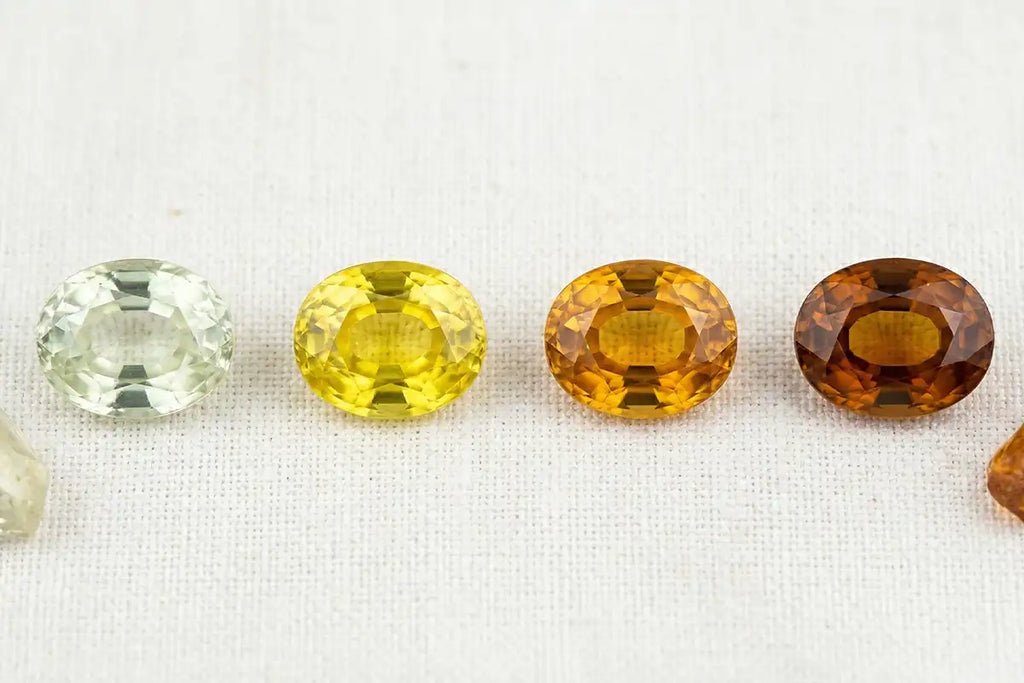
The full spectrum of nuances: pale lemon, canary, medium gold, warm honey, deep amber. The purer and more saturated the hue, free from any greenish or brownish cast, the higher the value. It is precisely this natural continuum, from burnt orange to solar yellow, that the Saphir Sunset collection expresses.
In Sanskrit, the yellow sapphire is called Pushparangam, meaning "the colour of a flower." This term was contracted into Pukhraj in Hindi, and this name is today just as common in India, Sri Lanka, and Pakistan as the term "yellow sapphire" is in English. There is no approximate synonym: to say Pukhraj is to name this stone precisely, within its own tradition.
It also bears the title of guru ratna, "gem of the Guru", because it is the stone of Jupiter, the planet of the Master in Vedic cosmology. This name says everything about its standing: not merely an ornamental stone among others, but a stone to which two millennia of astrological tradition have attributed a central symbolic role.
For those versed in Jyotish, Vedic astrology, the term Pukhraj refers very specifically to a natural, unheated yellow sapphire of sufficient quality for astrological use: transparent, free of major inclusions, and weighing at least two carats. This precision of vocabulary is often absent from Western articles, which use the word without fully grasping its significance.
The tradition of naming stones in Sanskrit connects directly to the philosophy of Mayuri: our designs themselves bear Sanskrit names, Surya, Kiran, Shanti, Kali. This is not an aesthetic borrowing, but the expression of a conscious cultural continuity with the traditions that first recognised the value of these stones.
Yellow sapphire and Vedic astrology: the stone of Jupiter
In Vedic astrology (Jyotish), each celestial body corresponds to a specific gemstone. Jupiter, Brihaspati in Sanskrit, is the "Master of the Gods" in Vedic mythology: the planet of wisdom, teaching, spiritual expansion, and prosperity. Its stone is the Pukhraj.
To wear a yellow sapphire within this tradition is to align oneself with the energy of Brihaspati: intellectual clarity, blessings upon ambitious endeavours, marital harmony, and fertility. Jupiter is also the Guru, the teacher, the figure of the transmission of knowledge. Teachers, jurists, physicians, and those seeking spiritual development are the primary recipients of the Pukhraj according to the classical texts of Jyotish.
The Vedic tradition is very precise about the conditions of wear:
Finger: the index finger (Tarjani) of the right hand, the finger of Jupiter
Initial day of wearing: Thursday (Guruvara, "day of the Guru")
Recommended metal: yellow gold, the colour of Jupiter
Associated mantra: "Om Brim Brihaspataye Namah", 108 repetitions are recommended at the time of putting on the ring
These guidelines are particularly recommended for those born under Sagittarius and Pisces, signs ruled by Jupiter according to Jyotish. It is important to note that these indications belong to the Vedic astrological tradition, and do not constitute medical advice of any kind.
The Navaratna: the nine stones of the nine planets
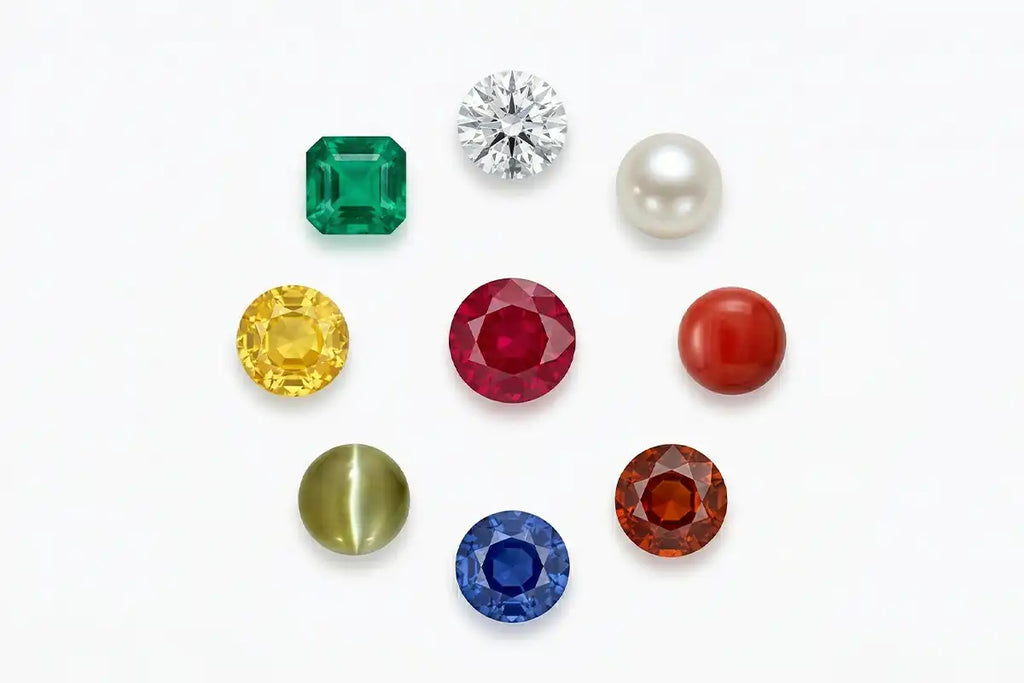
The Navaratna (Sanskrit: "nine gems") is the collection of nine precious stones associated with the nine celestial bodies of Vedic astrology. It is one of the oldest and most comprehensive systems in the history of cultural gemology.
Celestial body
Sanskrit name
Gemstone
Sun
Surya
Ruby (Manikya)
Moon
Chandra
Pearl
Mars
Mangal
Red coral
Mercury
Budha
Emerald
Jupiter
Brihaspati
Yellow Sapphire (Pukhraj)
Venus
Shukra
Diamond
Saturn
Shani
Blue Sapphire
Rahu (ascending node)
Rahu
Hessonite (orange garnet)
Ketu (descending node)
Ketu
Cat's eye (chrysoberyl)
The traditional Navaratna jewel brings together these nine stones in a composition symbolising complete cosmic harmony. Examples can be found in Mughal royal treasuries and in the courts of Sri Lanka and Thailand. The yellow Sapphire occupies the central position in certain Navaratna compositions, representing Jupiter, the planet of mastery and expansion.
Navaratna: the nine stones of Vedic astrology
Virtues and benefits of yellow sapphire: what tradition tells us
The virtues attributed to yellow Sapphire in Vedic and crystal healing traditions form a remarkably cohesive whole, drawn directly from its Jupiterian symbolism. Wisdom, mental clarity, prosperity, spiritual growth: these are the themes that recur throughout the classical Jyotish texts associated with Brihaspati.
According to Vedic tradition, Pukhraj encourages intellectual clarity, success in ambitious endeavours, harmony in marital relationships, and professional growth. In contemporary crystal healing, yellow Sapphire is associated with the solar plexus, the centre of self-confidence, abundance, and discernment, an attribution that aligns with Vedic symbolism through an entirely different path.
We present these virtues for what they are: a centuries-old cultural heritage, not proven medical properties. The value of a stone lies in its beauty, its history, and the emotion it conveys. The rest belongs to each individual.
Origins of yellow sapphire: Sri Lanka, Madagascar, Australia
The quality of a yellow Sapphire begins with its origin. Here are the main producing regions and what they yield:
Sri Lanka (Ceylon) is the benchmark in fine jewellery. Its yellow Sapphires display a vivid, luminous colour, low in iron content, and are often unheated. The deposits in the Ratnapura region have supplied the most internationally sought-after specimens for centuries. A certificate of Ceylonese origin commands a significant premium on the market.
Madagascar has become, within two decades, one of the world's leading producers. Quality is variable but can reach exceptional levels, often at prices slightly below Ceylon, making it a serious alternative for French fine jewellery.
Australia (Queensland) produces Sapphires with a high iron content, displaying an intense colour tending towards amber or yellow-green. Heat treatment is common. Less sought-after in fine jewellery, yet appreciated for their distinctive chromatic warmth.
Origin
Typical colour
Common treatment
Relative price
Sri Lanka
Lemon to vivid canary
Rare (no heat frequent)
+++
Madagascar
Yellow to warm gold
Possible
++
Australia
Amber to yellow-green
Frequent
+
Thailand
Intense yellow to orange
Almost systematic
+
The two most valued origins in French fine jewellery: Ceylon and Madagascar.
Treatments and quality: choosing your yellow sapphire
The yellow Sapphire market encompasses several levels of treatment. In fine jewellery, full transparency on this subject is non-negotiable.
Heat treatment is the most common process. High-temperature heat enhances colour saturation and reduces certain visible inclusions. A heated Sapphire remains a natural stone, but this treatment must be declared without exception. Price impact: 20% to 40% less than an unheated Sapphire of equivalent quality.
Beryllium diffusion is a more invasive treatment: beryllium ions are diffused into the crystalline structure under extreme heat, altering the colour at depth. Difficult to detect without gemological laboratory analysis, this modification significantly affects value and must be declared.
The "no heat" designation is the benchmark in fine jewellery. An unheated yellow Sapphire displays its natural colour in its purest form, along with its characteristic rutile silk, those silky inclusions visible under a loupe that confirm the stone has undergone no heat treatment. This designation commands a significant price premium. To verify it: a certificate from an accredited laboratory (GIA, GRS, Gübelin or SSEF).
How to read a certificate: look for the notation "No indications of heating" (GIA) or "Unheated" (GRS) under the "Comments" or "Enhancement" section. Any other notation indicates a treatment.
Yellow sapphire price: how much should you invest?
Yellow Sapphire is significantly less expensive than blue Sapphire of equivalent quality. This market reality stems from lower Western demand, entirely unrelated to gemological quality. For the discerning buyer, it represents a genuine opportunity.
Global production is estimated at approximately 500,000 carats per year, roughly ten times less than blue Sapphire. This production gap explains the growing interest from collectors and fine jewellery houses alike.
Our practical advice: from one carat upwards, always request a GIA, GRS or Gübelin certificate. It confirms the natural colour, thermal status and origin of the stone. Below that threshold, certification remains optional for a purely personal purchase. For around £1,250, it is possible to acquire a beautiful yellow Sapphire ring of jewellery quality, a fact that few jewellers mention, simply because yellow Sapphire remains largely overlooked in the market.
The Mayuri Sunset Sapphire collection: the fire of Jupiter in jewellery form
The Saphir Sunset collection was born from a gemological observation: corundum naturally produces a continuous spectrum ranging from deep orange to luminous yellow depending on its iron content. This gradient is not an artistic invention. It is the nature of the mineral itself, made visible in jewellery.
Three Sapphires, three colour temperatures: a deep orange Sapphire, an intermediate copper-orange Sapphire, a warm yellow Sapphire. Together, they trace the progression of light at dawn, or the energy of Jupiter moving from fire to clarity.
The connection with Vedic tradition does not stop there. Our designs carry Sanskrit names: Surya (the Sun), Kiran (the ray of light). These names are not decorative borrowings. They reflect a creative philosophy rooted in Vedic tradition, the same tradition that named yellow Sapphire "the stone of Jupiter" two millennia ago. Each piece in the collection is set in 18ct gold, the metal of Jupiter according to Vedic tradition. The circle is complete.
The Holi collection, which celebrates coloured gemstones in all their chromatic diversity, shares this same spirit: colour as a language, the stone as a keeper of memory.
At Mayuri, we believe in looking beyond the most common stones on the market. If a particular shade of yellow sapphire, canary yellow, burnt orange, or any other hue, inspires you, please do not hesitate to contact us to create your bespoke piece.
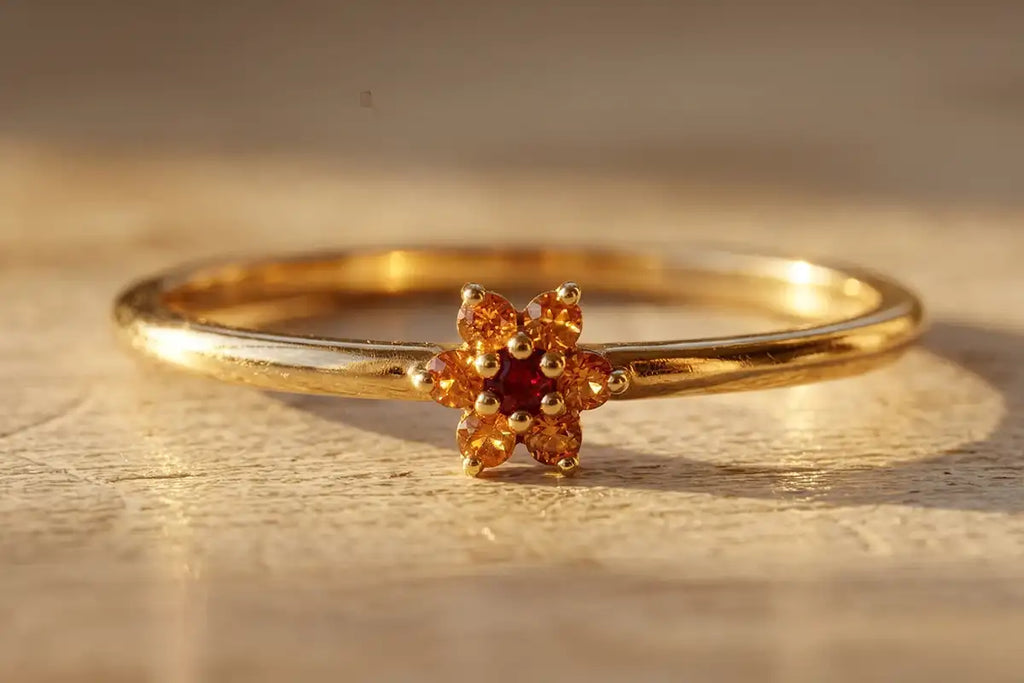
A piece from the Mayuri Sunset Sapphire collection, 18ct gold
Pukhraj is the Sanskrit and Hindi name for natural yellow sapphire. In the Vedic tradition (Jyotish), it is the stone of Jupiter (Brihaspati), associated with wisdom, prosperity, and mental clarity. In Indian jewellery, the term refers specifically to a natural, unheated yellow sapphire of sufficient quality for astrological use: transparent, free of major inclusions, and weighing at least two carats.
Is yellow sapphire treated?
The majority of yellow sapphires on the market are heated, a common treatment that enhances colour and must be disclosed. "No heat" (unheated) sapphires are rarer and more highly valued in fine jewellery. For absolute certainty, always request a certificate from an accredited laboratory: GIA, GRS, Gübelin, or SSEF.
Which finger should you wear yellow sapphire on?
According to the Vedic tradition, Pukhraj is worn on the index finger (the finger of Jupiter) of the right hand, preferably set in yellow gold. It is traditionally first worn on a Thursday morning, following a moment of conscious intention.
What is the difference between yellow sapphire and topaz?
These are two distinct minerals: sapphire is a corundum (hardness 9 on the Mohs scale), while topaz is an aluminium silicate (hardness 8 on the Mohs scale). Yellow sapphire offers greater resistance to abrasion and is generally rarer and more valuable. In fine jewellery, natural yellow sapphire is widely preferred.
How much does a natural yellow sapphire cost?
Prices range from £250 to £2,600 per carat, depending on origin, colour and treatment. A vivid canary-coloured, unheated Ceylon Sapphire sits firmly at the top of the spectrum. Yellow Sapphire remains significantly less expensive than blue Sapphire of equivalent quality.
Who can wear yellow sapphire?
In jewellery, anyone can wear a yellow sapphire: it is simply a matter of taste and style. Within the Jyotish tradition, Pukhraj is particularly recommended for natives of Sagittarius and Pisces (signs ruled by Jupiter), as well as for those whose Jupiter is weakened in their Vedic natal chart.
Is yellow sapphire rare?
Rarer than blue sapphire, with global production approximately ten times lower. An exceptional-quality unheated yellow sapphire remains a remarkably rare stone. Paradoxically, it remains more accessible in price than a comparable-quality blue sapphire on the Western market.
What is the ruling planet of the yellow sapphire?
Jupiter, known in Sanskrit as Brihaspati and also called Guru (the Master), is the largest planet in our solar system, associated across all traditions with wisdom, expansion, and abundance.