GemologyThe Mayuri Journal26 March 2026
Enriched on 19 August 2026
Gemology
Curating your sapphire palette: Sunset, Horizon, and bespoke creations at Mayuri
The Mayuri sapphire palette: Sunset, Horizon, and the gradients that define our jewellery.
Written by Déborah Baid, Founder · Mayuri ParisReading 9 min8 chapters
What the maison says
What to remember
Place a Kiran Sunset Sapphire ring beside a Noor Horizon Sapphire bracelet. One burns from the centre outward, an ardent orange melting into sunlit yellow. The other brightens gradually, a royal blue dissolving into pure white. Two radically different pieces, one single mineral: corundum. This is the story we want to tell you here.
How can a single mineral travel from midnight blue to pale straw yellow, from near-padparadscha orange to luminous white? And can one compose a personal palette, shaped by a precise memory, a sky seen together, a colour that belongs to you alone?
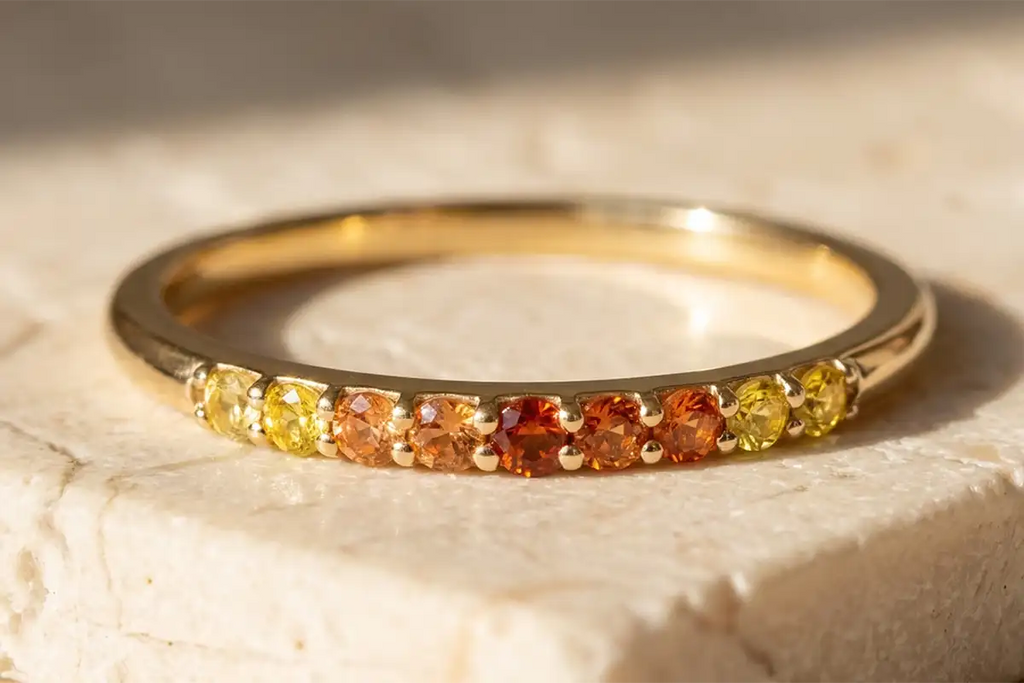
Kiran Sunset Sapphire ring in 18ct yellow gold, gradient from orange to golden yellow
A single mineral, a complete palette
Sapphire is not a stone. It is a name. Corundum (Al₂O₃, aluminium oxide) bears the name "sapphire" whenever its colour is not red. When it is red, it is called ruby. Everything else, virtually the entire visible spectrum, is sapphire.
Colour depends entirely on the trace elements present during the formation of the crystal. Iron and titanium turn corundum blue. Chromium alone produces pink or deep red. Iron alone at high concentration yields yellow. Chromium combined with other colour centres creates orange. And when no trace element enters the crystal lattice at all, corundum remains white, colourless, in its purest state.
What this means is fundamental: blue, orange, yellow and white are all expressions of the same mineral. Not different stones assembled arbitrarily. One and the same crystal, shaped by the minute impurities running through it, telling an entirely different colour story. In this sense, corundum is nature's most complete palette.
Its hardness of 9 on the Mohs scale, second only to Diamond, also makes it an ideal stone for everyday fine jewellery. But it is the chromatic palette that captivates us.
Loose sapphires in a range of colours: orange, blue, white, showcasing the full diversity of a single corundum mineral
Our obsession with light within the stone
It began at a gem market in Chanthaburi, Thailand. Our gemologists were examining a parcel of orange and yellow Sapphires when they noticed something that seemed obvious in the moment, yet had never quite crystallised for us before: the stones progress naturally. From deepest to palest, from most saturated to most delicate. Not an abrupt jump, not a stark contrast; a gentle gradation, as though the mine itself had wanted to tell a story.
A thought struck us: what if we preserved that progression within a single piece of jewellery?
Most jewellers seek to match the stones in a piece as closely as possible, to make them resemble one another. We chose to do the opposite: to read the natural gradation of a mineral and set it into a ring, a bracelet, a pair of hoops. Not to create a decorative effect, but because that progression exists in nature. We do not manufacture it. We preserve it.
This principle has become the gemmological signature of Mayuri. Not different stones assembled by chromatic whim. A single mineral, explored across the full richness of its natural palette. A mineralogical truth transformed into jewellery.
Horizon Sapphire: from royal blue to white dawn
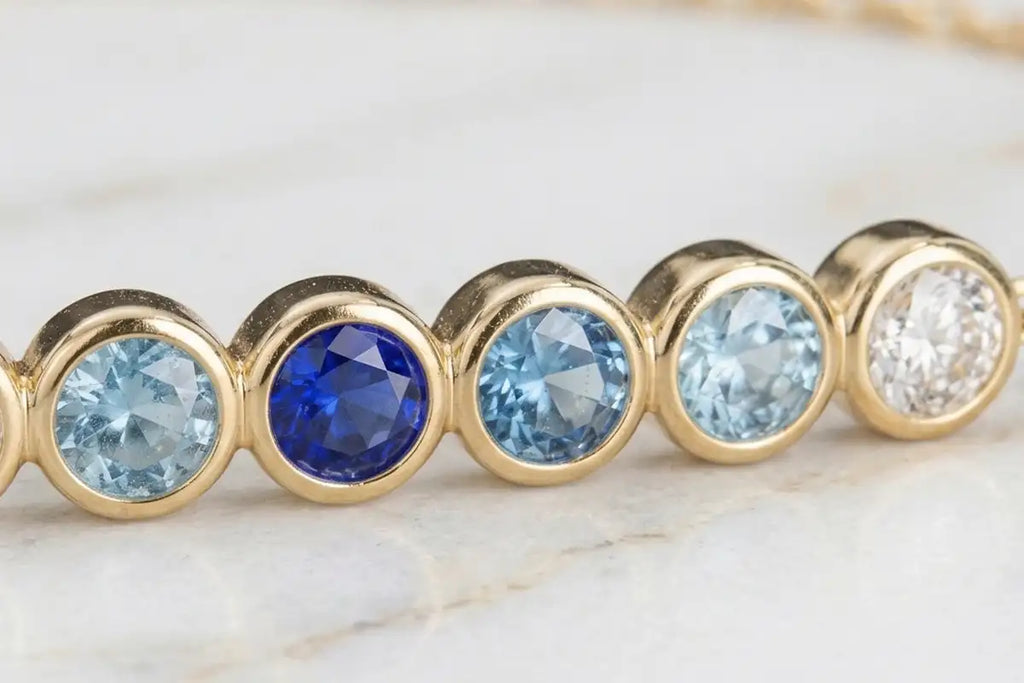
The Horizon palette moves from deep royal blue, rich in iron and titanium, through clear sky blue, all the way to pure white, the corundum in its original state, free from any trace elements. It is a cool gradient evoking the sky at the precise moment when night gives way to day, as black shifts to deep blue, then to washed-out blue, then to the white light of morning.
To compose a Noor Sapphire Horizon bracelet, our gemologists test dozens of blue sapphires before selecting the nine that make up the final palette. Each stone is examined under both natural and artificial light: the progression must be readable to the naked eye in both conditions, without breaks, without tonal jumps. A single stone that is too dark or too light between two neighbours is enough to disrupt the flow, and to produce the patchwork effect we refuse to accept.
The sourcing of Horizon blues is directed toward mines selected for the purity of their blue: no residual violet, no unwanted grey. Simply a frank, clear blue, capable of naturally transitioning toward white without veering into cold, greyish tones.
The white Sapphire that closes the palette deserves its own section. We will return to it.
Noor Horizon Sapphire bracelet, gradient from royal blue to pure white, bezel set in 18ct gold
Sunset Sapphire: from fiery orange to golden yellow
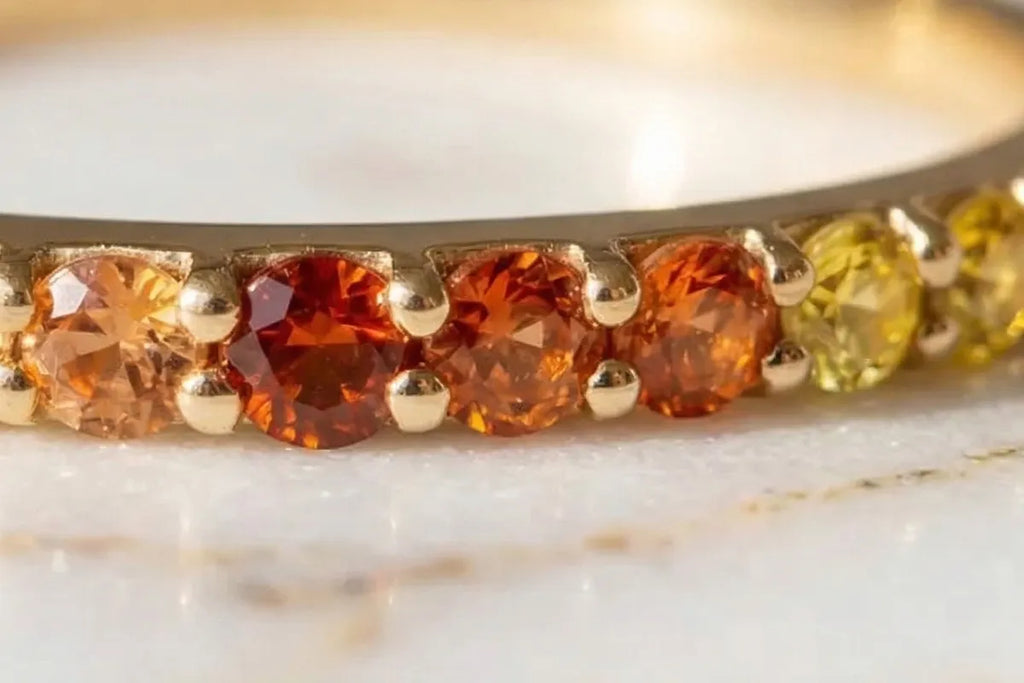
The Sunset palette is the thermal opposite of the Horizon: a warm gradient moving from the deepest orange, close to padparadscha, all the way to sunshine yellow Sapphire. The inspiration is direct: gemologists already use the word "sunset" to describe the most intensely orange, most ardent padparadschas. Mayuri extends this solar metaphor across an entire palette.
Chemically, the Sunset progression tells a precise mineralogical truth. In an orange sapphire, it is the combination of chromium and other colour centres that creates this singular hue. As chromium decreases and iron progressively dominates, the stone tends toward yellow. The Sunset does not choose its colours arbitrarily: it follows the chemistry of corundum.
Our Sunset sapphires come from Chanthaburi, in Thailand, one of the most recognised sources in the world for warm fancy sapphires. The region produces oranges and yellows of exceptional intensity and purity, free from the visible inclusions that compromise lower qualities. The global trend confirms what we had been observing for several years: sunset and orange-pink tones are among the most sought-after in fine jewellery in 2025 and 2026, with padparadscha leading as the most coveted stone on the market.
The Surya, Kiran, Anaya designs and the Lavani hoops carry this palette. Kiran in particular, with its nine sapphires in bezel settings, makes the orange-to-yellow gradient readable in light as well as in near darkness.
Kiran Sunset Sapphire ring, close-up on the 9 sapphires in an orange-to-yellow gradient
White sapphire: light in its purest form
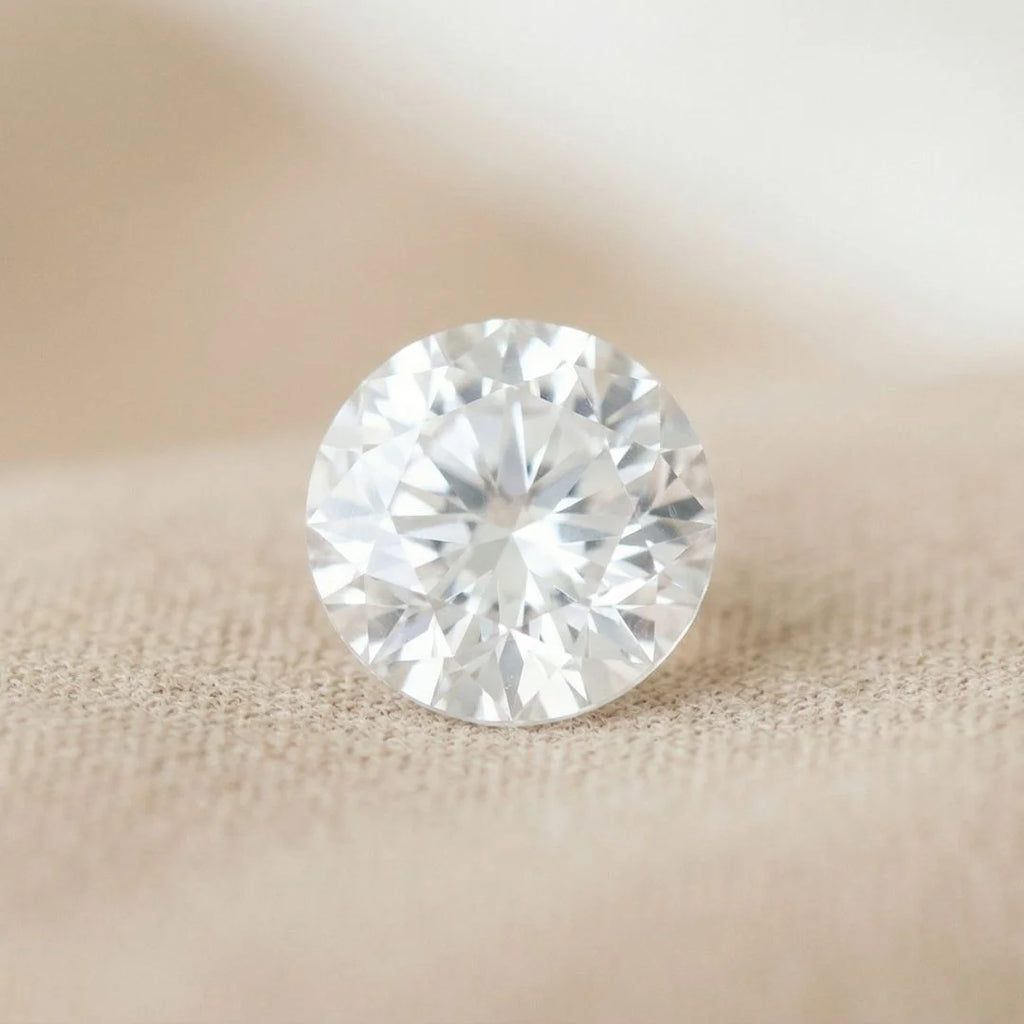
The white Sapphire, or leuco-sapphire (from the Greek leuco, meaning colourless), is corundum in its fundamental state. No trace element has coloured its crystalline structure, no impurity has shifted it toward blue or pink. It is the pure mineralogical foundation of corundum, what the stone is before any colour exists.
There is a persistent misconception: that white Sapphire is a substitute for Diamond, an affordable alternative for those who cannot acquire the original. This is a misreading. White Sapphire does not imitate Diamond. Its refractive index (1.77, compared to 2.42 for Diamond) gives it a different brilliance, softer and slightly pearlescent, one that belongs entirely to its own character. It is not an absence of Diamond. It is a presence of pure light.
In the Horizon palette, the White Sapphire is not a compromise: it is the culmination. When all colour fades, when iron and titanium have vanished from the crystal, what remains is light. It is a mineralogical conclusion as much as an aesthetic one.
Some clients composing their Horizon prefer the gradient to remain entirely chromatic, deep blue, mid blue, pale blue, without ever reaching white. Others seek precisely that final resolution into pure light. Both palettes are possible. This is exactly what bespoke creation allows.
White leucosapphire set on a Mayuri jewel
The art of selecting stones for a palette
Behind every Mayuri gradient jewel lies a process of selection that few ever witness. To build the palette of a nine-Sapphire bracelet, our gemologists may assess as many as thirty or forty stones before selecting those that will form the final progression.
The primary criterion is neither size nor carat weight. It is chromatic coherence. Each Sapphire is observed individually, then compared to its potential neighbours under two lighting conditions: natural light, in which the progression must read with clarity, and artificial light, in which it must neither disappear nor shift. The concept of a "chromatic suite" is central to our method: when we find twenty or thirty Sapphires that progress naturally from one to the next, ideally sourced from the same mine or the same vein, we know we have found the stones for a future jewel.
The risk to avoid is a "break": two adjacent stones whose tonal difference is too pronounced, disrupting the flow of the gradient and creating a sense of discontinuity. A single break is enough to make the jewel read as an assemblage rather than a progression.
The setting plays a precise gemmological role. A closed setting (a claw or tube that encases each stone) protects the colour by preventing stray light from diffusing across the sides of the stone and distorting the reading of the gradient. This is not simply an aesthetic choice; it is a decision that serves the clarity of the palette.
And beyond: violet, pink, teal, and pure padparadscha
Corundum does not end at blue and orange. It exists in violet (vanadium), in pink (chrome at low concentration), in teal (the blue-green of the spectrum's intermediate zone), and in pure padparadscha (orange-pink, the rarest and most coveted shade in the entire family). Each of these colours is a possible expression of one and the same mineral.
The Canopée Emerald completes the Mayuri gradient trilogy: a green gradient moving from deep tsavorite through Emerald and into pale tsavorite. The same approach, the same devotion to natural gradation, applied this time to beryl and garnet. Three gradients, three mineralogical families, one coherent vision.
If all these colours exist in nature, they can exist in your jewel.
Compose your own bespoke palette
If Mayuri can compose Horizon and Sunset, it can compose yours.
Can you envision a deep violet gradient softening into blue, then dissolving into white? A pink-padparadscha-sunshine yellow gradient that tells the story of a particular dawn? A teal-pale blue-white gradient evoking the light of the sea? Our gemologists can source the Sapphires that carry exactly those tones.
The process follows three stages. First, a conversation to define the colours that speak to you: a visual reference, a memory, a shade you have carried in mind for some time. Next, the sourcing of stones from the appropriate mines and markets, with rigorous selection according to our chromatic suite method. Finally, the creation of the piece in our atelier, with the setting and metal chosen to best illuminate your palette.
Composing a palette means creating a piece of jewellery that tells a personal chromatic memory. A sunset witnessed together. A particular quality of morning light. A singular sky. The chemistry of corundum is rich enough to hold all of that.
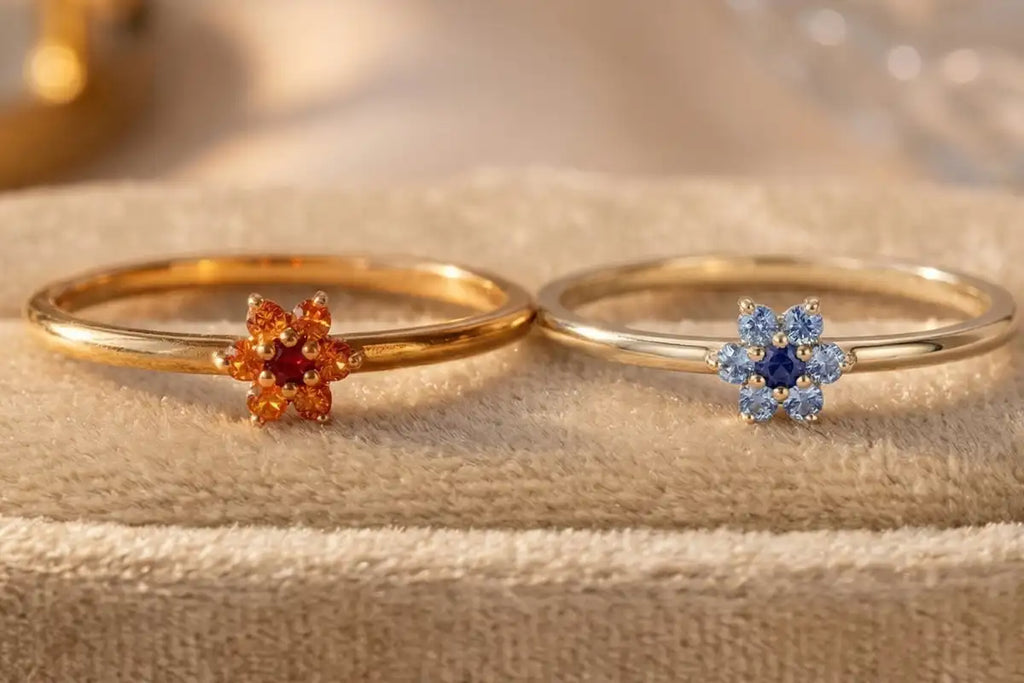
The two Mayuri palettes side by side: Sunset Sapphire (orange to yellow) and Horizon Sapphire (blue to white)
Frequently asked questions
What is the Mayuri Sunset Sapphire?
The Sunset Sapphire is a palette of natural sapphires progressing from deep orange sapphire, close to padparadscha, through mid-tone orange sapphire to sunny yellow sapphire. All the stones are corundum, yet the intensity of colour varies according to the trace elements present in each crystal. The gradient evokes the sky at the close of day.
What is the Mayuri Horizon Sapphire?
The Horizon Sapphire is a palette of sapphires progressing from deep royal blue, rich in iron and titanium, through pale blue to pure white, the purest corundum, free of any trace element. It is a cool gradient evoking the light of dawn, as the sky transitions from night into day.
What is the difference between the Sunset Sapphire and padparadscha?
Padparadscha is a singular sapphire, prized for its precise orange-pink hue: exceptionally rare and highly coveted. The Sunset Sapphire draws its inspiration from it; the deepest orange stone in our palette is the one that comes closest to padparadscha in its warm dominance. Yet the Sunset is a complete palette, from near-padparadscha through to yellow, while padparadscha is a single stone of one fixed colour.
Is white sapphire a true sapphire?
Entirely so. White sapphire, or leuco-sapphire, is pure corundum, free of trace elements, the very same mineral as blue or orange sapphire. It is not a diamond substitute; it is a gemstone in its own right, with its own elegance, a soft brilliance, and exceptional hardness of 9 out of 10 on the Mohs scale.
Can you compose your own sapphire palette as a bespoke creation?
Yes. Our gemologists can source sapphires in the shades that suit you, violet, pink, teal, padparadscha, yellow, and compose a bespoke gradient for your piece. The process begins with a consultation to define your palette, followed by stone sourcing and the creation of the piece in our atelier.
Where do Mayuri's sapphires come from?
Horizon sapphires, in blue, come from mines selected for the purity and depth of their colour. Sunset sapphires, in orange and yellow, are sourced from Chanthaburi in Thailand, one of the world's finest origins for AAA-quality warm fancy sapphires.
Does the Canopée Emerald collection belong to the same family of gradients?
Yes, the Canopée Emerald is the third gradient in the Mayuri signature: a green progression from deep tsavorite through emerald to pale tsavorite. Like Horizon and Sunset, it is built on the principle of a single mineral explored across the full richness of its natural palette.