BirthstonesThe Mayuri Journal17 May 2025
Enriched on 11 March 2026
Birthstones
Ruby: The Birthstone of July
Discover the passion of ruby, July's birthstone, a symbol of love and power that inspires vitality and creativity.
Written by Déborah Baid, Founder · Mayuri ParisReading 4 min12 chapters
What the maison says
What to remember
Ruby is the official birthstone for the month of July, known as ratnaraj in Sanskrit, the "king of precious stones". Long before diamonds claimed that title in the Western imagination, ruby reigned supreme over the world of gems. It is the most valuable coloured gemstone per carat: an exceptional Burmese "pigeon's blood" ruby surpasses even the diamond in value.
Ruby belongs to the corundum family, the hardest mineral after diamond (9 on the Mohs scale), making it an ideal stone for jewellery worn every day. This guide covers everything you need to know: colours, legendary origins (Burma, Mozambique), quality, treatments, pricing, and the Mayuri ruby collection in 18ct gold.
What is the birthstone for July?
The official birthstone for the month of July is the ruby, according to the standardised list established by the American Gem Trade Association (AGTA) and Jewelers of America in 1912.
Ruby is associated with passion, courage and vitality, qualities that make it a deeply meaningful gift for those born in July. Traditionally linked to royalty and power, Burmese kings considered themselves the sacred guardians of the rubies found in the "Valley of Rubies" (Mogok). Across Europe, royal crowns were set with rubies to symbolise divine authority.
History and symbolism of the Ruby
The word "ruby" derives from the Latin rubeus (red). In Sanskrit, ruby is called ratnaraj, "king of precious stones", a title that speaks volumes about its place in human history.
Burmese rubies from Mogok have been mined since at least the sixth century. The kings of Burma held the title of "Lord of Rubies" and no stone could leave the country without their authorisation. In the Hindu tradition, ruby is the stone of the Sun (Surya): it is said to bring protection, success and power to its wearer. Ruby is also the gemstone for 15th and 40th wedding anniversaries in France.
Marco Polo recounts that the King of Ceylon possessed a ruby "as long as a man's palm and as thick as his arm". This was most likely a spinel, as rubies and spinels were frequently confused until the eighteenth century. The famous "Black Prince's Ruby" in the British Crown Jewels is, in fact, a spinel.
Gemological properties of the Ruby
Ruby is a variety of corundum (aluminium oxide, Al₂O₃), the same mineral as Sapphire. The difference? Chromium gives Ruby its red; titanium and iron give Sapphire its blue.
Hardness: 9 on the Mohs scale, just below Diamond (10). The second hardest stone in the world, making it an excellent choice for rings worn every day.
Pleochroism: a Ruby displays two distinct hues depending on the angle of observation (orangey red and purplish red).
UV Fluorescence: Burmese rubies fluoresce naturally under UV light (strong red fluorescence), which intensifies their colour in natural light. Thai rubies, with a higher iron content, do not fluoresce.
"Pigeon's blood": the most coveted colour in the world
"Pigeon blood" (pigeon blood) refers to the most sought-after and valuable Ruby colour: a pure, intense red, free of any brown or violet overtones, with a subtle fluorescence that imparts an inner glow.
Technical definition according to the Gem Research Swisslab (GRS, the only laboratory to have formalised this term): pure dominant red (hue 3–4/6), maximum saturation (vivid), medium to medium-dark tone, with a fluorescence that prevents the stone from appearing dark. Only certified laboratories (GRS, Gübelin, SSEF) may officially assign the designation "pigeon blood"; it is not standardised across all laboratories.
The term is thought to derive from the idea that the ideal red evokes the fresh blood of a newly sacrificed pigeon, an image long used by Burmese traders in Mogok. Burma's "pigeon's blood" rubies are the most prized: the Sunrise Ruby (25.59 ct, Burma) sold for $35 million at Sotheby's Geneva in 2015, setting an absolute record for a coloured gemstone.
A word of caution: the term "pigeon's blood" is sometimes used loosely in the trade. Only a recognised laboratory certificate serves as true proof.
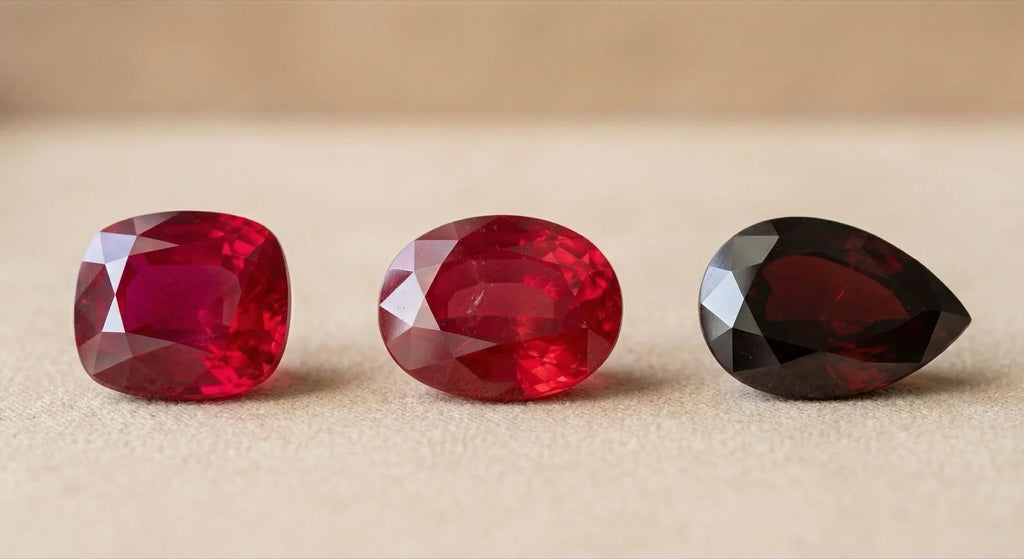
Comparing ruby red hues: Burmese pigeon's blood, medium red and deep red
Burma (Myanmar), Mogok: the legendary benchmark since the 6th century. "Pigeon's blood" rubies of pure red with intense fluorescence. The "Valley of Rubies" in Mogok yields the most prized specimens in the world. Since the 2000s, the Mong Hsu mine has also supplied Burmese rubies, typically heat-treated.
Mozambique (Montepuez): the game-changer of the 21st century. Discovered in 2009, the Montepuez mine (operated by Gemfields) now produces a greater volume of rubies than Burma. The colour is slightly deeper, offering excellent value for money. The finest specimens rival their Burmese counterparts.
Sri Lanka (Ceylon): pink to light red rubies, often reclassified as "pink sapphire" by gemological laboratories. Madagascar: an emerging producer offering rubies in a range of colours, with strong value for money. Thailand (Chanthaburi): historically the world's centre of the ruby trade, producing darker, iron-rich rubies.
Origin
Typical colour
Rarity
Price range ($/ct)
Burma (Mogok)
"Pigeon's blood" red
Exceptional
$6,000 - $36,000+
Mozambique (Montepuez)
Intense red
Moderate
$600 - $6,000
Sri Lanka
Pink to light red
Moderate
$240 - $2,400
Madagascar
Varied
Moderate
$240 - $1,800
Thailand
Deep red
Moderate
$120 - $1,200
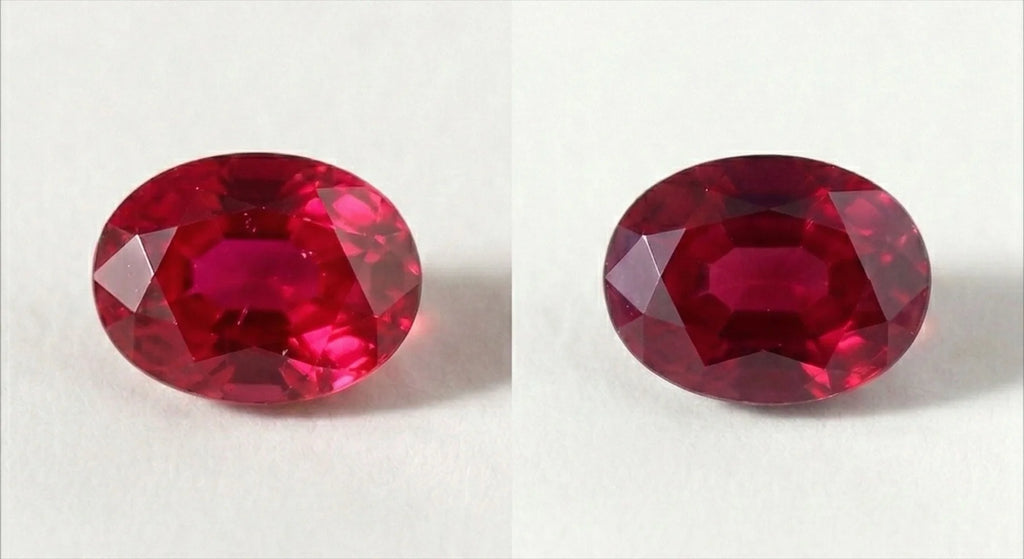
Natural rubies from Burma and Mozambique compared side by side on a neutral background
Ruby and Sapphire: two stones, one family
Ruby and sapphire are, in fact, the very same mineral: corundum (Al₂O₃). Only the trace elements differ. Chromium gives ruby its red, while titanium and iron produce the blue of sapphire. This close kinship remains surprisingly little known to the general public.
By international convention, only red corundum is called "ruby." All other colors (blue, pink, yellow, orange, green, violet) are classified as "sapphires." Both stones share the same physical properties: hardness 9, density ~4.0, trigonal crystal system.
The boundary between ruby and pink Sapphire is a subject of debate: at what level of saturation does pink become red? Each laboratory applies its own criteria. A "pink" ruby according to one lab may be classified as a "pink Sapphire" by another. At Mayuri, we offer jewellery set with both rubies and sapphires: the corundum family is at the heart of our expertise in coloured gemstones.
Understanding Ruby quality
Colour (60–70% of value): the ideal red is a pure, vivid, saturated red, free of brown or orange undertones. Neither too light (which would place it in pink Sapphire territory) nor too dark (a so-called "dead" ruby). The chromium fluorescence intensifies the vibrancy of the red.
Clarity: unlike Diamond, ruby has no universal grading system. Fine inclusions (rutile needles, known as "silk") are accepted and can even enhance the stone's appearance by diffusing light, creating a soft "velvet" effect.
Cut: rubies are cut to optimise colour rather than carat weight. The oval and cushion cuts are the most common, as they maximise the saturation of the red.
Carat weight: rubies over 1 carat are significantly rarer than sapphires of the same size. Prices rise sharply at key thresholds (1 ct, 2 ct, 3 ct, 5 ct).
Unlike Diamond, where the GIA's 4C system is universal, no standardised grading exists for rubies. Each laboratory applies its own criteria. At Mayuri, we select every ruby individually for the saturation and vibrancy of its colour.
Heat treatment: approximately 90% of rubies on the market have been heated to high temperatures (1,200–1,800°C) to enhance colour and clarity. This is a standard practice, widely accepted within the trade, but it must always be disclosed.
"No heat" ruby: a fine-quality unheated ruby is worth two to ten times more than its heated equivalent. The "no heat" designation on a laboratory certificate (GIA, Gübelin, SSEF) is a significant value factor.
Fracture filling (lead-glass filling): a controversial treatment that involves filling the fractures of a low-quality ruby with lead glass to artificially enhance its transparency. These "composite" rubies are worth only a fraction of the price of a natural ruby. They are fragile (sensitive to lemon juice, vinegar, and household cleaners) and are not accepted as genuine rubies within the trade. To learn more, consult the analyses of Lotus Gemology.
Beryllium diffusion: a treatment that alters the colour in depth; it must always be disclosed.
Rubies at Mayuri are heat-treated, offering excellent value for the quality. For bespoke orders, we offer "no heat" rubies on request.
In crystal healing, the Ruby is associated with the root chakra (Muladhara) and the heart chakra (Anahata): it symbolises vital force, passion, and courage.
The Ruby is regarded as a stone of protection, vitality, and passionate love across many traditions (Hinduism, Tibetan Buddhism, and medieval European traditions). In Ayurveda, the Ruby (manikya) is the stone of the Sun (Surya). It is said to bring self-confidence, energy, and success.
A universal symbol of passion and ardent love, the Ruby is a deeply meaningful gift for life's most significant occasions.
Ruby pricing guide in fine jewellery
Ruby prices vary enormously depending on colour, clarity, weight, origin, and treatments. It is the most expensive coloured gemstone per carat.
Commercial Ruby: $120–$600/ct, standard quality, decent colour, often heat-treated
Fine Ruby (Mozambique, Madagascar): $600–$6,000/ct, beautiful colour, good clarity, standard heat treatment
Exceptional Ruby (Burma, no heat): $6,000–35,000+ per carat
For comparison, a fine-quality ruby typically costs two to five times more than a sapphire of equivalent quality. At Mayuri, our ruby jewels in 18ct yellow gold are accessible from approximately $350–600 for styles featuring smaller stones.
Caring for your Ruby jewellery
Ruby is one of the most resilient stones in fine jewellery, with a hardness of 9, second only to the diamond. More durable than emerald or peridot, it withstands minor impacts and temperature variations with greater ease.
Cleaning: warm water, mild soap, and a soft brush. Pat dry with a microfibre cloth.
Ultrasonic cleaner: generally safe for rubies that have not undergone fracture filling, unlike emerald.
Exception: lead glass-filled rubies are fragile. Never expose them to lemon juice, vinegar, bleach, or ultrasonic cleaners.
Ruby is one of the most low-maintenance stones in fine jewellery, an additional reason to choose it as an engagement ring.
The Mayuri collection: Ruby jewellery in 18ct gold
Mayuri offers a collection of ruby jewels: rings, Earrings, necklaces, bracelets, and pendants, all crafted in 18ct gold. The classic ruby collection showcases rubies selected for the saturation and vibrancy of their red, featured in the Shanti, Devi, Sumitra, and Shadi designs. Each design is available in 18ct yellow gold, white gold, and rose gold.
The Mayuri ruby is a natural AAA-quality ruby, individually selected for its colour and heat-treated for an excellent price-to-quality ratio. For bespoke orders, Mayuri also offers Burmese rubies, no-heat rubies, and rubies of a specific cut or origin upon request.
The Ruby is an ideal stone for an engagement ring: hardness 9 (suitable for daily wear), stable colour, and a symbolism deeply rooted in passionate love. A bold alternative to the classic diamond.
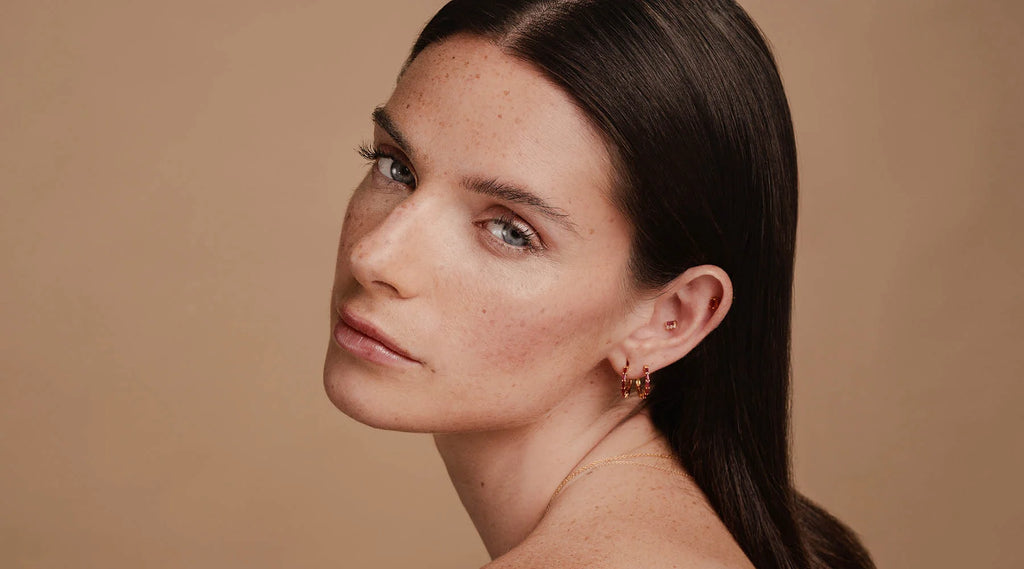
Mayuri ruby ring in 18ct gold with individually set natural ruby
The official birthstone for the month of July is the Ruby, according to the standardised list established in 1912 by the American Gem Trade Association. The red Ruby is the classic and singular choice for those born in July, unlike other months that offer several alternative stones.
What is a "pigeon's blood" Ruby?
"Pigeon's blood" designates the most prized Ruby colour in the world: a pure, intense red, free from brown or violet undertones, with a subtle fluorescence. GRS (Gem Research Swisslab) is the leading laboratory to have formalised this classification. Only a certificate issued by a recognised laboratory can confer this designation.
What is the price of a natural Ruby?
Prices vary considerably depending on colour, clarity, carat weight, and origin. A commercial-grade Ruby falls between $120 and $600 per carat. A fine Mozambican Ruby ranges from $600 to $6,000 per carat. Burmese "pigeon's blood" Rubies exceed $18,000 per carat. The all-time record stands at $30.3 million for the Sunrise Ruby (25.59 ct).
What is the difference between a Ruby and a Sapphire?
The Ruby and the Sapphire are two varieties of the same mineral: corundum (Al₂O₃). Red corundum is called Ruby, its colour produced by chromium, while all other colours are classified as Sapphires. The Sapphire is the birthstone for September.
How to recognize a genuine Ruby?
A natural Ruby is distinguished by its inclusions (rutile needles, known as "silk"), its UV fluorescence (vivid red in Burmese stones), its refractive index (1.762 to 1.770), and its hardness (9 on the Mohs scale). A certificate from a recognised laboratory (GIA, Gübelin, SSEF) is the only reliable guarantee. Exercise caution with lead-glass filled Rubies, which are widespread and sold at very low prices.
Where do the finest Rubies come from?
The most highly valued Rubies originate from Mogok, Burma, renowned for its "pigeon's blood" stones. Mozambique, with the Montepuez mine operated by Gemfields, has become the world's leading source by volume, producing exceptional specimens. Sri Lanka, Madagascar, and Thailand are also well-regarded origins.
What are the virtues of the Ruby?
In crystal healing, the Ruby is associated with vitality, passion, and courage. It is traditionally connected to the root chakra, grounding energy, and to the heart chakra, the seat of passionate love. In Ayurveda, it is considered the stone of the Sun.
How to care for a Ruby jewel?
The Ruby is one of the easiest gemstones to care for. Clean it with warm water, mild soap, and a soft brush. Ultrasonic cleaning is generally safe for Rubies that have not been fracture-filled. Avoid sharp impacts. Lead-glass filled Rubies are fragile and should never be exposed to acids or ultrasonic cleaners.
Is the Ruby suited for an engagement ring?
Yes, the Ruby is an excellent alternative to the Diamond for an engagement ring. Its hardness of 9 on the Mohs scale, second only to the Diamond, makes it far more durable than most coloured stones for daily wear. Its red colour is a timeless symbol of passion and ardent love.