BirthstonesThe Mayuri Journal17 May 2025
Enriched on 11 March 2026
Birthstones
Sapphire: The September Birthstone
Sapphire, the birthstone of September: history, symbolism and meaning in our jewelry.
Written by Déborah Baid, Founder · Mayuri ParisReading 4 min13 chapters
What the maison says
What to remember
Sapphire is the birthstone for the month of September, a symbol of wisdom, loyalty and nobility since Antiquity. It is also the most popular gemstone for engagement rings after the diamond, immortalised by the iconic ring worn by Lady Diana and later by Kate Middleton in 2010.
Sapphire belongs to the corundum family, the hardest mineral after diamond (9 on the Mohs scale), making it an ideal stone for everyday fine jewellery. This guide covers everything you need to know: colours, origins, quality, treatments, prices, and the Mayuri Sapphire collection with its signature colour gradients.
What is the birthstone for September?
The official birthstone for September is Sapphire, according to the standardised list established by the American Gem Trade Association (AGTA) and Jewelers of America in 1912.
Sapphire is associated with wisdom, sincerity and fidelity, virtues that make it an ideal gift for those born in September. Traditionally linked to royalty and the clergy, cardinals wore a sapphire on their right ring finger, and the kings of France set it within their crowns.
History and symbolism of the Sapphire
The word "sapphire" derives from the Latin sapphirus and the Greek sappheiros, meaning "precious blue stone". Historians believe the Ancients were in fact referring to lapis lazuli.
Sapphire is a symbol of divine wisdom in many traditions: the Persians believed the sky was an immense sapphire whose reflection coloured the heavens, and the Talmud mentions the Tablets of the Law engraved on sapphire. Since the Middle Ages, it has been the stone of kings and cardinals, adorning the royal crowns of Europe.
Sapphire is the gemstone of the 5th and 45th wedding anniversaries in France.
In 1981, Prince Charles presented Lady Diana with a 12-carat oval sapphire from Sri Lanka, surrounded by 14 diamonds. This ring became the most famous piece of jewellery in the world. In 2010, Prince William gave it to Kate Middleton, reigniting the trend for sapphire engagement rings.
Gemological properties of the Sapphire
Sapphire is a variety of corundum (aluminium oxide, Al₂O₃), the same mineral as Ruby. The difference? Chromium gives Ruby its red; titanium and iron give Sapphire its blue.
Hardness: 9 on the Mohs scale, just below Diamond (10). Excellent for rings worn daily, including engagement rings.
Pleochroism: a blue Sapphire displays two distinct shades depending on the angle of observation (violet-blue and greenish-blue).
Sapphire is the second hardest gemstone after Diamond; in fine jewellery, only a Diamond can scratch it.
The colors of Sapphire: far beyond blue
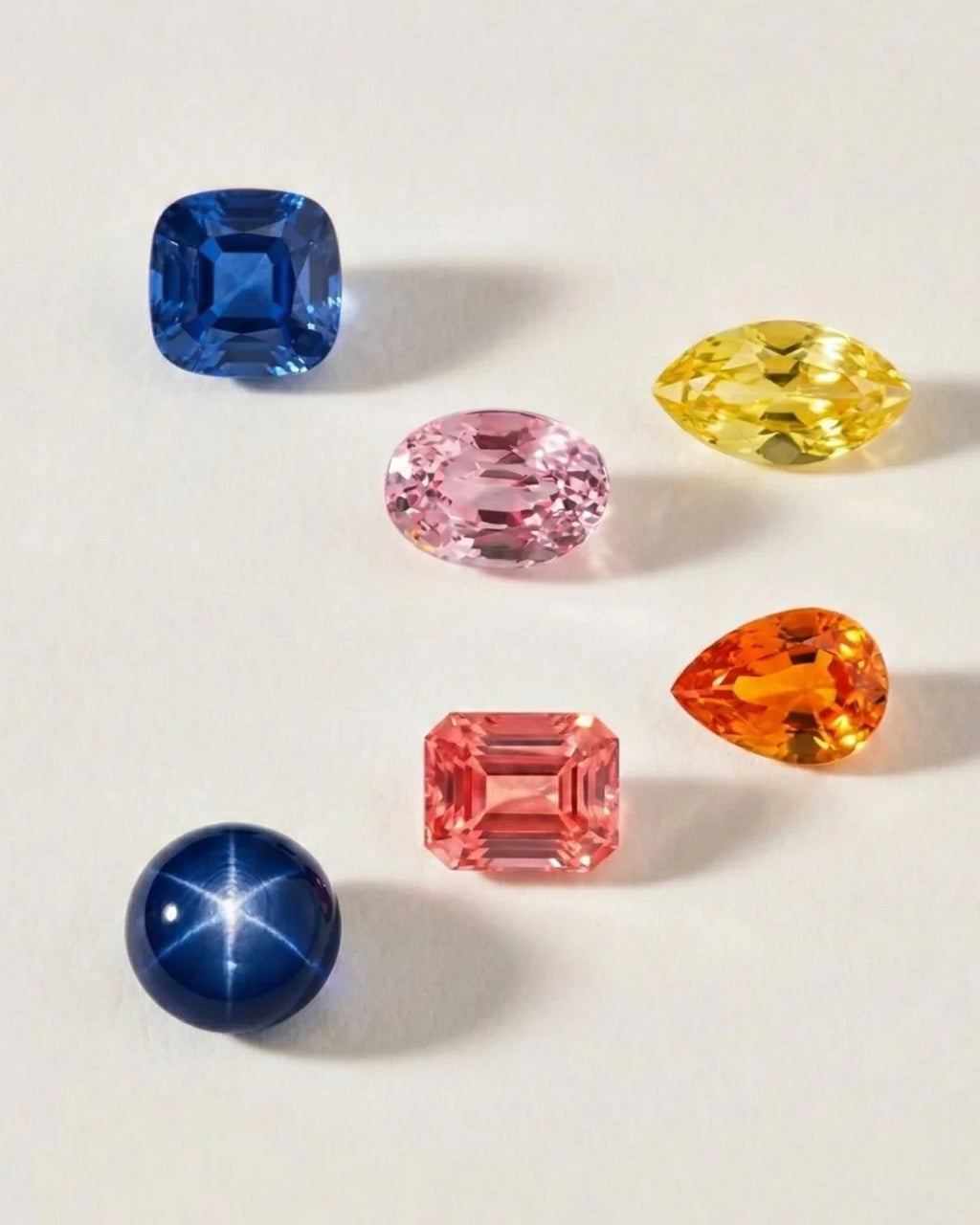
Sapphire exists in every colour except red (which is Ruby): blue, pink, yellow, orange, green, violet, and colourless (White Sapphire). All colours beyond blue are known as "fancy sapphires."
Blue Sapphire: the most classic and sought-after colour. The ideal blue is a rich, saturated cornflower blue, neither too deep nor too dark.
Pink Sapphire: highly coveted as an engagement ring stone, with prices steadily rising in recent years.
Yellow and orange Sapphire: warm, radiant hues ranging from bright lemon yellow to deep, vivid orange. These are the shades featured in the Mayuri Sunset Sapphire gradient collection.
Padparadscha Sapphire: the rarest of all. Its colour blends pink and orange in a delicate balance, reminiscent of the lotus blossom (from the Sinhalese padma raga). Laboratories (GIA, SSEF, Gübelin) differ on the exact definition of this hue. Exceptional specimens exceed $12,000 per carat.
Star Sapphire: the asterism phenomenon, in which a six-rayed star appears on the surface, created by needle-like rutile inclusions in an oriented arrangement.
The Sapphire color palette: blue, pink, yellow, orange, padparadscha and star sapphire
The origins of Sapphire: from Kashmir to Madagascar
Kashmir (India): the legendary benchmark. A uniquely "velvety" blue, produced by microscopic rutile inclusions that scatter light. The last significant production dates to around 1880. Existing specimens achieve $18,000 to $60,000+ per carat at auction.
Sri Lanka (Ceylon): the world's oldest continuous source, with over 2,000 years of mining history. Ceylon Sapphires are light blue and luminous, with a delicate violet undertone. Diana's ring features a Ceylon Sapphire.
Burma (Myanmar): intense "Royal Blue" Sapphires with exceptional saturation. The "Royal Blue" designation is used by the Gübelin laboratory and GRS as a benchmark of quality.
Madagascar: a major producer since the 2000s, offering excellent value for money and an remarkably diverse range of Sapphire colours.
Montana (USA): unique "teal" Sapphires (blue-green), highly sought after by contemporary designers.
Australia: deep blue Sapphires, often with very high saturation. A historically significant source of production.
Origin
Typical Colour
Rarity
Price Range (USD/ct)
Kashmir
"Velvet" blue
Extreme
$18,000 - $60,000+
Sri Lanka (Ceylon)
Luminous blue
Moderate
$1,200 - $6,000
Burma
Intense "Royal Blue"
High
$2,400 - $12,000
Madagascar
Varied
Moderate
$350 - $2,400
Montana
Teal blue-green
High
$600 - $3,600
Australia
Deep blue
Moderate
$250 - $1,200
Sapphire and Ruby: two stones, one family
The Sapphire and the Ruby are precisely the same mineral: corundum (Al₂O₃). Only the trace elements differ: chromium gives ruby its red, while titanium and iron give sapphire its blue.
This relationship is a little-known fact among the general public. By convention, only red corundum is called "ruby"; all other colours are "sapphires." Both stones share the same physical properties: hardness 9, density approximately 4.0, trigonal crystal system.
At Mayuri, we offer jewellery set with rubies and sapphires. The corundum family lies at the heart of our expertise in coloured gemstones.
Understanding the quality of a Sapphire
Colour (60–70% of the value): the ideal blue is a medium to medium-dark blue, vivid and saturated, with no grey zones or overly dark centre. GRS and Gübelin use the designation "Royal Blue" for the finest specimens.
Clarity: unlike diamonds, sapphires have no universal grading system. Fine inclusions (rutile needles, known as "silk") are accepted and can even enhance colour by diffusing light.
Cut: sapphires are cut to optimise colour, not carat weight. A skilled cutter seeks the right balance between saturation and brilliance.
Carat Weight: prices increase significantly from 1 carat onward, then in tiers (2 ct, 3 ct, 5 ct).
Unlike diamonds, where the GIA 4C system is universal, there is no standardised grading for sapphires. Each laboratory applies its own criteria. At Mayuri, we select every sapphire individually for the saturation and vibrancy of its colour.
Heat treatment: 80 to 90% of sapphires on the market have been heated to high temperatures (1,200–1,800°C) to enhance colour and clarity. This is a standard practice, accepted within the trade, but must be disclosed.
"No heat" Sapphire: a fine-quality unheated sapphire is worth 2 to 5 times more than its heated equivalent. The mention of "no heat" on a laboratory certificate (GIA, Gübelin, SSEF) is a major distinction.
Beryllium Diffusion: a controversial treatment that alters colour deep within the stone by diffusing an element (beryllium) into the crystal. Used to create vivid orange or yellow Sapphires from pale stones. This treatment must be disclosed without exception.
Surface Diffusion: a shallower treatment that colours only the surface of the stone. Detectable by immersion. To learn more about treatments, consult the resources of Lotus Gemology.
The Sapphires featured at Mayuri are heated, offering an exceptional quality-to-price ratio. For bespoke orders, we offer "no heat" Sapphires upon request.
Horizon Mayuri collection Sapphire ring in 18K gold, with a deep blue to White Sapphire gradient
In crystal healing, the blue Sapphire is associated with the throat chakra (Vishuddha): it encourages communication, mental clarity, and meditation.
The Sapphire is regarded as a stone of wisdom, truth, and spiritual protection across many traditions, including Hinduism, Buddhism, and Christianity.
In Ayurveda, the blue Sapphire (neelam) is the stone of Saturn (Shani). It is said to bring discipline, patience, and stability. The pink Sapphire is associated with love and compassion, while the yellow Sapphire is linked to prosperity and joy.
A guide to Sapphire pricing in fine jewellery
Sapphire prices vary considerably depending on colour, clarity, weight, origin, and treatment.
Commercial Sapphire: $120–$600/ct, standard quality, acceptable colour, typically heated
Fine Sapphire (Ceylon, Madagascar): $1,200–$6,000/ct, beautiful colour, good clarity, standard heating
Exceptional Sapphire (Burma, Ceylon no heat): $6,000–$18,000/ct
Kashmir Sapphire: $18,000–$60,000+ per carat, extreme rarity, historic specimens
Padparadscha: $6,000–$36,000+ per carat, depending on colour and weight
For context, a fine-quality Sapphire typically costs two to five times less than a Ruby of equivalent quality, and three to ten times less than a Diamond of the same size.
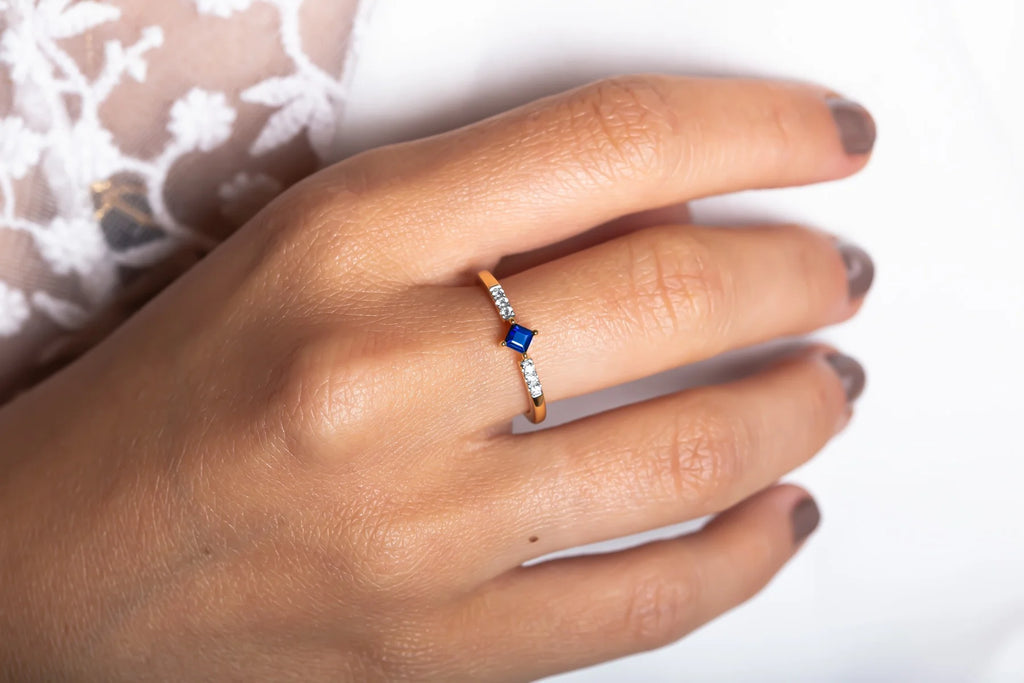
At Mayuri, Sapphire jewellery is available in 18K gold, from classic blue Sapphire to our signature Horizon and Sunset gradients.
Sapphire engagement rings: the legacy of Lady Diana
Sapphire is the most popular non-diamond engagement stone in the world, thanks to the iconic ring worn by Lady Diana (1981) and later by Kate Middleton (2010).
This ring, featuring a 12-carat oval Ceylon Sapphire surrounded by 14 Diamonds, set in white gold, was created by jeweller Garrard for the sum of £28,000 at the time.
Sapphire offers genuine advantages for an engagement ring: a hardness of 9 (ideal for everyday wear), stable colour (which does not alter over time), a symbol of fidelity. Unlike a Diamond, Sapphire brings a touch of colour and personality. Pink and Padparadscha Sapphires are increasingly sought after for engagement jewellery.
Mayuri Sapphire jewellery in 18K gold is designed to last: the hardness of Sapphire protects the stone in everyday wear.
Caring for your Sapphire jewellery
Sapphire is one of the most durable stones in fine jewellery, with a hardness of 9, second only to Diamond. More resistant than Emerald or peridot, it better withstands light impacts and temperature variations.
Cleaning: warm water, mild soap, and a soft brush. Dry with a microfibre cloth.
Ultrasonic cleaner: generally safe for unfractured Sapphire, unlike Emerald
To avoid: severe impacts (sharp edges, falls on hard surfaces), prolonged exposure to harsh chemicals
Sapphire is one of the easiest gemstones to care for in fine jewellery, yet another reason to choose it for an engagement ring.
The Mayuri collection: Sapphire jewellery in 18K gold
Mayuri offers a wide collection of Sapphire jewellery: rings, Earrings, necklaces, bracelets and pendants, all crafted in 18K gold.
Classic Sapphire Collection: blue sapphires selected for the saturation and vibrancy of their colour. Exclusive Mayuri designs: Kali, Shanti, Devi, Surya, Anaya, Kiran...
Horizon Sapphire Collection: Mayuri's signature gradient, blending deep blue sapphire into pale blue and then White Sapphire. Three shades of blue seamlessly fused in a natural gradient inspired by marine horizons. An exclusive jewellery creation that showcases the chromatic diversity of Sapphire.
Sunset Sapphire Collection: a gradient moving from deep orange sapphire to mid-orange and then yellow sapphire. A sunset captured in precious stones, highlighting fancy sapphires in a warm gradient. A signature Mayuri piece impossible to find anywhere else.
For bespoke orders, Mayuri also offers pink sapphires, padparadscha (subject to availability) and unheated sapphires upon request.
Sunset Mayuri collection Sapphire ring in 18K gold, with an orange to yellow gradient
The official birthstone for the month of September is Sapphire, according to the standardised list established in 1912 by the American Gem Trade Association. Blue sapphire is the classic choice, but all Sapphire colours (pink, yellow, orange, green, padparadscha) are original alternatives for those born in September.
What is the price of a natural Sapphire?
Prices vary enormously depending on colour, clarity, weight and origin. A commercial-quality Sapphire ranges from $120 to $600 per carat. A fine Ceylon Sapphire costs between $1,200 and $6,000 per carat. The most exceptional Kashmir sapphires exceed $18,000 per carat.
What is the finest color of Sapphire?
The ideal blue is a medium to medium-dark, vivid and saturated hue, sometimes described as "cornflower" or "Royal Blue" by gemological laboratories. Yet pink, padparadscha and yellow sapphires also hold considerable value and are increasingly sought after. The The "best" colour depends on your personal preferences.
What is the difference between Sapphire and tanzanite?
Sapphire (corundum) has a hardness of 9 on the Mohs scale and is found in many countries. Tanzanite (zoisite) has a hardness of 6.5 and is found exclusively in Tanzania. Sapphire is harder and better suited to rings worn on a daily basis. Tanzanite is the birthstone for December.
What is a padparadscha sapphire?
Padparadscha is the rarest variety of Sapphire. Its name comes from Sinhalese and refers to the colour of the lotus flower: a delicate blend of pink and orange. Exceptional specimens exceed $12,000 per carat. Laboratories such as GIA, SSEF, and Gübelin have no universal definition for this hue.
Are sapphire and ruby the same stone?
Yes, Sapphire and Ruby are two varieties of the same mineral: corundum (Al₂O₃). Red corundum is called Ruby, coloured by chromium, while all other colours are classified as Sapphires. Ruby is the birthstone for July.
How can you tell if a sapphire is genuine?
A natural Sapphire is distinguished by its inclusions, such as rutile needles known as "silk", its refractive index of 1.762 to 1.770, and its hardness of 9 on the Mohs scale. A certificate from a recognised laboratory (GIA, Gübelin, or SSEF) is the only reliable guarantee. Synthetic Sapphires exist and are chemically identical to natural ones; only a trained gemologist with the proper equipment can tell them apart.
How do you care for a sapphire jewel?
Sapphire is one of the easiest gemstones to care for. Clean it with lukewarm water, mild soap, and a soft brush. Ultrasonic cleaning is generally safe for unfractured Sapphires. Avoid hard knocks and exposure to harsh chemicals.