

What to remember
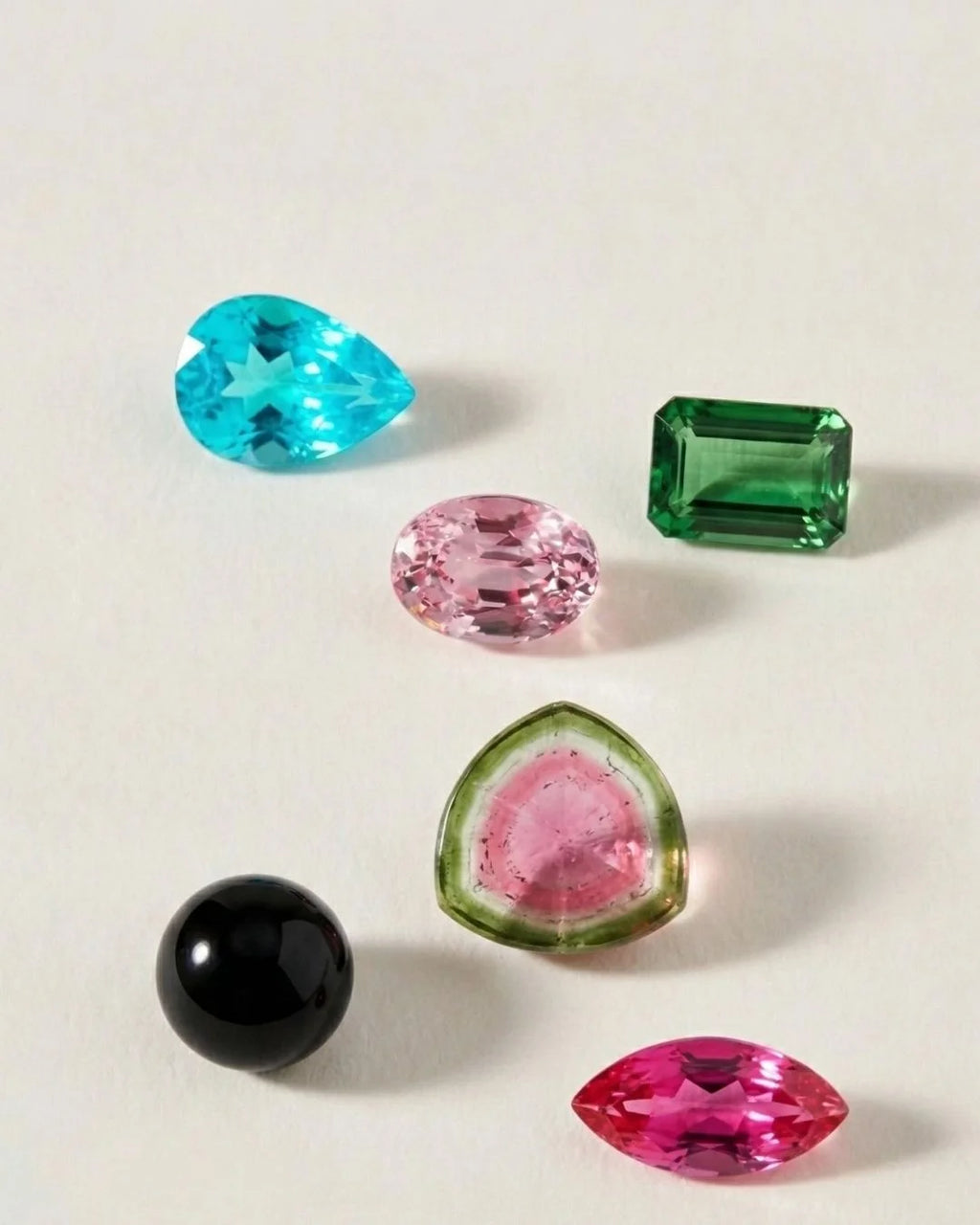
Tourmaline is the official birthstone of the month of October, alongside opal. Its name comes from the Sinhalese turmali, meaning "stone of mixed colours," and this etymology says it all. It is the gemstone with the widest colour palette in nature: pink, green, neon blue (Paraiba), bicolour "watermelon," black, red rubellite, yellow, and violet.
The price range between varieties is the most spectacular of all gemstones: a common green tourmaline costs around $25/ct, while a Brazilian Paraiba can reach $95,000/ct. This guide covers everything you need to know: a colour overview, the legend of the Paraiba, unique properties (pyroelectricity), origins, opal as an alternative, and Mayuri tourmaline jewellery.
What is the birthstone for October?
The official birthstones for the month of October are tourmaline and opal, according to the AGTA/Jewelers of America list. Tourmaline is the modern choice (added in 1912), while opal is the traditional choice.
Tourmaline is better suited to everyday jewellery thanks to its hardness of 7 to 7.5 on the Mohs scale. Opal, with a hardness of 5.5 to 6.5, is more fragile and sensitive to dehydration. A stone of protection and inspiration, tourmaline is associated with creativity and open-mindedness.
History and symbolism of tourmaline
Tourmaline has long been mistaken for other gemstones. The famous "Caesar's Ruby" from the Russian royal crown is in fact a red tourmaline (rubellite).
In 1703, Dutch merchants brought back from Ceylon a stone that "attracts ashes" when heated. They named it aschentrekker ("ash puller"). This was the first documented observation of tourmaline's pyroelectricity.
The etymology comes from the Sinhalese turmali, meaning "stone of mixed colours": the Sri Lankans made no distinction between tourmaline and other coloured gemstones. A symbol of creativity and tolerance in contemporary tradition, the remarkable diversity of tourmaline's colours makes it a metaphor for openness. It is also the 8th anniversary stone for marriage.
The rainbow of tourmalines: every colour
Tourmaline has the most complex chemistry of any gemstone. Its formula contains more than ten elements, which accounts for its uniquely vast colour range.
Pink Tourmaline (elbaite): the most popular variety in fine jewellery. Ranging from soft pastel pink to vivid pink (known as rubellite when deeply red). Rubellite retains its colour under incandescent light, while pastel pink tourmaline tends to shift toward brown.
Green Tourmaline (elbaite, chrome tourmaline): from pale green to deep forest green. Chrome tourmaline, coloured by chromium just like emerald, displays a more vivid, more prized green.
Paraiba Blue Tourmaline: the star of the family, explored in detail in the following section.
Watermelon Tourmaline: a pink heart encased in a green rind. These spectacular crystals are widely shared across social media.
Black Tourmaline (schorl): 95% of all tourmaline found in nature is black. Popular in crystal healing for its protective properties, it can also make for an elegant, understated jewel.
Bicolour/polychrome tourmaline: natural crystals combining two or three colours within a single stone.
Paraiba tourmaline: the most electrifying gemstone in the world
In 1989, Brazilian miner Heitor Dimas Barbosa discovered, in the São José da Batalha mine (State of Paraíba, Brazil), a tourmaline of a neon blue never seen before. A revolution in the world of coloured gemstones had begun.
This singular electric colour is due to copper, an element rarely found in tourmalines. The neon blue-green of the Paraiba is inimitable and instantly recognisable.
From the 2000s onward, copper-bearing tourmalines were discovered in Mozambique and Nigeria. The debate has since been heated: can a tourmaline that does not come from Brazil truly be called a "Paraiba"? The LMHC (Laboratory Manual Harmonisation Committee) says yes, provided it is copper-bearing (coloured by copper) and of its characteristic neon hue.
Brazilian Paraiba tourmalines reach $60,000 to $95,000 per carat for exceptional specimens. African Paraiba stones (from Mozambique) are more accessible, ranging from $600 to $6,000 per carat for fine quality. Paraiba is the coloured gemstone that has seen the greatest appreciation in value over the past 30 years.
Gemological properties of tourmaline
Tourmaline is not a single mineral but a mineralogical group encompassing several species: elbaite (the most common in fine jewellery, available in pink, green, and blue), dravite (brown), schorl (black), liddicoatite (Madagascar), and uvite.
- Hardness: 7 to 7.5 on the Mohs scale, offering good durability for jewellery, though care should be taken to avoid impacts (it is more fragile than Sapphire or Ruby).
- Crystal system: trigonal. Density: 3.02 to 3.26 g/cm³. Refractive index: 1.624 to 1.644.
- Pleochroism: tourmaline displays distinctly different colours depending on the viewing axis. The cutter must orient the stone to showcase its finest colour.
- Pyroelectricity: tourmaline generates an electric charge when heated. It is one of the rare minerals to possess this property.
- Piezoelectricity: tourmaline also generates electricity under pressure, a quality used in scientific instruments.
To explore the properties of this gemstone in greater depth, please consult the full GIA guide on tourmaline.
The origins of tourmaline
Brazil: the historic source of tourmalines in every colour. The state of Minas Gerais produces pink and green tourmalines, while the state of Paraiba yields the Paraiba of legendary origin.
Mozambique and Nigeria: major sources of copper-bearing tourmalines ("African Paraiba") since the 2000s. Production is more abundant than in Brazil, with more accessible price points.
Afghanistan: high-quality pink and green tourmalines, from the Kunar and Nuristan deposits.
Madagascar: spectacular liddicoatite tourmalines (polychrome cross-section slices), as well as green and pink tourmalines.
Sri Lanka: the historic source from which the name turmali originates, known for yellow and brown tourmalines.
United States (Maine, California): historic deposits, prized collector's tourmalines. The Tourmaline Queen mine in California has yielded many celebrated specimens.
The virtues and benefits of tourmaline
Black tourmaline (schorl): in crystal healing, it is the stone of protection above all others. Associated with grounding, the absorption of negative energies and electromagnetic protection.
Pink tourmaline: associated with love, compassion and emotional healing. The stone of the heart chakra (Anahata).
Green tourmaline: associated with vitality, prosperity and renewal. The stone of the heart chakra as well.
Watermelon Tourmaline: a combination of pink (love) and green (vitality) energies, for a harmonious emotional balance.
Opal: the second birthstone of October
Opal is the traditional birthstone for October, before tourmaline was added in 1912. Its unique characteristic is the "play of colour" (opalescence): flashes of rainbow colours that dance across the surface, created by the diffraction of light within a structure of silica microspheres.
Opal is more fragile than tourmaline, with a hardness of 5.5 to 6.5 on the Mohs scale and a sensitivity to dehydration that can cause cracking in very dry environments. The main sources are Australia (White Opal, Black Opal from Lightning Ridge), Ethiopia (Welo Opal), and Mexico (Fire Opal).
For everyday jewellery, tourmaline is a more durable alternative to opal. Mayuri can create a piece with the stone of your choice as part of a bespoke project.
How to choose a quality tourmaline
Colour (the foremost criterion): look for saturation and vibrancy. For pink, a true, clear pink with no brown undertones. For green, a vivid green with no grey areas. For Paraiba, a saturated neon blue-green.
Clarity: pink tourmalines are generally cleaner than green ones. "Veil" or "feather" inclusions are common in green tourmalines.
Cut: favour a cut that enhances the colour. Elongated cuts such as emerald cut and baguette cut are classic choices.
Be mindful of pleochroism: a poorly cut tourmaline may appear too dark along one axis. The cutter must orient the stone correctly.
Our recommendation: a laboratory certificate (GIA, Gübelin) is advised for Paraiba stones and pieces exceeding 2 carats.
A guide to tourmaline prices in fine jewellery
The price gap between tourmaline varieties is the most striking of all gemstones:
- Black Tourmaline: $6 to $35 per carat, the most affordable variety (and also the most common)
- Common Green Tourmaline: $25 to $120 per carat, the most accessible of the coloured varieties
- Pink Tourmaline: $60 to $600 per carat, depending on saturation and clarity
- Watermelon Tourmaline: $60 to $600 per carat, depending on the quality of the bicolour zoning
- Rubellite (deep red): $240 to $1,200 per carat for fine-quality stones
- Chrome Tourmaline: $360 to $1,200 per carat for vivid green specimens
- Paraiba (Mozambique/Nigeria): $600 to $6,000 per carat
- Paraiba (Brazil, origin): $6,000 to $95,000 per carat; exceptional specimens rival coloured diamonds
For context, tourmaline offers an excellent colour-to-price ratio compared to Sapphire or Ruby, particularly for non-Paraiba varieties.
Caring for your tourmaline jewellery
With a hardness of 7 to 7.5 on the Mohs scale, tourmaline is more resistant than peridot or opal, yet more delicate than Sapphire (9) or Ruby (9). It does require a few precautions.
- Cleaning: warm water, mild soap, and a soft brush. Pat dry with a microfibre cloth.
- To avoid: ultrasonic cleaners (risk of cracking in included stones), steam, and chemical products
- Thermal shock: avoid exposure to sudden temperature changes, as tourmaline may crack
- Storage: keep separate from harder stones (Sapphire, Diamond) to prevent scratching. Use an individual pouch
Create your custom tourmaline jewel with Mayuri
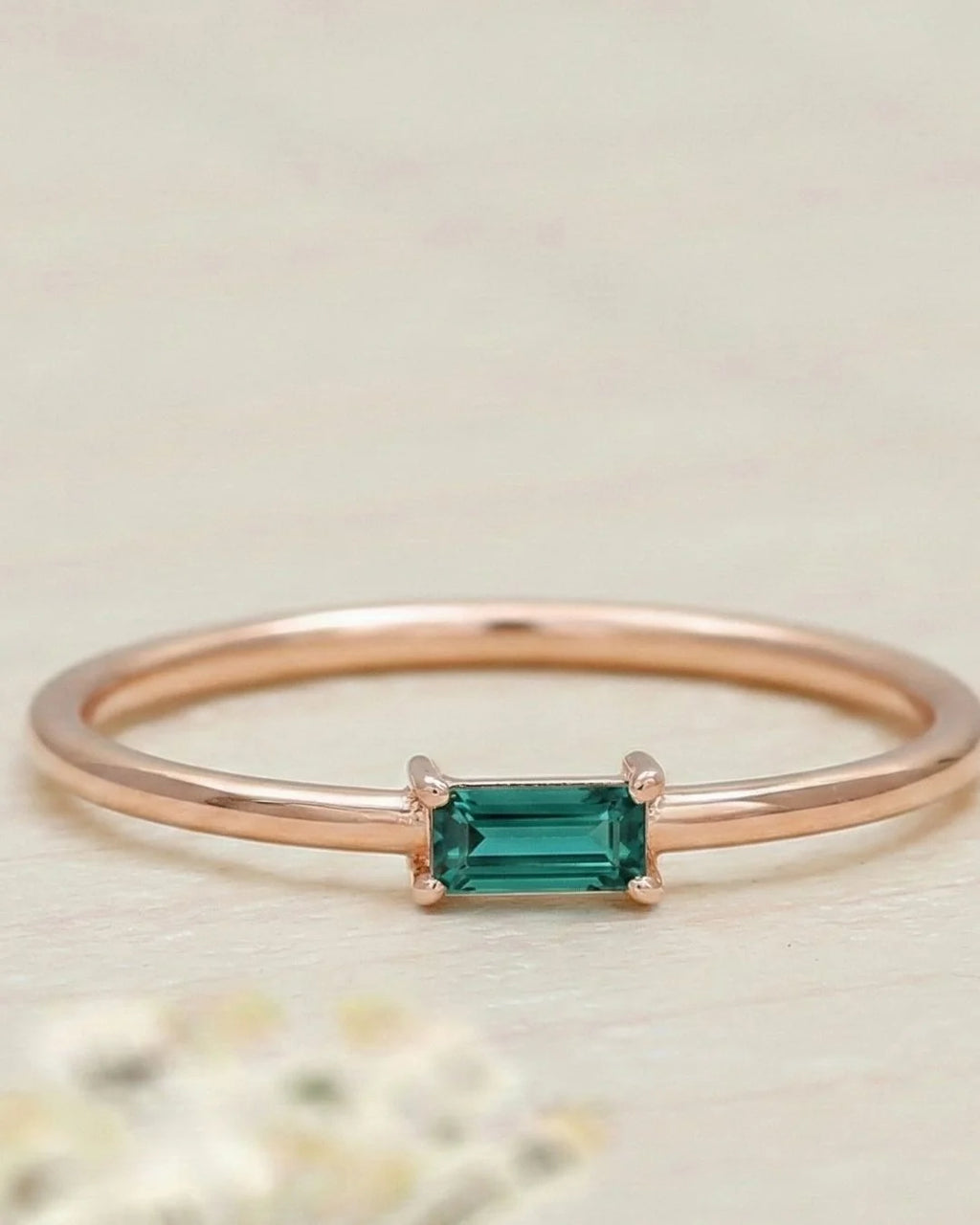
Our atelier creates bespoke tourmaline jewellery in 18ct gold (yellow, rose, and white). Each tourmaline is selected for the vibrancy of its colour and the quality of its cut.
Contact our team to define your project: choice of tourmaline (vivid pink, chrome green, watermelon bicolour), setting, and metal. Tourmaline pairs particularly beautifully with 18ct rose gold, which creates a soft contrast with green tourmalines, and with yellow gold, in warm harmony with pink tourmalines.
For a Paraiba, Mayuri can source this exceptional gem as part of a truly exceptional bespoke project.
Frequently asked questions
What is the birthstone for October?
The official birthstones for October are tourmaline and opal. Tourmaline is the modern choice (added in 1912), opal the traditional one. Tourmaline is more durable (hardness 7 to 7.5 on the Mohs scale) and better suited to everyday fine jewellery.
What colours does tourmaline come in?
Tourmaline exists in more colours than any other gemstone: pink, green, neon blue (Paraiba), black (schorl), red (rubellite), yellow, violet, bicolour watermelon (pink and green), and colourless. This unique diversity is due to the mineral's complex chemistry, with more than ten elements in its formula.
What is Paraiba tourmaline?
Paraiba tourmaline is a rare variety coloured by copper, first discovered in 1989 in Brazil. Its neon blue-green colour is entirely unique and cannot be replicated. Brazilian specimens can reach $60,000 to $95,000 per carat. Similar cuprian tourmalines have been found in Mozambique and Nigeria, at more accessible price points.
What is the difference between tourmaline and opal?
Tourmaline (hardness 7 to 7.5) is more durable than opal (hardness 5.5 to 6.5). Opal is sensitive to dehydration and may crack over time. Tourmaline offers a rich palette of solid colours, while opal displays a unique iridescent play of colour. Both are birthstones for October.
What are the virtues of black tourmaline?
In crystal healing, black tourmaline (schorl) is regarded as the ultimate stone of protection. It is associated with grounding, the absorption of negative energies, and electromagnetic shielding.
What is the price of a tourmaline?
Prices vary by variety: black tourmaline $6 to $35 per carat, green tourmaline $25 to $120 per carat, pink tourmaline $60 to $600 per carat, rubellite $240 to $1,200 per carat, African Paraiba $600 to $6,000 per carat, Brazilian Paraiba $6,000 to $95,000 per carat.
How can you tell if a tourmaline is genuine?
Tourmaline is distinguished by its pleochroism (different colours depending on the viewing angle), its pyroelectricity (attracting dust when heated), and its refractive index (1.624 to 1.644). A laboratory certificate is recommended for valuable pieces, especially Paraiba tourmalines.
