BirthstonesThe Mayuri Journal15 January 2025
Enriched on 11 March 2026
Birthstones
Citrine: The November Birthstone
Citrine, November's birthstone, celebrated for its associations with prosperity and creativity.
Written by Déborah Baid, Founder · Mayuri ParisReading 4 min11 chapters
What the maison says
What to remember
Citrine is one of the two official birthstones for the month of November, alongside topaz. Its name comes from the Latin citrina, meaning lemon, a reference to its luminous yellow colour. It is a variety of quartz coloured by iron (Fe3+) within its crystalline structure, the same mineral as amethyst.
Contrary to what one might expect, approximately 95% of citrines on the market are amethysts that have been artificially heat-treated. Natural citrine, coloured by iron without human intervention, is in fact rarer than amethyst itself. Known as the "merchant's stone" or the "sun stone," it has symbolised prosperity and abundance since the Renaissance. This guide covers everything worth knowing: history, varieties (Madeira, ametrine), the truth about heat-treated citrines, a comparison with topaz, a quality and price guide, and Mayuri citrine jewellery.
What is the birthstone for November?
The birthstones for November are citrine and topaz, according to the official 1912 list established by the Jewelers of America. Citrine is a variety of quartz ranging in colour from yellow to orange, while topaz exists in several colours, the most prized being imperial topaz (orange-pink). The two stones are often confused due to their similar yellow hues, yet they are two entirely distinct minerals.
Before 1912, topaz was the sole birthstone for November. The addition of citrine offered a more accessible alternative. November marks the opening of the festive season, and golden citrine makes an ideal seasonal gift, a symbol of warmth and prosperity.
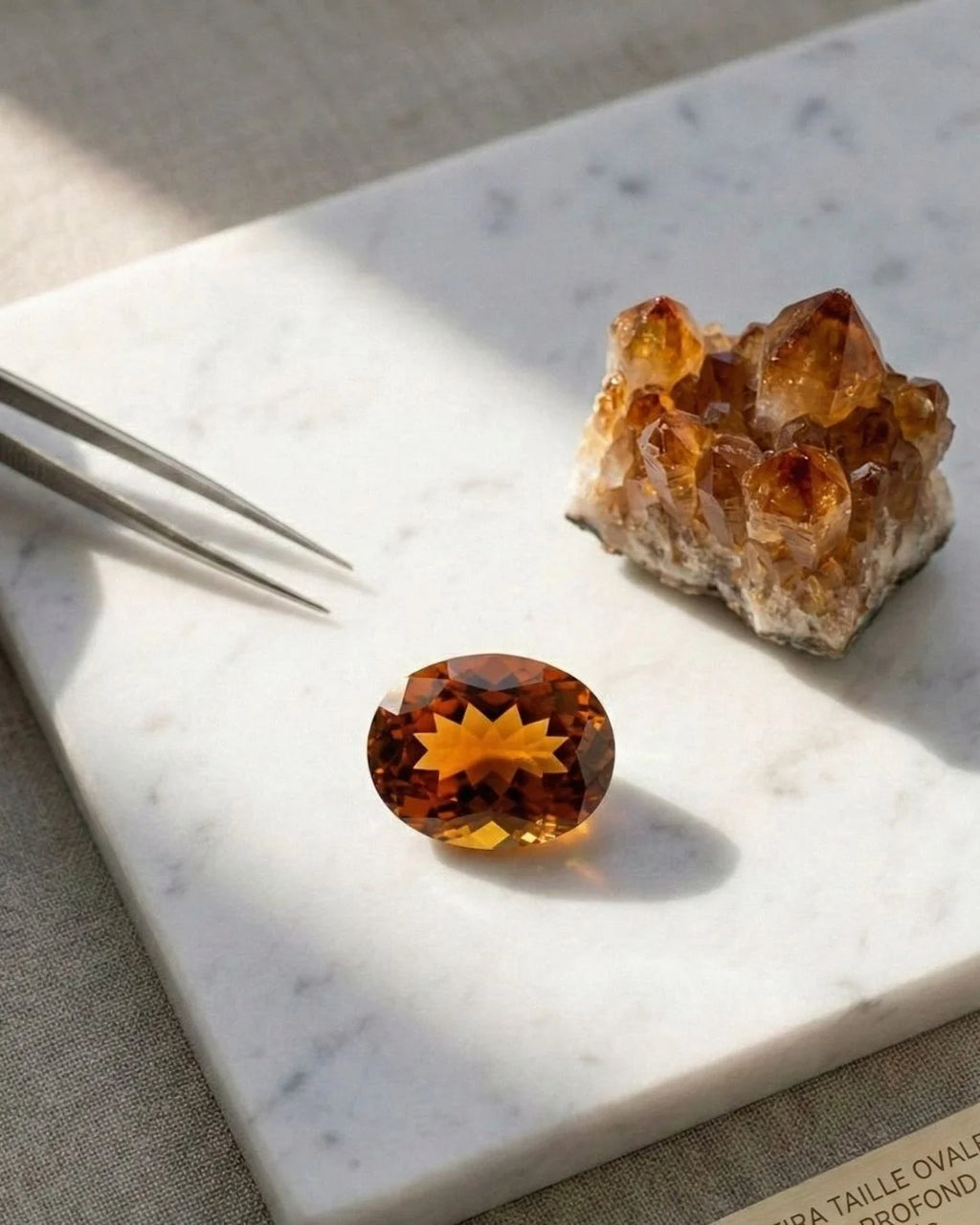
Oval-cut Madeira Citrine displaying a deep orange-brown hue with golden reflections
History and symbolism of citrine
The term "citrine" appeared in gemology during the fourteenth century, derived from the Latin citrina. In antiquity, citrine was confused with yellow topaz: the Greeks and Romans made no distinction between the two. It was not until the eighteenth century and the advent of modern mineralogy that citrine was identified as a distinct form of quartz.
Known as the "merchant's stone" during the Renaissance, traders would place a citrine in their cash drawer or purse, convinced it attracted fortune. In China, citrine is still associated with generosity and financial success.
Citrine's golden colour has naturally linked it to the sun and vital energy across European and Asian traditions. A stone of optimism and joy, citrine is said not to accumulate negative energy, hence its nickname of "a stone that does not absorb negative energy" in crystal healing.
Gemological properties of citrine
Citrine is a variety of quartz (SiO2), sharing the same chemical formula as amethyst, rose quartz, and smoky quartz. Its yellow-orange colour comes from iron (Fe3+) in a different oxidation state from the one responsible for amethyst's violet hue.
Colour: lemon yellow to orange-brown. Saturation depends on iron concentration.
Hardness: 7 on the Mohs scale, making it robust for everyday wear, and stronger than Emerald (delicate despite a rating of 7.5–8) and tanzanite (6.5).
Crystal system: trigonal (hexagonal). Natural citrine crystals are rare.
The connection between citrine and amethyst is fundamental: both gemstones are the same mineral, coloured by iron. The only difference lies in the oxidation state. When heated to 300–500°C, amethyst irreversibly transforms into citrine.
To explore the properties of this gemstone in greater depth, consult the full GIA guide on citrine.
Citrine varieties: from lemon yellow to Madeira
Madeira: deep orange-brown with red undertones, named after Madeira wine. This is the the most precious and sought-after by collectors, originating primarily from Brazil (Minas Gerais).
Palmeira: light orange, the colour of a palm tree at sunset. A highly popular intermediate hue in contemporary fine jewellery.
Rio Grande: deep golden yellow, sourced from Rio Grande do Sul (Brazil). A warm, saturated colour offering excellent value for money.
Pale Citrine / Lemon: light lemon yellow, the most common and most accessible shade. Delicate and luminous.
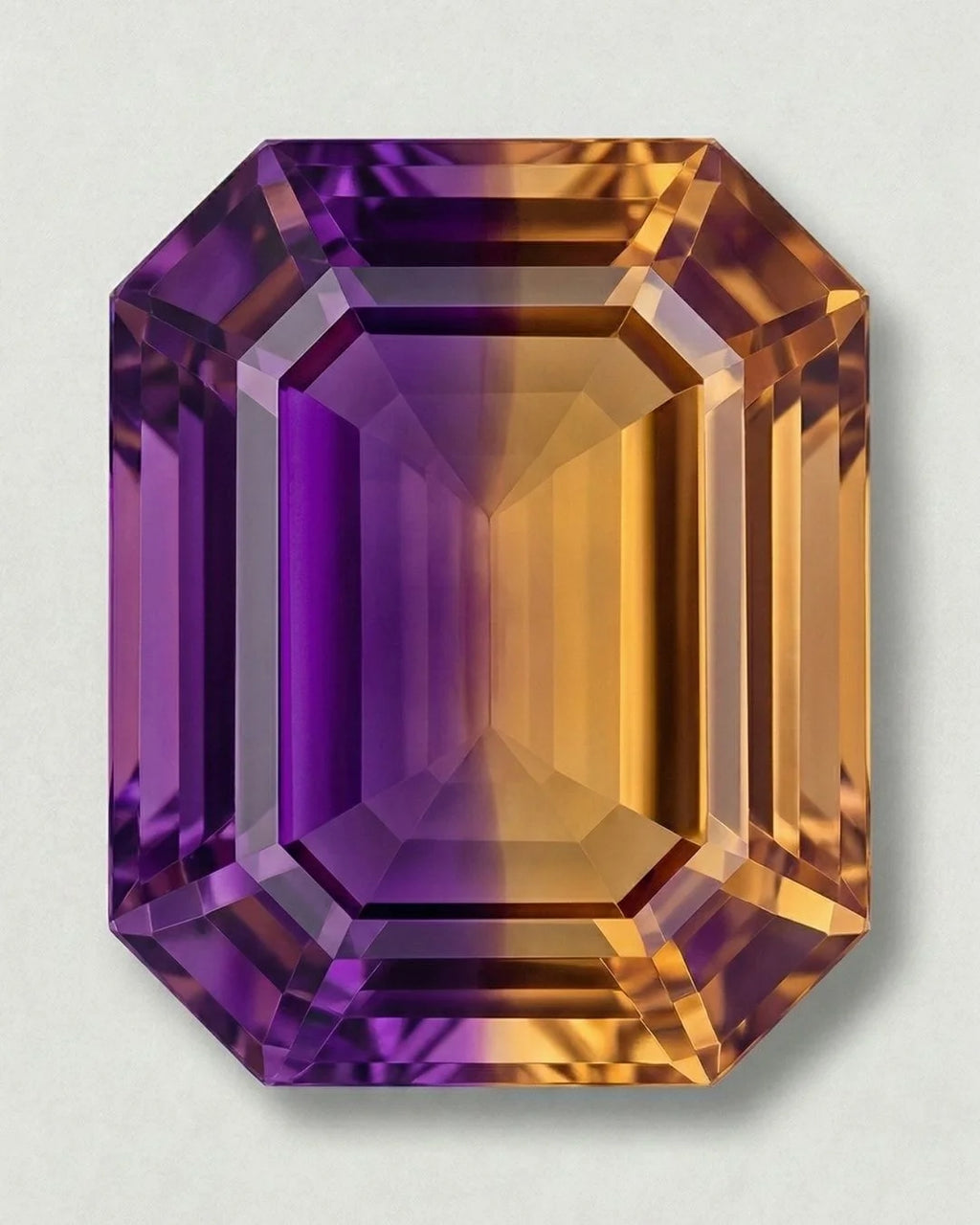
Ametrine: half amethyst, half citrine within the same crystal, a naturally bicoloured stone. It originates almost exclusively from the Anahí mine in Bolivia, the only significant source in the world. The violet zone (amethyst) and the golden zone (citrine) coexist within a single quartz crystal.
Natural Bolivian ametrine displaying both a violet zone and a golden zone within a single crystal
An important note: most "Madeira citrines" or "deep citrines" on the market are amethysts that have been heat-treated at high temperatures. The following section explores this topic in greater depth.
Natural citrine vs. heat-treated citrine: the truth about the market
Approximately 95% of citrines on the market are artificially heated amethysts or smoky quartzes. Natural citrine, coloured by iron without human heat treatment, is in fact far rarer than amethyst.
Heating to 300–500°C alters the oxidation state of Fe3+ iron within the quartz, transforming the violet of amethyst into yellow-orange. The process is irreversible.
How to tell them apart: natural citrine generally displays a pale yellow to golden yellow hue and a subtle colour zoning. Heated citrine (formerly amethyst) tends toward burnt orange or reddish brown, sometimes retaining traces of purplish zoning in parallel bands visible under a loupe.
Is this a problem? Not at all, provided the treatment is disclosed. Heating amethyst is an age-old and widely accepted practice within the gemological trade. The CIBJO (international standard) requires disclosure of any treatment. The issue arises only when heated citrine is sold as "natural" without any mention of the treatment.
For bespoke creations at Mayuri, the client may specify whether they wish for a natural citrine (rarer, with a subtle golden yellow hue) or whether they prefer the accessibility and beauty of a heated amethyst (more intense colours, softer price point). In both cases, the nature of the stone is fully disclosed.
Citrine vs. topaz: two November stones not to be confused
The historic confusion between citrine and yellow topaz led jewellers to use the misleading terms "citrine topaz" or "golden topaz" to refer to citrine. These are two entirely different minerals: topaz is a aluminum silicate, citrine is a quartz.
Criterion
Citrine
Imperial Topaz
Blue Topaz
Family
Quartz (SiO2)
Aluminium silicate (Al2SiO4)
Aluminium silicate (Al2SiO4)
Colour
Lemon yellow to orange-brown
Orange-pink to salmon pink
Light blue to deep blue
Mohs Hardness
7
8
8
Density
2.65
3.49-3.57
3.49-3.57
Rarity
Abundant (heated) / rare (natural)
Rare (Ouro Preto, Brazil)
Abundant (irradiation-treated)
Indicative price/ct
$6-$95
$240-$2,400
$6-$36
Common treatment
Heating (amethyst)
None or light heating
Irradiation + heating
November birthstone
Yes (since 1912)
Yes (traditional)
Yes (same family)
Properties and benefits of citrine
In crystal healing, citrine is associated with the solar plexus chakra (Manipura) and the sacral chakra (Svadhisthana).
It is said to carry properties of prosperity, self-confidence, and creative energy. Nicknamed the "merchant's stone" or "stone of success," it is thought to be favorable to projects and new ventures.
Citrine is renowned for not absorbing negative energy, making it one of the rare stones that requires no regular cleansing, according to crystal healing practitioners.
In Feng Shui, citrine is placed in the "wealth" corner (south-east) of the home to invite abundance.
How to choose a quality citrine
Color (the dominant criterion, accounting for approximately 60% of the value): saturation is the primary factor. A deep, uniform golden orange (Madeira type) is the most highly prized. Pale lemon yellow is more common and more affordable. Avoid shades that are too brown or too greenish.
Clarity: gem-quality citrine is generally eye-clean. Visible inclusions are rare and significantly reduce value. This is one of citrine's great advantages: unlike emerald, finding a clean stone is both easy and affordable.
Cut: the cut influences color intensity. Fancy shapes (pear, marquise, trillion) are popular as they maximize brilliance. Oval and cushion cuts are timeless choices.
Carat weight: like amethyst, citrine's price per carat does not increase dramatically with size. Beautiful stones of 5 to 20 carats remain accessible, making it an ideal gemstone for jewellery with a bold visual presence.
Price guide: citrine in fine jewellery
Pale Citrine / Lemon: $6–18/ct, the most accessible variety, ideal for larger statement pieces
Standard Citrine (good golden saturation): $12–35/ct
Palmeira / Rio Grande (intense golden orange): $24–60/ct
Madeira (deep orange-brown, the most prized): $35–95/ct for fine-quality specimens
Ametrine (Bolivia, naturally bicolour): $18–60/ct, rare and distinctive
High-quality, unheated natural citrine can reach $120–180/ct for truly exceptional specimens. The rarity of natural citrine is greatly underestimated by the general public.
An ideal stone for the festive season: a celebratory golden hue, a symbol of prosperity and a refined price point.
With a hardness of 7 on the Mohs scale, citrine is robust enough for everyday wear, harder than tanzanite (6.5) and comparable to amethyst (both belonging to the quartz family).
Cleaning: warm water, mild soap, and a soft brush. A simple and safe method. Ultrasonic cleaners are acceptable, unless the stone contains visible fractures.
Light sensitivity: like amethyst, citrine may lose its colour with prolonged exposure to direct sunlight or UV rays. Avoid displaying a citrine jewel in a sunny window or in direct sunlight for extended periods. Store in a jewellery case, away from light.
Heat sensitivity: avoid sudden thermal shocks. Do not wear the piece in the sauna
Storage: in an individual jewellery case, away from light and kept separate from other jewellery (citrine, at 7 on the Mohs scale, can be scratched by a Sapphire or a Diamond)
Our advice: consult our guide on caring for gold jewellery for all precautions related to the metal.
Citrine and the festive season: a gift for the occasion
November opens the festive season. Citrine, with its warm, golden hue, is naturally associated with the celebratory spirit of the year's end.
A symbol of prosperity and success, gifting a citrine for the holidays is a way of wishing the recipient a year filled with achievement.
Gift ideas by budget: citrine Earrings in 18ct Yellow Gold (an accessible and luminous gift), citrine pendant (a bold and warm centrepiece), citrine ring (effortless everyday elegance).
Mayuri's bespoke service allows you to choose the precise shade of gold, from a delicate lemon yellow to a deep Madeira, tailored to the tastes of the person you are gifting. Citrine pairs beautifully with every gold: yellow gold (warm harmony), rose gold (a soft contrast), white gold (a modern sensibility).
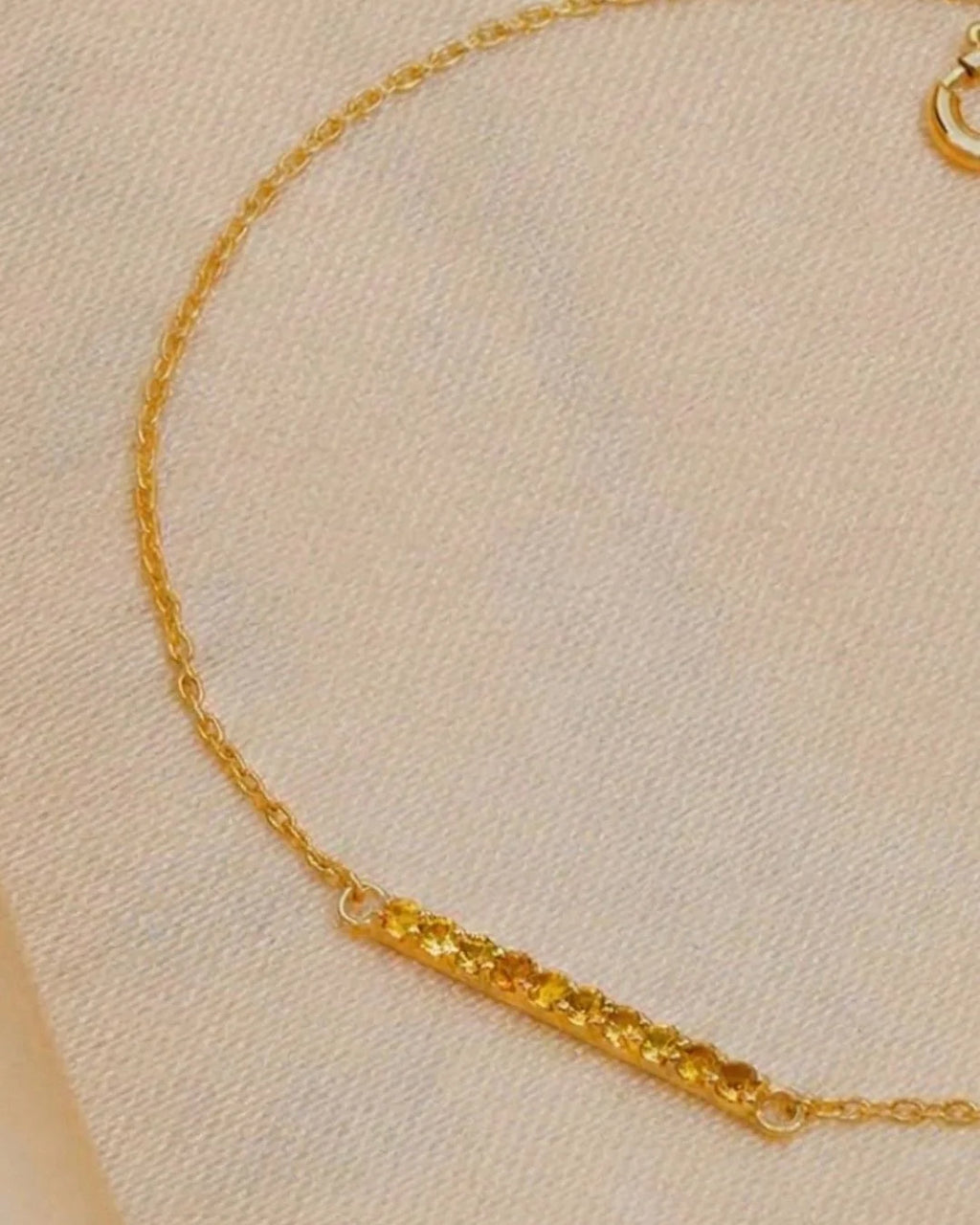
Mayuri citrine jewel in 18ct yellow gold, ideal as a festive season gift
Frequently asked questions
What is the birthstone for November?
The birthstones for November are citrine and topaz. Citrine is a yellow-orange quartz, while topaz is an aluminum silicate that exists in a range of colours. The two are frequently confused due to their shared yellow tones, yet they are entirely distinct minerals.
What are the properties of citrine?
In crystal healing, citrine is associated with prosperity, self-confidence, and positive energy. Known as the "merchant's stone," it is said to favour new projects and ventures. It is connected to the solar plexus chakra.
How to tell a natural citrine from a heat-treated one?
Natural citrine typically displays a pale to golden yellow tone with subtle colour zoning. Heat-treated citrine (formerly amethyst) tends toward burnt orange or reddish brown, sometimes retaining traces of violet banding visible under a loupe. Approximately 95% of citrines on the market are heat-treated amethysts.
What is the difference between citrine and topaz?
Citrine is a quartz (SiO2, hardness 7 on the Mohs scale), while topaz is an aluminum silicate (Al2SiO4, hardness 8 on the Mohs scale). Imperial topaz (orange-pink) is considerably rarer and more valuable than citrine. The confusion stems from their similar yellow colouring, yet they are two entirely different minerals.
What is the price of a citrine?
Prices range from $6 to $18 per carat for pale citrine, and from $35 to $95 per carat for Madeira citrine. Bolivian ametrine falls between $18 and $60 per carat. Citrine remains one of the most accessible coloured gemstones in fine jewellery.
Is citrine rare?
Heat-treated citrine (processed amethyst) is abundant and widely available. Natural citrine, coloured by iron without any heat treatment, is, by contrast, remarkably rare. Deposits of natural citrine are found primarily in Minas Gerais, Brazil, and are far more limited than those of amethyst.
How to cleanse and recharge a citrine?
In crystal healing, citrine is considered one of the few stones that requires no regular cleansing, as it is believed not to absorb negative energies. For the physical care of the piece, a gentle wash with warm soapy water is sufficient. Please note: prolonged exposure to direct sunlight should be avoided, as it may cause the stone to fade.
What is the difference between amethyst and citrine?
Amethyst and citrine are the same mineral: quartz coloured by iron. The difference lies in the oxidation state of the iron. Heating an amethyst to between 300 and 500°C transforms it irreversibly into citrine. Approximately 95% of commercial citrines are heat-treated amethysts. Amethyst is the birthstone for February.
Does citrine suit all types of gold?
Yes, this is one of citrine's greatest strengths. It harmonises beautifully with 18ct yellow gold for a warm, natural pairing, creates an elegant contrast with rose gold, and takes on a modern, contemporary feel with white gold. Vermeil is also an accessible option for citrine jewellery.