

What to remember
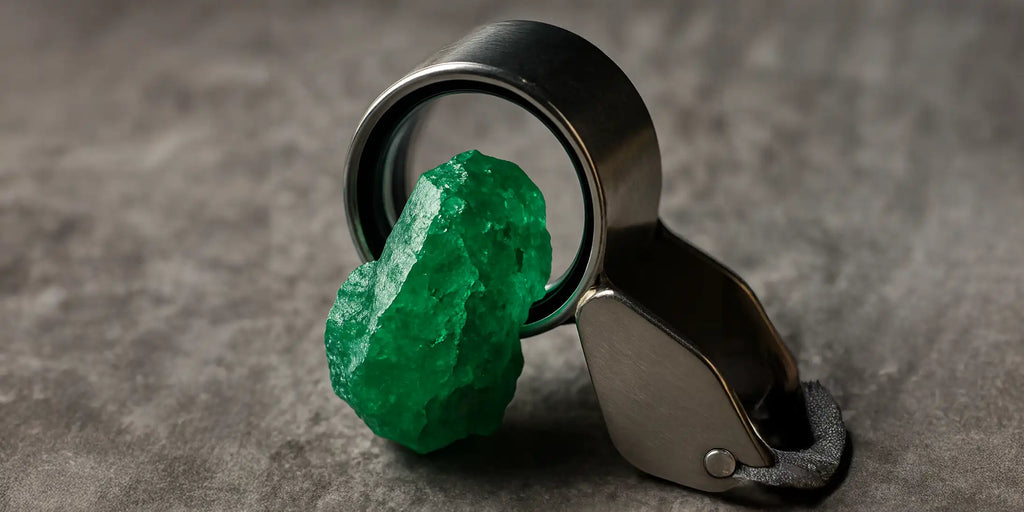
You're holding a green crystal that has caught your eye? You're wondering whether it might be a genuine raw Emerald or another mineral? Identifying an Emerald in its natural state is not always straightforward, even for a trained eye. Unlike the polished stones found in jewellery, a raw Emerald can appear dull, opaque, or even unassuming at first glance.
A raw Emerald is, in essence, a beryl crystal coloured green by trace amounts of chromium or vanadium. What makes it so exceptional is precisely that it has retained its natural crystalline form, that beautiful hexagonal structure gifted by nature over millions of years. One word of caution, however: not all green crystals are Emeralds.
The challenge is that in the field, a raw Emerald can easily go unnoticed or be mistaken for another mineral. Its colour may appear muted, it can be covered in inclusions that obscure its beauty, and its shape may have been altered by erosion. This is why knowing the right signs is essential to avoid overlooking a true treasure.
Where do Emeralds come from? A brief guide to geology
To accurately identify a raw Emerald, one must first understand where and how it forms. It is no coincidence that Emeralds are not found everywhere: their formation requires very specific, almost miraculous, geological conditions.
Picture two entirely different rock types meeting deep within the Earth. On one side, you have granites or pegmatites rich in beryllium. On the other, dark rocks such as black schists or serpentines, saturated with chromium. When these two worlds converge, particularly during hydrothermal phases with circulating hot fluids, something remarkable happens: beryllium meets chromium, and the Emerald is born.
This exceptional encounter explains why natural Emerald deposits are so rare, and why each producing region has its own distinct characteristics. In Colombia, for example, Emeralds form within graphitic black schists, which gives them their uniquely pure green colour. In Brazil, formation tends to occur within pegmatites, resulting in sometimes different colour variations.
When searching for Emeralds in the field, keep an eye out for these geological indicators. If you find yourself in an area where light-coloured rocks (granites) sit alongside dark rocks (schists), you may well be on the right track.

Recognising the characteristic silhouette of the Emerald
The first indicator that never misleads? The geometry of the crystal. A well-preserved raw Emerald displays that instantly recognisable hexagonal prism shape: six faces meeting to create an elegant, almost architectural silhouette.
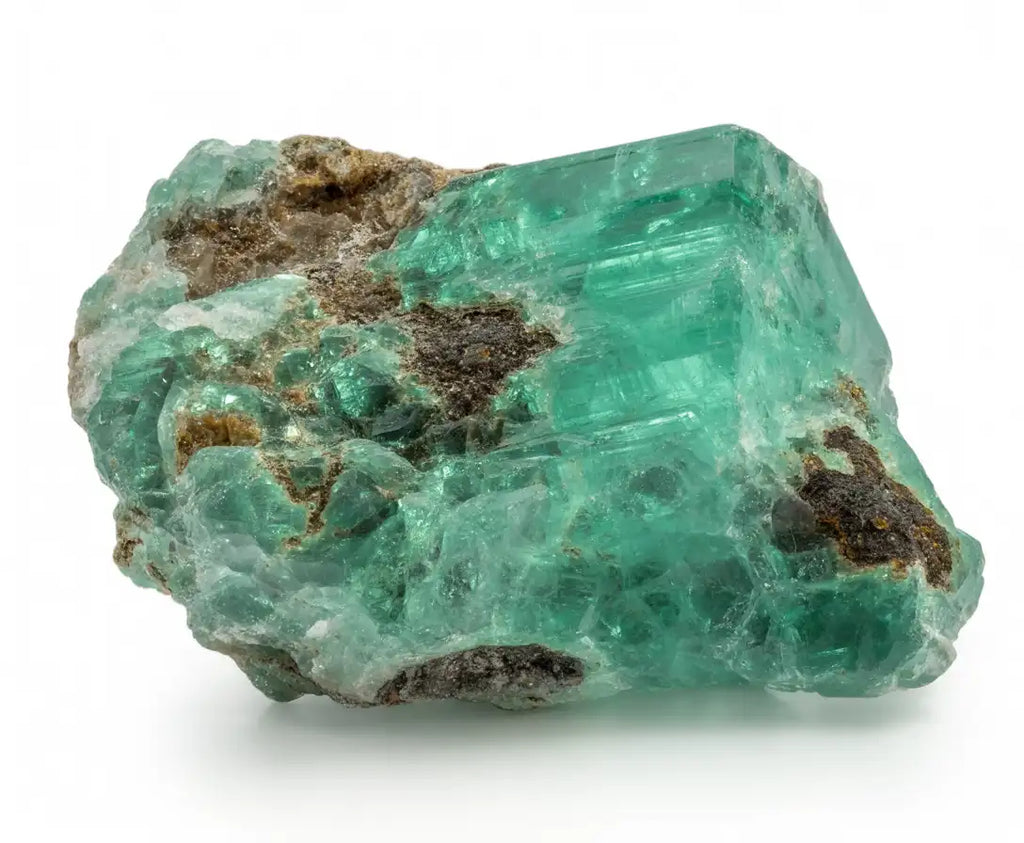
Picture a pencil with six faces rather than a round one. That is exactly it. Some crystals are compact and sturdy, others remarkably elongated. We have had the privilege of observing raw Colombian Emeralds where the proportions were striking: ten centimetres in length and barely one centimetre in width. A true needle of nature.
The longitudinal faces often bear fine parallel striations running from one end of the crystal to the other. It looks as though someone has delicately scored the surface with a precision tool. These striations, visible to the naked eye on fine specimens, become truly fascinating under a loupe.
At the terminations, the crystal ends in faces that are generally flat, sometimes slightly rounded depending on the growth conditions. Bear in mind, however, that even when eroded, broken or incomplete, a fragment of Emerald retains traces of its emerald crystal structure original hexagonal form.
Occasionally, one encounters rarer phenomena: twinned crystals, where two individuals have grown together in a perfect embrace. These double formations create more complex geometries, yet the trained eye will always find the underlying hexagonal signature.
This is precisely what makes this characteristic so valuable: it immediately rules out all minerals that crystallise according to other systems. If your green stone does not have this geometry, look elsewhere; it is almost certainly not an Emerald.
A few practical field tests
Now that we have examined the shape, let us get to the heart of the matter with some simple yet revealing tests.
The hardness test, your greatest ally
Emerald has a emerald hardness of between 7.5 and 8 on the Mohs scale. In practical terms, this means it can scratch glass with ease, while a Diamond will scratch it without difficulty. If you have a pane of glass to hand (take care not to cause any damage), your Emerald should scratch it effortlessly. Conversely, if a steel knife can mark your stone, it is most likely not an Emerald.
The weight in the hand
With experience, one develops a feel for the weight of minerals. Emerald is neither particularly heavy nor particularly light; it has a moderate density of around 2.7 g/cm³. Compared to malachite, which is noticeably heavier, or green fluorite, which feels quite different, Emerald has a character all its own.
How does it fracture?
When an Emerald breaks (something one naturally hopes to avoid), it does not cleave along clean planes as fluorite crystals do. Its fracture is rather irregular, sometimes with bright surfaces that catch the light. This is known as conchoidal fracture.
Comparative table of physical properties:
| Mineral | Hardness | Weight Feel | How It Breaks |
|---|---|---|---|
| Emerald | 7.5-8 | Moderate | Irregular fracture |
| Green Tourmaline | 7-7.5 | Slightly heavier | Similar fracture |
| Diopside | 5.5-6.5 | Heavier | Cleaves at right angles |
| Green Apatite | 5 | Similar | More brittle |
That singular, unmistakable shade of green
The colour of Emerald is both its charm and its complexity. Contrary to what one might expect, not all raw emeralds display a vivid, brilliant green.
Colour variations by origin
Each region of the world produces Emeralds with their own distinct colour signature. Colombian stones, widely considered the finest, typically display the pure, intense green we instinctively associate with Emerald. It is chromium that gives them this so characteristic colour.
Zambian Emeralds tend toward a blue-green tone. The first time our team encountered one, the difference in hue was striking. It is iron, combined with chromium, that creates this particular nuance.
In Brazil, lighter tones are common, sometimes with a hint of yellow. These variations arise from vanadium, which partially replaces chromium within the crystal structure.
Transparency: do not be deceived by appearances
Here is something that often comes as a surprise: raw emerald may appear completely opaque, yet reveal a magnificent transparency once cut. The numerous inclusions, which we will explore further on, can sometimes give the impression of an unremarkable stone. Do not be deceived.
Colour can also vary within a single crystal. We have seen emeralds with deeply saturated zones alongside areas that are almost colourless, creating fascinating patterns. These variations tell the story of crystallisation, with its periods of abundance or scarcity in colouring elements.
The Emerald's "garden": decoding its inclusions
The inclusions in a raw emerald within a raw emerald are like reading an open book about its formation. This is poetically referred to as the "garden of the emerald," and it is one of the most reliable ways to identify it with certainty.
The golden clue: pyrite
In raw Colombian emeralds, you will often find small, brilliant golden cubes. This is pyrite, and it is almost a signature. These perfectly formed cubic crystals catch the light and glimmer from within the emerald. Under a 10x loupe, they become truly beautiful to observe.
Mica platelets
Other common inclusions resemble tiny silvery flakes that shimmer as you turn the stone. These are generally mica lamellae, bearing witness to the geological environment in which the stone was formed.
Fluid inclusions
More subtle yet equally revealing, fluid inclusions sometimes form "fingerprint" patterns or branching channels within the crystal. These ancient pockets of fluid speak to the conditions of temperature and pressure present during formation.
What is particularly fascinating is that these inclusions are not arranged at random. They often follow the geometry of the crystal, forming planes parallel to the faces or concentrating within certain growth zones. This geometric organisation is what sets them apart from the generally chaotic inclusions found in other similar green minerals resembling emerald.
Avoiding common pitfalls: distinguishing Emeralds from other green stones
The mineral world is full of green crystals that can deceive the untrained eye. Let us look at the main "false friends" of the emerald.
Other green beryls
Not all green beryls are emeralds. Pale, yellowish green beryls exist that lack the intense, characteristic colour of a true emerald. The difference? The depth and purity of the green. A genuine raw emerald retains its saturated colour even when its surface appears dull.
This distinction between Green beryl vs. Emerald is a crucial distinction for any collector. A true Emerald owes its colour to chromium or vanadium, not simply to iron as with other green beryls.
Green tourmaline, the great imitator
Here is the most common pitfall. Green tourmaline can truly resemble an Emerald at first glance. How do you tell them apart? First, by shape: tourmaline has a triangular cross-section, not a hexagonal one. Then, if you rub a tourmaline with a cloth, it may attract small pieces of paper, a tell-tale sign of its electrical properties.
Diopside and its right angles
Green diopside is recognisable by its perfect cleavage, which forms right angles when it breaks. Its lower hardness (5.5 to 6.5) and higher density also help to distinguish it. The crystals are often less well-defined than those of Emerald.
Apatite, the softer stone
Green apatite reveals itself through its low hardness (just 5 on the Mohs scale). A knife can scratch it with ease, unlike Emerald. Its crystals are also generally less well-formed.
To summarise the key differences:
- Emerald: hexagonal shape, exceptional hardness, chromium-rich green, characteristic inclusions
- Tourmaline: triangular cross-section, electrical properties, distinct striations
- Diopside: breaks at right angles, lower hardness, higher density
- Apatite: easily scratched by a knife, less well-defined crystals
A world tour of Emeralds
Each major Emerald-producing region has its own distinctive characteristics, which a trained eye can learn to recognise.
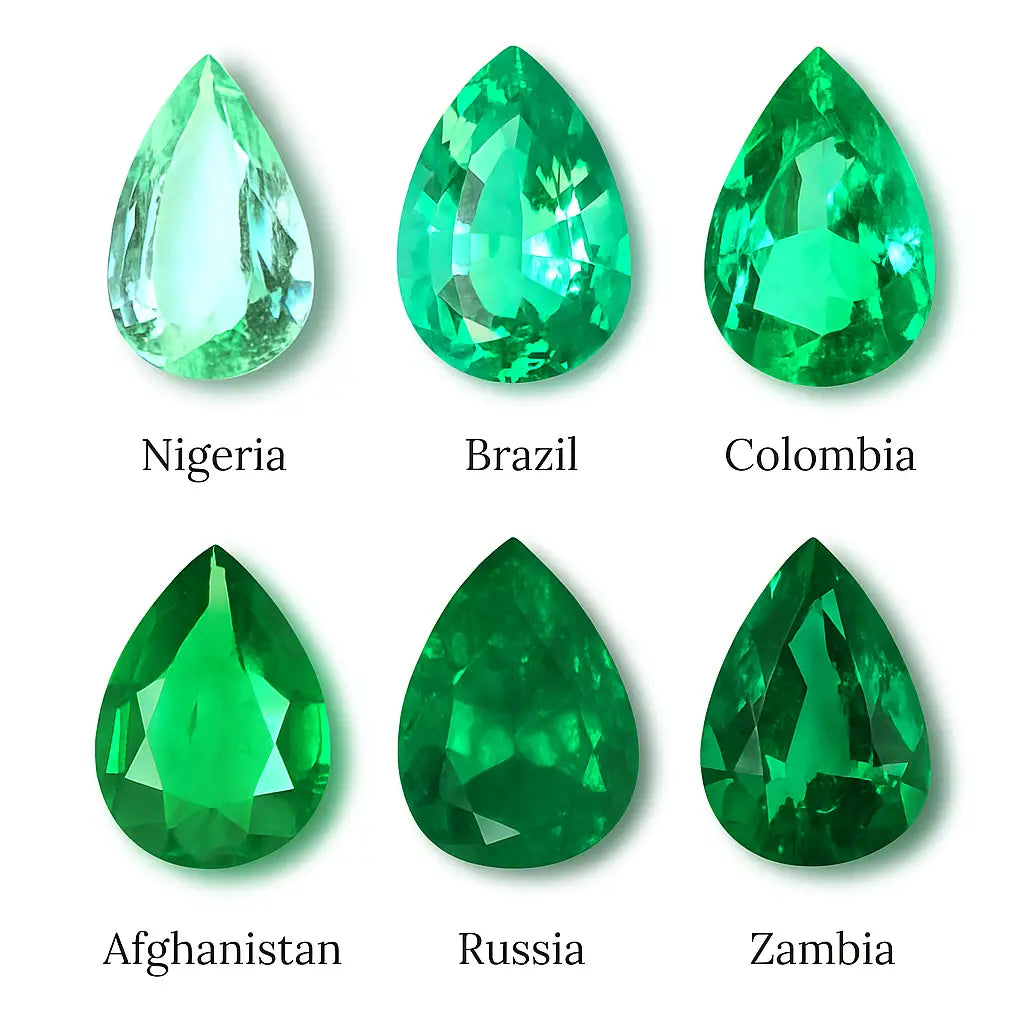
Image credit: The Natural Emerald Company
Colombia, the kingdom of Emerald
The legendary mines of Muzo, Chivor and Coscuez produce what are widely considered the finest Emeralds in the world. Their rough Emerald crystals display that pure, intensely characteristic green, complete with the famous pyrite inclusions mentioned earlier. Muzo crystals are often perfectly formed, with sharp terminations that captivate collectors the world over.
Chivor has its own distinctive traits: crystals there frequently show twinning, creating fascinating and complex formations. The colour can differ slightly, sometimes carrying a subtle blue undertone.
Brazil and its nuances
Santa Terezinha, in Goiás, and the Bahia deposits offer Emeralds with a wider range of hues. Here, it is often vanadium that colours the crystals, sometimes producing lighter or slightly yellowish tones. The inclusions differ as well: more mica, less pyrite than in Colombia.
Zambia and its blue-green hues
The Emeralds from Kafubu carry that distinctive blue-green tint that is immediately recognisable. Iron, present alongside chrome, creates this unique colour. They frequently contain actinolite inclusions, those fine green needles that form radiating patterns within the crystal.
And the others...
Madagascar surprises with the diversity of its Emeralds across different deposits. Russia, in the Urals, produces specimens often associated with white phenakite crystals, a mineralogical combination characteristic of that region.
Your field kit for identifying Emeralds
The essential 10x loupe
Invest in a good geologist's loupe. It is your finest tool for observing crystal striations, examining inclusions, and checking all the small details that make the difference. A quality loupe reveals wonders invisible to the naked eye.
Discreet hardness tests
A few test points (copper, steel, quartz) kept in a small case will allow you to verify hardness without damaging your specimens. Always test on a less visible area.
The UV lamp, useful for elimination
Even though Emeralds generally do not fluoresce, a small UV lamp can help identify other green minerals that do light up under those rays. It is a reliable way to rule out certain candidates.
Your essential references
Build yourself a small uncut Emerald collection of reference samples, including certified specimens of Emerald, tourmaline, diopside, and more. Nothing replaces direct comparison for training the eye and developing a collector's intuition.
Apps and guides
Several mobile apps offer mineralogical databases with photographs. While they are no substitute for expertise, they can be genuinely useful in the field for quick comparisons.
Our field tips for passionate enthusiasts
After years of searching for and identifying Emeralds, here is our practical advice for never overlooking a true treasure.
Always combine several indicators
Never rely on a single criterion. True identification of a raw Emerald comes when multiple elements align: the hexagonal form, the hardness, the colour, the inclusions, and the geological context. It is this convergence that brings certainty.
Train your eye
Visit museums, mineral fairs, and private collections. The more authentic Emeralds you encounter, the sharper your eye will become. A great deal can be learned by speaking with experienced collectors who are generous enough to share their finest specimens.
Document your finds
Always note where and under what conditions you found a specimen. The geological context, the associated rocks, the weather that day: all these details enhance the value of your collection and assist in identification.
Stay humble in the face of doubt
When in doubt, do not hesitate to consult a specialist or have your specimen analysed. Modern analytical techniques, including spectroscopy and X-ray diffraction, can confirm an identification and even reveal the geographic origin of a stone. This is particularly important for pieces of significant value.
Respect nature and the law
Always research local regulations before collecting. Many sites are protected and require permits. Respecting geological sites ensures their preservation for future generations of enthusiasts.
Identifying a raw Emerald requires patience, careful observation, and a great deal of practice. Yet the satisfaction of finally holding that mythical green crystal in its natural state is truly unmatched. Each Emerald tells a unique geological story, and learning to read it is, in its own way, becoming a detective of the natural world.