BirthstonesThe Mayuri Journal17 May 2025
Enriched on 9 March 2026
Birthstones
Peridot: The Birthstone of August
Peridot, August's birthstone, symbolises personal growth and draws prosperity.
Written by Déborah Baid, Founder · Mayuri ParisReading 4 min11 chapters
What the maison says
What to remember
Peridot is the official birthstone for the month of August, alongside spinel (added in 2016). Its name is thought to derive from the Arabic faridat, meaning "gem," and the ancient Egyptians called it the "gem of the sun". It is the gem variety of olivine, a mineral formed in the Earth's mantle and brought to the surface through volcanic eruptions.
Unlike most gemstones, peridot is never treated: its olive-green colour is intrinsic, resulting from the iron present in its crystal structure (an idiochromatic gem). Peridot crystals have even been found in meteorites dating back 4.5 billion years, as well as on the surface of Mars. This guide covers everything you need to know: history, volcanic and extraterrestrial origins, unique properties, a comparison with emerald, spinel as an alternative, and Mayuri peridot jewellery.
What is the birthstone for August?
The official birthstones for August are peridot and spinel, according to the AGTA/Jewelers of America list (updated 2016). Sardonyx is the historical choice of antiquity, worn since Roman times.
Peridot remains the most popular and the oldest choice: it has been associated with the month of August for centuries. Spinel was added in 2016 by the AGTA as a second August birthstone, offering a broader colour palette (red, pink, blue, violet). Peridot is also the gemstone of the 16th wedding anniversary.
History and symbolism of peridot: the gem of the sun
The ancient Egyptians mined peridot on the island of Zabargad (also known as St. John's Island) in the Red Sea as early as 1500 BCE. It is one of the oldest known gemstone deposits in the world. They called it the "gem of the sun" for its verdant brilliance and the way it captured the light.
A fascinating historical confusion: peridot was long mistaken for emerald. Some historians believe that Cleopatra's famous emerald collection was in fact composed of peridots. The term "chrysolite" (an ancient name for peridot) appears in numerous biblical and medieval texts, and the stone adorned European churches, where it was often misidentified as emerald.
The etymology remains debated: possibly from the Old French peritot (of obscure origin), or from the Arabic faridat (gem). The mineralogical name "olivine" simply derives from its olive colour. In ancient traditions, peridot is a a symbol of strength, protection against nightmares, and prosperity.
Gemological properties of peridot
Peridot is the gem variety of olivine, a mineral from the nesosilicate group. Its colour is intrinsic (idiochromatic), due to iron in its chemical composition, not to impurities as in most gemstones.
Colour: olive green to yellow-green. Saturation depends on iron content. The most prized stones display a vivid green with no brown undertone
Hardness: 6.5 to 7 on the Mohs scale, more delicate than emerald (7.5–8) and Sapphire (9). Sensitive to acids and thermal shock
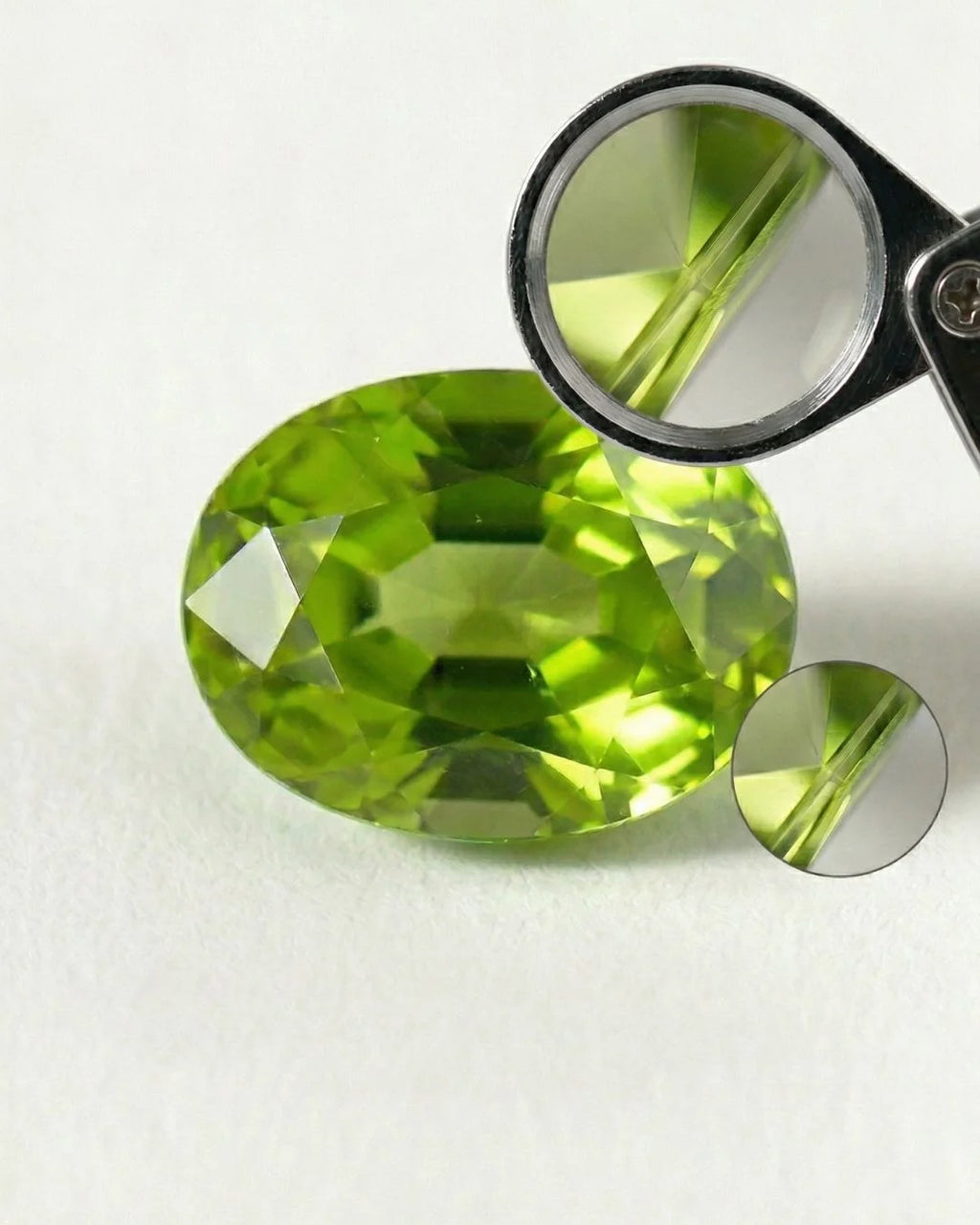
Double refraction: peridot has a very high birefringence (0.036). Under a loupe, one can observe a clear doubling of the back facet edges, a reliable identification test. On larger stones (over 5 ct), this doubling is visible to the naked eye
Typical inclusions: "lily pads" (flat discs of ludwigite surrounded by a halo), black chromite, tension veils. These inclusions are diagnostic
Peridot is never treated: it is one of the rare gemstones whose colour is 100% natural
To explore the properties of this gemstone further, consult the full GIA peridot guide.
Natural peridot displaying double refraction: the doubling of edges visible under a gemological loupe
The origins of peridot: from volcanoes to meteorites
Peridot forms in the upper mantle of the Earth, at a depth of 20 to 55 km, rising to the surface through volcanic eruptions. It is one of the rare gemstones of mantle origin.
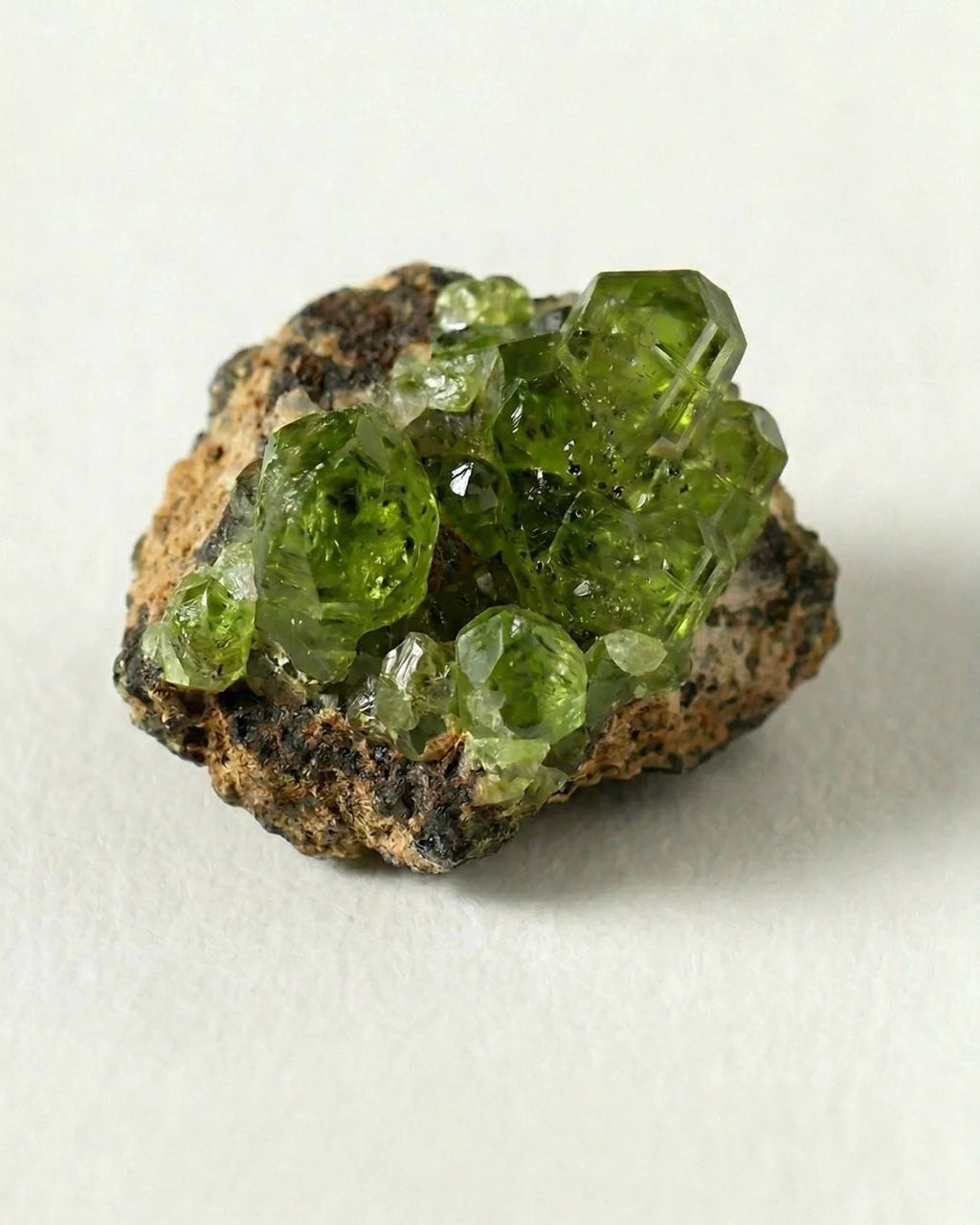
Zabargad Island (Egypt, Red Sea): a legendary historical source. Mined by the pharaohs, lost for centuries, and rediscovered around 1900. Now exhausted, the peridots of Zabargad remain among the most sought-after by collectors.
Raw peridot crystals from Zabargad Island in Egypt, a historic source mined since Antiquity
Sapat Valley (Pakistan, Himalayas): a major modern source. It produces the finest peridots in the world, including large specimens (over 10 ct) of an intense, luminous green.
San Carlos (Arizona, USA): the world's leading source by volume. It produces the majority of peridots on the market, though typically small in size (under 2 ct). China (Hebei): an important source since the 1990s. Myanmar (Mogok): peridots of excellent quality, often found in larger sizes.
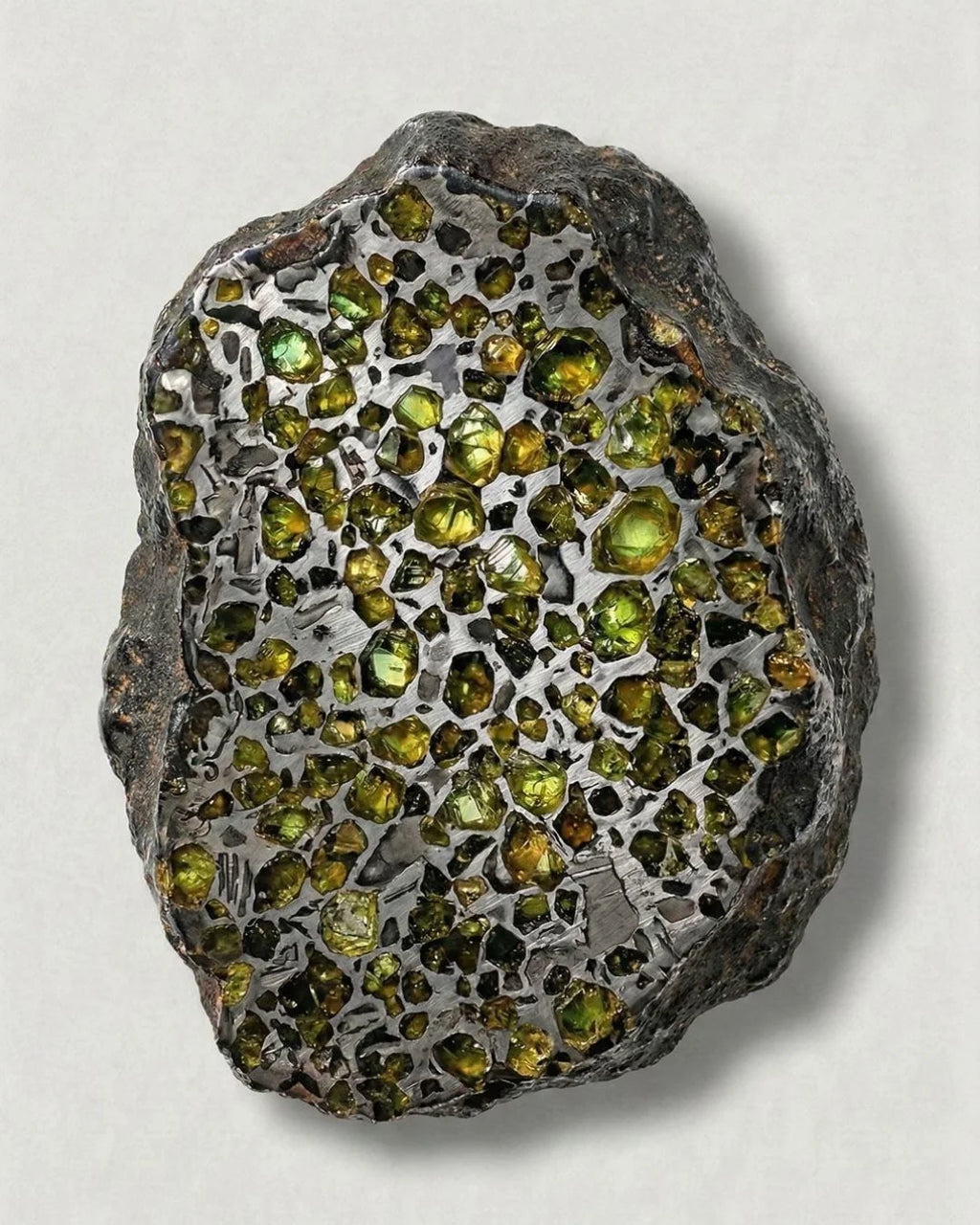
Perhaps the most fascinating detail of all: olivine crystals (peridot) have been discovered in pallasite meteorites dating back 4.5 billion years. The NASA has detected olivine on the surface of Mars. Peridot is, quite literally, a gemstone that exists beyond the Earth.
Olivine (peridot) crystals within a pallasite meteorite, an extraterrestrial gem dating back 4.5 billion years
Peridot and Emerald are often confused by the general public: both are green, yet they are remarkably different.
Colour: peridot leans toward olive green and yellow-green, always with a warm, slightly golden undertone. Emerald has a deep blue-green with a cool, bluish hue.
Hardness: peridot rates 6.5 to 7 on the Mohs scale (more delicate), while Emerald rates 7.5 to 8 (harder, yet more brittle due to its inclusions).
Price: peridot is far more accessible. A beautiful peridot costs $35–$230/ct, while a fine emerald ranges from $600–$6,000/ct. The ratio is 1 to 25
Treatments: peridot is never treated. Emerald is oil-treated in 99% of cases
Mineral origin: peridot is a variety of olivine (iron-bearing), while emerald is a variety of beryl (chrome/vanadium). They belong to entirely different mineral families
Peridot is the ideal choice for those seeking a natural, untreated green stone at an accessible price point in fine jewellery.
The virtues and benefits of peridot
In crystal healing, peridot is associated with the heart chakra (Anahata) and the solar plexus (Manipura).
Protection: traditionally regarded as a stone of protection against nightmares and negative energies. The ancient Egyptians wore it as a solar talisman.
Prosperity and abundance: associated with good fortune and the attraction of wealth in Eastern traditions.
Emotional healing: peridot is reputed to soothe jealousy, resentment and irritability, encouraging forgiveness and an open heart.
Vitality: associated with physical renewal and vital energy, in harmony with its volcanic origins (a stone born from the Earth's inner fire).
Spinel: the second birthstone for August
Since 2016, the AGTA (American Gem Trade Association) has officially added spinel as a second birthstone for August, alongside peridot.
Spinel is a mineral little known to the general public, yet highly prized by connoisseurs. Like peridot, it is almost never treated. The famous "Black Prince's Ruby" in the English Crown Jewels is in fact a red spinel weighing 170 carats: the most celebrated "rubies" in history are often spinels.
Spinel exists in red, pink, blue, violet and black. The red spinel ("flame spinel") rivals the ruby in colour, at a fraction of the price. With a hardness of 8 on the Mohs scale, it makes an excellent stone for everyday jewellery, more durable than peridot. For a bespoke creation in spinel, Mayuri can source the ideal stone according to your colour and cut preferences.
How to choose a quality peridot
Colour (the primary criterion): look for a vivid, saturated green, free from excessive brown or yellow undertones. A pure "grass" green is the most prized. Stones that are too light or too olive in tone lose their value.
Clarity: jewellery-grade peridot is generally eye-clean, with no inclusions visible to the naked eye. "Lily pad" inclusions are acceptable, provided they do not affect the stone's transparency.
Cut: large peridots (above 5 ct) with a beautiful colour are rare and precious. Favour cuts that maximise brilliance: cushion, oval and round brilliant.
A note on double refraction: a well-oriented cut minimises the visible "blurring" that can appear in larger stones. A laboratory certificate (GIA) is recommended for stones above 3 carats.
A guide to peridot pricing in fine jewellery
Peridot is one of the most accessible fine gemstones in jewellery, offering an excellent colour-to-price ratio:
Fine quality peridot: $60–$240/ct, vivid green, eye-clean, 2–5 ct
Exceptional peridot (Pakistan, Myanmar): $240–$720/ct, large size (above 5 ct), intense and saturated colour
Collector peridot (historic Zabargad): $600–1,200+/ct, rarity and historical provenance
By comparison, peridot is approximately 10 to 25 times less expensive than Emerald at equivalent quality. It is the most accessible green stone in fine jewellery. A Mayuri peridot piece in 18ct yellow gold remains within a very approachable price range compared to Emerald or Sapphire creations.
Caring for your peridot jewellery
With a hardness of 6.5–7 on the Mohs scale, peridot is more delicate than Sapphire (9), Ruby (9), or Emerald (7.5–8). It requires a little extra care.
Cleaning: warm water, mild soap, and a soft brush. Dry with a microfibre cloth.
To avoid: ultrasonic cleaners (risk of cracking), steam, and any acidic products, including vinegar or lemon juice, as peridot is sensitive to acids.
Thermal shock: avoid exposing peridot to sudden temperature changes, as this may cause cracking.
Storage: keep away from harder stones such as Diamond, Sapphire, and Ruby to prevent scratching. Use an individual pouch.
For more comprehensive care advice, consult our dedicated jewellery care guide.
Bespoke peridot jewellery in 18ct yellow gold by Mayuri
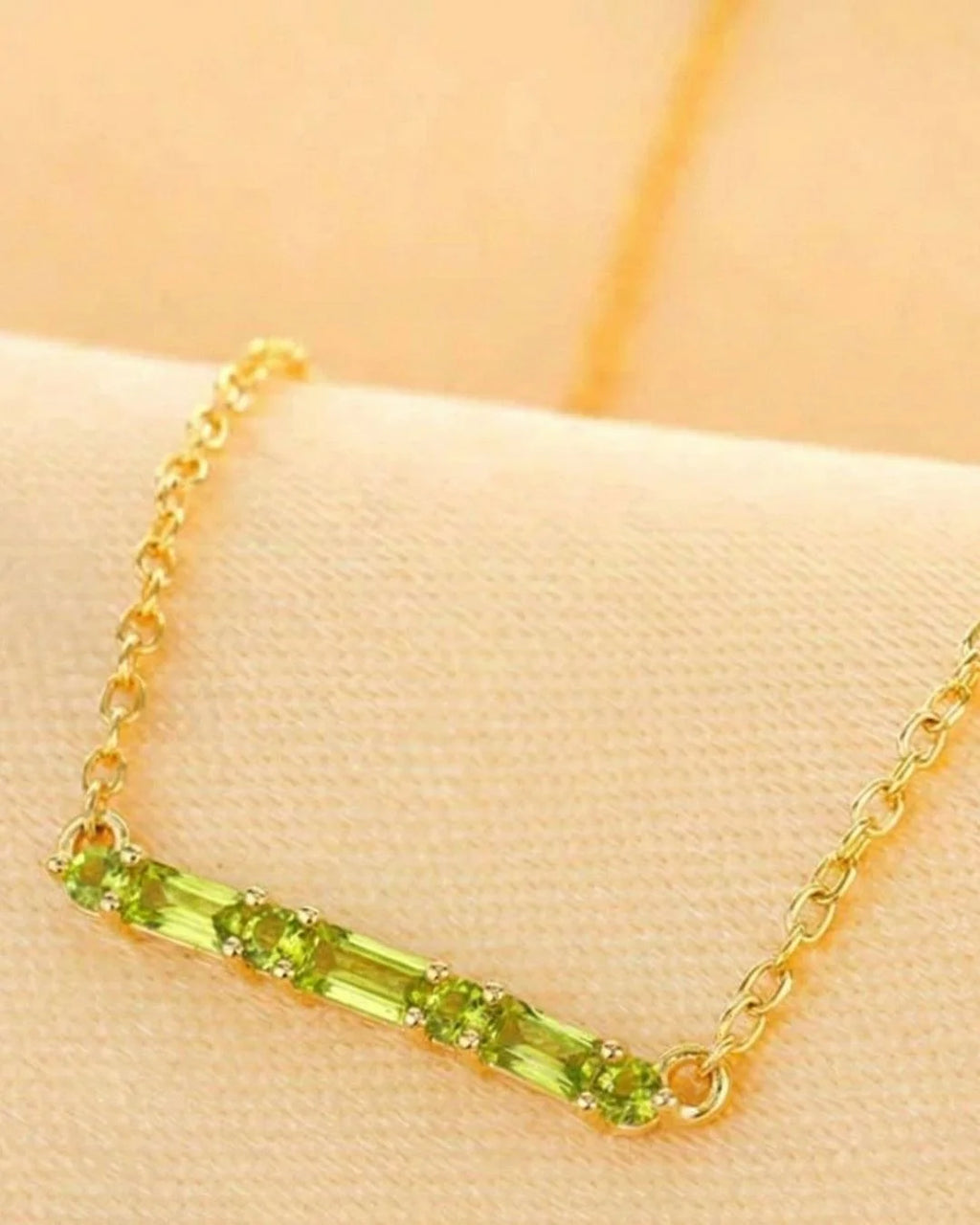
Our atelier creates bespoke peridot pieces in 18ct gold, available in yellow, rose, and white. Peridot pairs beautifully with 18ct yellow gold: the warmth of the metal enhances the golden hues of the olive green. Rose gold offers a delicate, contemporary contrast.
For bespoke creations, Mayuri can source peridots from a variety of origins and sizes, selected for the vibrancy of their colour and their clarity. Peridot is an ideal choice as an August birthstone gift: a natural, untreated stone set in accessible fine jewellery. It is also an excellent alternative to Emerald for more considered budgets.
Peridot jewellery set in 18ct yellow gold by Mayuri, bespoke creation for the August birthstone
The official birthstones for the month of August are peridot and spinel (added in 2016 by the AGTA). Sardonyx is the ancient historical choice. Peridot remains the most popular: its natural olive-green colour and accessibility make it an ideal choice for fine jewellery.
What colour is peridot?
Peridot ranges from yellow-green to deep olive green. Its colour is intrinsic, due to the iron within its crystal structure, and is never treated. It is one of the rare gemstones whose colour is entirely natural. The most prized peridots display a vivid, saturated green with no brown undertones.
What are the properties of peridot?
In crystal healing, peridot is associated with protection, prosperity, and emotional calm. The Egyptians called it the "gem of the sun" and wore it as a talisman. It is connected to the heart chakra and the solar plexus.
What is the difference between peridot and Emerald?
Peridot (olive-green, olivine) and Emerald (blue-green, beryl) belong to different mineral families. Peridot is 10 to 25 times less expensive, is never treated, yet is more delicate (6.5–7 on the Mohs scale versus 7.5–8). Emerald offers a deeper, more bluish green. Peridot is the accessible choice for a natural green gemstone.
Is peridot a precious stone?
Peridot is a fine (semi-precious) stone, not a precious stone in the strict sense of the term (Diamond, Ruby, Sapphire, Emerald). This distinction is one of classification, not of value. Peridot has been used in fine jewellery since ancient Egypt and features in the collections of the world's most prestigious museums.
Where does peridot come from?
Peridot forms deep within the Earth's mantle and reaches the surface through volcanic eruptions. Its primary sources include Pakistan (Sapat Valley, home to the finest specimens), Arizona (USA, the largest volume), China, Myanmar, and historically Egypt (Zabargad Island). Peridot has even been discovered in meteorites and on the surface of Mars.
How do you care for peridot jewellery?
Clean with lukewarm soapy water and a soft brush. Avoid ultrasonic cleaners, steam, and acidic products. Peridot, with a hardness of 6.5–7 on the Mohs scale, is more delicate than Sapphire or Ruby: store it separately and protect it from thermal shock.
What is the price of a peridot?
Prices vary according to size and origin: $12–$60 per carat (commercial grade), $60–$240 per carat (fine quality), $240–$700 per carat (exceptional, Pakistan origin). Peridot is the most accessible green gemstone in fine jewellery, priced 10 to 25 times lower than Emerald.
Can peridot be worn every day?
Yes, provided a few precautions are taken. With a hardness of 6.5–7 on the Mohs scale, peridot is well suited to rings worn occasionally, as well as Earrings, pendants, and necklaces worn daily. For an everyday ring, our recommendation is to choose a protective setting such as a bezel or closed setting.