The 4Cs of Diamonds: Understanding Quality to Choose with Confidence
The 4 Cs of diamonds explained: carat, color, clarity, cut. Your guide to understanding and choosing well.
Written by Johan Nel, Jewellery designer & goldsmith · trained in gemmology · Mayuri ParisReading 13 min9 chapters
What the maison says
What to remember
Imagine two one-carat diamonds, displayed side by side in a showcase, at the same price. The first sparkles like a star under the showroom light. The second appears dull, almost opaque, lifeless. The difference is neither colour nor clarity. It is the cut.
Our gemologists encounter this paradox every week. Two stones that are identical on paper can behave radically differently once set, depending on the quality of their cut. The 4Cs system, created by the GIA (Gemological Institute of America) in the 1950s, is the key to making the right choice. This guide explains it without jargon, with clear reference points to help you choose with confidence.
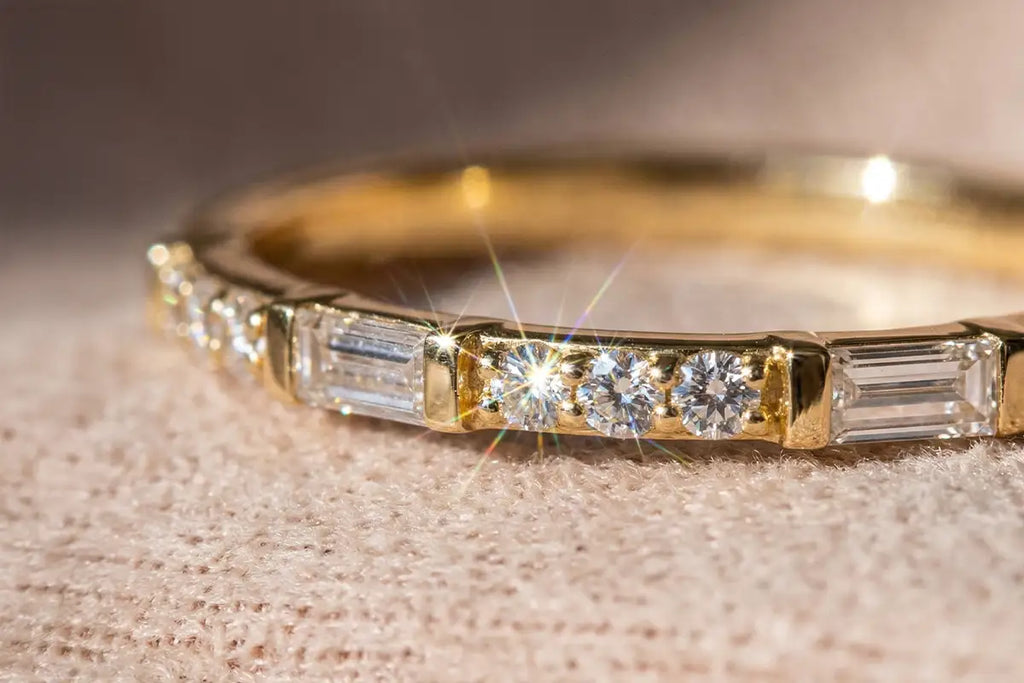
Brilliant cut diamond illustrating the 4Cs, brilliance and clarity
1. Why the 4Cs? A history of standardisation
Before the 4Cs, evaluating a diamond was a matter of subjective negotiation. Two dealers, two systems, no common language between Antwerp, New York, and Bombay. Buyers had no tool to compare two stones objectively: quality depended entirely on the seller's word.
Robert Shipley, founder of the GIA, changed that in the 1940s and 1950s. His goal was to bring objectivity to quality assessment and establish a universal language. The four criteria he codified, Cut, Color, Clarity, and Carat weight, became the global standard.
Today, 90% of gem-quality diamonds worldwide are evaluated according to the GIA 4Cs. Every major laboratory (GIA, HRD, IGI) and every leading jewellery house uses this system. It is more than a technical tool: it is a contract of trust between seller and buyer. A GIA certificate is a verifiable promise.
2. Cut: the soul of the diamond
The first misconception to address: Cut does not refer to the geometric shape of the stone (round, oval, cushion, pear). It refers to the quality of the cutting execution, meaning the precision with which the facets have been calculated and polished. It is an entirely human criterion, the only one of the 4Cs that does not depend on nature.
GIA Cut grades for round brilliant diamonds range from Excellent to Poor:
Excellent: optimal proportions, maximum brilliance
Very Good: slightly below Excellent, with very strong results
Good: acceptable, but with a visible loss of brilliance
Fair / Poor: incorrect proportions, significant loss of luminosity
For fancy shapes (oval, cushion, pear, emerald cut), the GIA does not assign an overall Cut grade; it evaluates Polish and Symmetry separately. These stones require additional expertise at the time of purchase.
Why proportions determine brilliance: an Excellent-cut diamond has a pavilion angle between 40.6 and 41.8 degrees and a table between 54 and 57%. These precise proportions allow light to enter through the table (the top of the stone), bounce off the bottom facets as if in a mirror, and exit toward the eye in a rainbow of colours. This is the phenomenon of dispersion and scintillation.
A Fair or Poor cut allows light to "leak" through the base without returning toward the eye. The stone appears dull, even opaque, even if its chemical composition is perfect. This is why a G/VVS with an Excellent Cut will always outshine a D/FL with a Fair Cut. Brilliance is the first thing the eye perceives. Our position is clear: Excellent Cut as a minimum, without exception.
3. Color: from D to Z
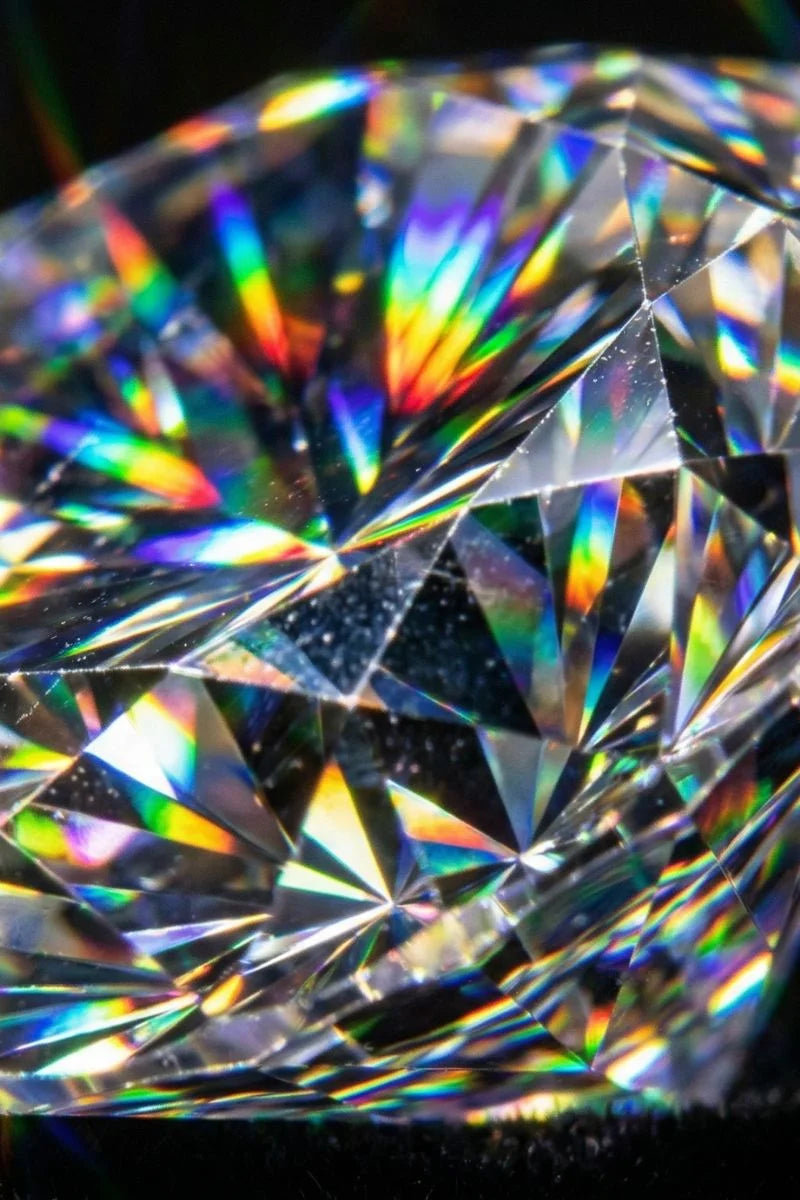
Macro of the facets of a brilliant-cut diamond, rainbow reflections
The GIA colour scale runs from D (completely colourless, the rarest) to Z (slightly yellow or visibly brown). It does not begin at A, to avoid any confusion with older grading systems. In practice, what matters to the buyer are the functional categories:
D-F (Colorless): completely colourless under all lighting conditions. Extremely rare and very costly. The difference between D and F is imperceptible even to a gemologist without equipment.
G-J (Near-Colorless): a slight tint visible only when the stone is compared against a D reference in a controlled environment. Once set in a piece of jewellery and worn: invisible to the naked eye
K-M (Faint): a slight yellow tint perceptible to the naked eye in certain lighting conditions. May be suitable for some yellow gold settings with a tighter budget.
G is our standard: the tint is invisible to the naked eye in a gold setting. The value for money is optimal; you do not pay for a difference no one can see. And here is a counterintuitive insight: in an 18ct yellow gold setting, a G or even an H is indistinguishable from a D. Yellow gold reflects a subtly warm tone that visually cancels out the difference. In rhodium-plated white gold, G remains the sensible minimum.
4. Clarity: from FL to I3
Clarity measures the absence of inclusions (internal flaws, foreign crystals, fractures) and surface blemishes (polishing marks). The GIA scale comprises 11 grades:
FL / IF (Flawless / Internally Flawless): no inclusions visible at x10 magnification. Exceptionally rare and costly. No perceptible difference when worn.
VVS1 / VVS2 (Very Very Slightly Included): inclusions visible only under x10 magnification by a trained gemologist. Invisible to the naked eye. This is our standard: maximum beauty guaranteed, without paying the premium of absolute rarity found in FL grades.
VS1 / VS2 (Very Slightly Included): inclusions visible at x10 magnification, but not to the naked eye under normal conditions. Acceptable for most jewellery pieces.
SI1 / SI2 (Slightly Included): inclusions sometimes visible to the naked eye depending on their position and size. SI1 may still be acceptable if the inclusions are located beneath the setting. SI2 carries a risk of impact on brilliance.
I1 / I2 / I3 (Included): inclusions are visible, with a measurable impact on brilliance and potentially on the structural integrity of the stone.
Our practical advice: for everyday jewellery, VS1 is the sensible minimum. VVS offers a complete guarantee of imperceptibility, without the prohibitive cost of FL.
5. Carat weight: understanding threshold effects
1 carat equals 0.2 grams. A round brilliant 1-carat Diamond measures approximately 6.5 mm in diameter. Weight is measured to the hundredth of a carat (0.01 ct = 1 point). So far, nothing complex.
The subtlety lies elsewhere: price per carat is not linear. There are price jumps at the market's psychological thresholds: 0.50 ct, 0.75 ct, 1.00 ct, 1.50 ct, and 2.00 ct. Demand concentrates around these round figures, creating an artificial premium.
The numbers speak for themselves: a 0.98 ct G/VVS/Excellent Diamond costs approximately 15 to 20% less than a 1.02 ct stone of the same quality. The difference in diameter between the two stones is 0.1 mm, one tenth of a millimetre, completely invisible to the naked eye.
The "just under" approach: look for stones slightly below key thresholds (0.48 ct, 0.95 ct, 1.45 ct, 1.95 ct) for the best value without any visual compromise. This is often the most effective lever for optimising a Diamond budget.
6. How the 4Cs interact: finding the sweet spot
Criterion
What it means
Mayuri Quality
Cut
Proportions and symmetry of the facets, determining brilliance
Excellent to Very Good
Color
Absence of yellow tint (D = colourless, Z = yellow)
G (near-colourless)
Clarity
Absence of inclusions visible under x10 magnification
VVS (very, very slight inclusions)
Carat (Weight)
Weight in carats (1 carat = 0.2 grams)
Varies by design
The 4Cs are not independent. Budget should be allocated with a clear hierarchy to maximise visible brilliance when worn. Before setting out this hierarchy, it is worth naming what the market offers by default.
What you will find at most retailers: the vast majority of jewellers, including many well-known names, offer diamonds graded H-SI (H for colour, SI1 or SI2 for clarity). This is a commercially acceptable quality and widely sold. However, an H-SI diamond is noticeably less brilliant and less valuable than a G/VVS. The H colour grade can appear slightly warm on white gold in certain lighting conditions. An SI1 may present inclusions that are faintly visible to the naked eye, depending on their position. H-SI is an economic compromise, not a fine jewellery standard.
Our recommended order of priority:
Cut: Excellent, always, without exception. This is the criterion that determines brilliance. Non-negotiable.
Colour: G minimum. G is the threshold at which colour becomes imperceptible when worn in a standard setting.
Clarity: VS1 minimum (VVS where budget allows). Below VS1, the risk of visible inclusions increases.
Carat: chosen according to remaining budget, targeting just under the key weight thresholds.
The Mayuri sweet spot: G/VVS/Excellent at the optimal size for the budget. Not the most expensive option possible, but the point at which every pound spent translates into visible beauty.
Criterion
Market Standard
Mayuri Standard
To Avoid
Cut
Good-Very Good
Excellent
Fair, Poor
Color
H
G
I and below on white gold
Clarity
SI1-SI2
VVS
SI2 and below
Carat
Round threshold
Optimal "just under"
Unnecessary premium
7. Certifications: GIA, HRD, IGI
A grade is only as reliable as the laboratory that issued it. Here are the three benchmark references in the market:
GIA (Gemological Institute of America): the absolute global reference. The strictest and most widely recognised, by both professional buyers and private clients. Founded in 1931 in Los Angeles. Every GIA certificate is verifiable online via GIA Report Check.
HRD Antwerp (Hoge Raad voor Diamant): the European equivalent of the GIA. Identical standards, highly recognised across Europe and particularly in Belgium. Founded in 1973 in Antwerp. An excellent alternative to the GIA for natural diamonds of value.
IGI (International Gemological Institute): widely used for laboratory-grown diamonds and Asian markets. Slightly less rigorous than GIA or HRD according to trade experts for natural stones. Acceptable for lab-grown diamonds, though less recommended for higher-value natural stones.
The absolute rule: for any natural diamond purchase above £850, always request a GIA or HRD certificate. It is the only verifiable guarantee of the stated quality.
8. G/VVS quality at Mayuri
All our diamonds are graded G/VVS/Excellent. This is not a budget constraint; it is a gemological decision.
D/FL represents absolute perfection on paper. But the difference between D and G is only perceptible in a laboratory, with a reference stone for comparison, under controlled lighting. When worn, set in a mounting, in real life: imperceptible. Paying the premium for D/FL means paying for a quality that only an instrument can measure.
Choosing G/VVS allows us to invest the available budget where it truly shows: the Excellent Cut, which determines brilliance; solid 18ct gold, which ensures durability and setting integrity; and hand-finished craftsmanship throughout. This is not a compromise. It is the most intelligent choice for maximising beauty when worn.
9. Applying the 4Cs to choose your engagement ring
A practical guide in four steps, from shape to certificate.
Step 1: Choose the shape. The round brilliant cut maximises brilliance (it is the only shape for which the GIA assigns an overall Cut grade). Fancy shapes such as oval, cushion, pear, and emerald cut are on-trend and often offer more visible surface area for the same carat weight. A 1ct oval appears larger than a 1ct round.
Step 2: Start with an Excellent Cut. Allocate the first portion of your budget to the Cut. Verify the GIA grade. Resist the temptation of a larger carat with a Fair or Good Cut; the stone will appear dull, without exception.
Step 3: Adjust the carat weight. Stay just under key thresholds (0.95ct rather than 1ct, 1.45ct rather than 1.50ct). The visual difference is negligible. The price difference is real, often 15 to 20%.
Step 4: Verify the certificate. Request the GIA or HRD certificate with the stone's unique number laser-inscribed on the girdle (the edge of the stone). This unique number can be verified online via GIA Report Check, confirming that the stone you are wearing corresponds exactly to the certificate presented.
The Cut, without hesitation. It is the only criterion that depends entirely on the craftsman, not on nature. An Excellent Cut transforms an ordinary diamond into an extraordinary stone. A Poor Cut wastes even the finest raw material. For round brilliant diamonds, always check the Cut grade on the GIA certificate.
Is the difference between G and D truly visible?
Not when worn, set in a mounting. The difference between G and D only detectable in a laboratory, under specialised light, with a reference stone placed alongside. In real life, in a set jewel: impossible to distinguish. Between D and G, the price difference is significant. The visual difference when worn is nonexistent.
VVS or VS2: which should you choose?
It depends on budget and context. VVS guarantees the complete imperceptibility of inclusions, even under a loupe. VS2 may have inclusions visible at x10, but generally not to the naked eye under normal conditions. For a valued engagement ring intended to last generations, VVS is our recommendation. VS1 is the reasonable minimum.
A 0.9 carat or 1 carat diamond: what is the visual difference?
Approximately 0.1 mm in diameter (6.3 mm vs 6.4 mm). Imperceptible to the naked eye. The price difference, however, can exceed 15%. A 0.95 ct G/VVS/Excellent is a superior stone, at the price of a lower-quality 1 ct.
How do you read a GIA certificate?
The GIA certificate states: the unique number laser-inscribed on the girdle, the shape and cut, the measurements (diameter, depth), the 4C grades, the fluorescence report, and the plotting of inclusions (a visual map). Each number is verifiable at gia.edu/report-check. If the seller cannot provide a GIA or HRD certificate, consider it a red flag.
Why does Mayuri choose G-VVS quality?
Because it represents the optimal balance between perceptible quality and investment value. D-FL quality costs significantly more for an identical beauty when worn. That additional budget, we dedicate to the Excellent Cut and to artisanal finishing. When worn, that is what truly makes the difference.