Care TipsThe Mayuri Journal1 March 2026
Enriched on 8 March 2026
Care Tips
What is vermeil?
Vermeil: the elegance of gold, the strength of silver
Written by Johan Nel, Jewellery designer & goldsmith · trained in gemmology · Mayuri ParisReading 4 min12 chapters
What the maison says
What to remember
Vermeil is a material that many confuse with gold-plated jewellery. It is neither an inexpensive plating nor costume jewellery: it is a noble goldsmithing technique, governed in France by a legal decree, with a history stretching back to Antiquity.
Today, vermeil is experiencing a remarkable resurgence of interest. Customers are seeking genuine gold jewellery without the price of solid gold, and vermeil answers precisely that need: 18ct gold deposited onto 925 sterling silver, a precious and hypoallergenic alloy.
But what distinguishes quality vermeil from ordinary gilding? Why does France enforce some of the strictest standards in the world? And how did a material once used for the royal silverware of Versailles find its way into contemporary fine jewellery?
This guide explores the definition, history, craftsmanship, and regulations surrounding vermeil; everything you need to know before choosing your first vermeil jewellery pieces.
Vermeil: definition and composition
Vermeil is 925 sterling silver coated with a layer of gold through electrolysis (electroplating). The result is a piece of jewellery whose surface is in genuine gold, not an alloy, not a chemical plating, but gold deposited atom by atom onto a precious metal.
What makes vermeil unique
Three elements define vermeil:
The base: 925 sterling silver (92.5% pure silver and 7.5% copper for strength). It is a precious, hypoallergenic metal with intrinsic value. This is the fundamental difference from gold-plated jewellery, which uses brass or copper as its base.
The gold layer: in France, a minimum of 5 microns of gold with a fineness of at least 750 thousandths (18ct). The gold is applied through electrodeposition (electroplating), ensuring lasting adhesion.
The thickness: 5 microns is approximately ten times thicker than standard gold plating (0.5 to 1 micron). This is what accounts for the difference in durability between the two materials.
Vermeil is therefore not a "subcategory" of gold. It is a material in its own right, with its own identity and its own regulations.
The history of vermeil: from Antiquity to modern fine jewellery
Vermeil has a history spanning several millennia. Long before it became a jewellery material, it was a symbol of power and refinement.
Mercury gilding: the forerunner of vermeil
The earliest gilding techniques applied to silver date back to Antiquity. The Romans and Egyptians applied gold leaf to silver objects. But the true revolution came with the mercury gilding (or "fire gilding"), a technique mastered as far back as the Middle Ages.
The process was as ingenious as it was dangerous: gold was dissolved in liquid mercury to create an amalgam, which was then applied to the silver object. The piece was heated to evaporate the mercury, leaving behind a perfectly bonded layer of gold. The mercury vapours were highly toxic, and gilders often paid a heavy price with their health.
The Versailles Vermeil
It was in the 17th century that vermeil reached its pinnacle in France. Louis XIV commissioned more than 200 vermeil tableware pieces for the grand banquets of Versailles: plates, cutlery, serving dishes, candelabras. Vermeil was a royal material, reserved for the court and the great noble households. The Musée des Arts Décoratifs still holds pieces from that era.
Electroplating: the 19th-century revolution
In 1805, Italian chemist Luigi Brugnatelli discovered electrodeposition, the ability to deposit a metallic layer through an electrolytic bath. This invention transformed the production of vermeil: toxic mercury was left behind, replaced by a clean, controlled, and reproducible process.
Electroplating modernised vermeil and made it far more accessible, without any compromise on quality. This is the very process used today by all fine jewellery houses, including Mayuri.
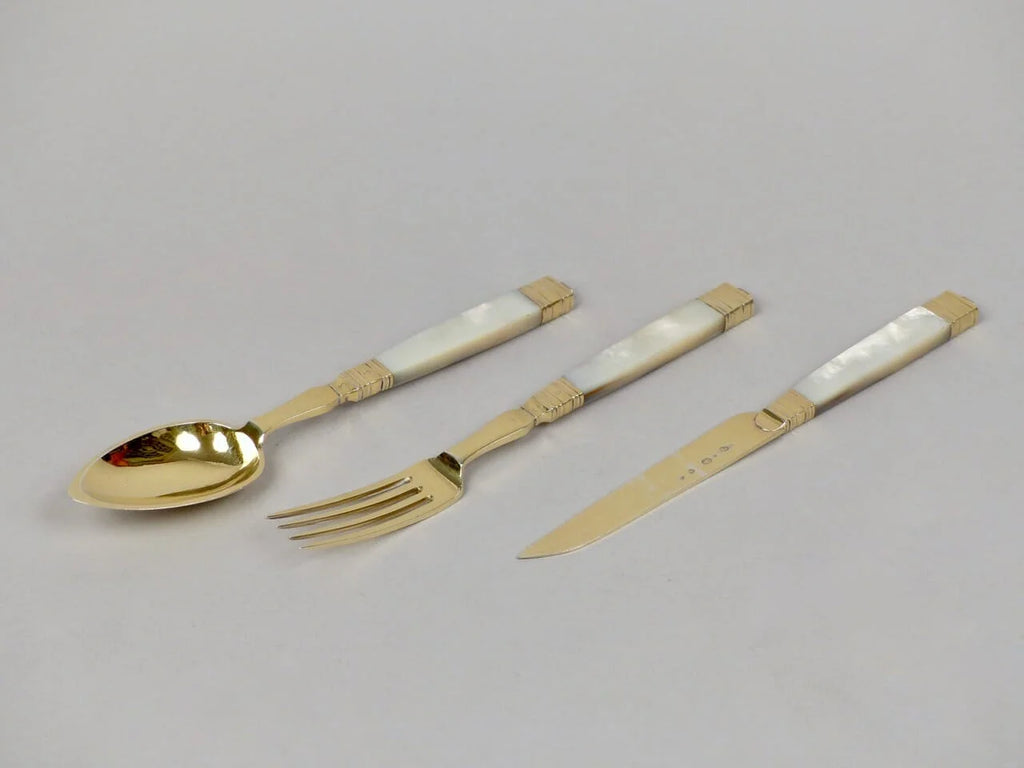
18th-century vermeil silverware inspired by Louis XIV's commissions for Versailles
French regulation: the 1985 decree
France is one of the few countries in the world to regulate vermeil by law. The Decree No. 85-1 of 3 January 1985 on precious metal articles sets out precise requirements:
Base metal: 925 Silver, mandatory
Gold purity: minimum 750 thousandths (18ct)
Gold layer thickness: minimum 5 microns
Comparison with international standards
In the United States, the FTC (Federal Trade Commission) standard is significantly less stringent:
Minimum thickness: 2.5 microns (half the French standard)
Minimum fineness: 10ct gold (417 parts per thousand, compared to 750 in France)
In other words, a piece of jewellery labelled "vermeil" in the United States may not qualify for that designation in France. This regulatory difference explains why French vermeil is recognised as a superior quality standard in the international market.
The vermeil hallmark: how to identify it
In France, vermeil jewellery must be identified by a specific marking: an engraved "V" on the piece. This hallmark guarantees the consumer the vermeil nature of the jewellery, in accordance with the French Consumer Code.
How to verify the hallmark
The "V" is generally engraved on the inside of the shank for a ring, on the clasp for a bracelet or necklace, or on the fitting for Earrings. It is sometimes very small and may require a magnifying glass to read.
The vermeil hallmark is an engraved "V", not to be confused with other French guarantee hallmarks: the hallmark for solid silver is a Minerva head, while that for gold is an eagle. The absence of a hallmark on a piece of jewellery sold as "vermeil" in France should raise a red flag.
Modern vermeil is produced through electrodeposition, an electrochemical process known as electroplating. Here are the key steps:
The process in 5 steps
Preparation of the base: the 925 Silver jewellery is polished and degreased to achieve a perfectly clean surface. Any impurity will compromise the adhesion of the gold layer.
Undercoat bath (optional): some workshops apply a thin intermediate layer (palladium or rhodium) to improve adhesion and durability. At Mayuri, no nickel is used, an ethical choice made out of respect for sensitive skin.
Electroplating bath: the piece is immersed in a solution containing gold salts. An electric current causes gold ions to migrate toward the jewellery, where they are deposited atom by atom. The thickness is controlled by the duration and intensity of the current.
Rinsing and inspection: the piece is rinsed, then subjected to a thickness check (measured by X-ray fluorescence or micrographic cross-section)
Finishing: a final polish to achieve the characteristic golden radiance of vermeil
This process, compliant with ISO standard 4524 , ensures a uniform, adherent, and lasting layer of gold, far superior to simple chemical plating.
Is vermeil real gold?
Yes. The surface layer of a vermeil piece is made of genuine gold. In France, this means 18ct gold (750 thousandths), identical to that used in fine jewellery for solid gold pieces.
The difference from solid gold is structural, not qualitative:
Solid 18ct gold: the piece is composed entirely of a gold alloy (75% gold and 25% other metals). Higher price point, greater weight, multigenerational durability.
Vermeil: a 925 Silver base coated in 18ct yellow gold. The same visual brilliance , the same quality of gold on the surface, at an accessible price. The gold layer does wear over time (1 to 5 years, depending on wear and care).
Vermeil is therefore not an imitation of gold. It is a distinct process that uses the very same gold, applied over a precious metal base.
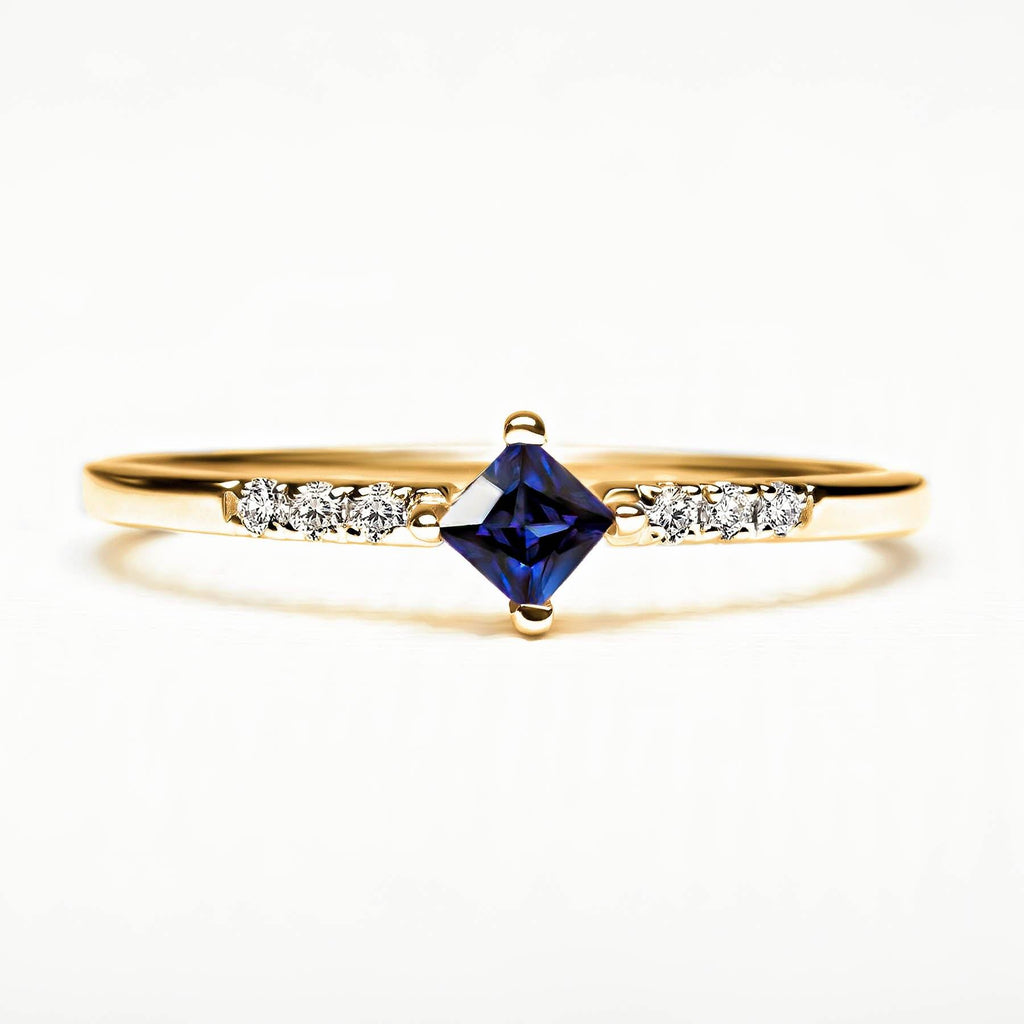
The Kali ring in 18ct vermeil, set with a princess cut sapphire and diamond pavé, by Mayuri
Vermeil, gold-plated, gold-toned, gold filled: the essential differences
A full comparison (detailed table covering thickness, lifespan, price, and allergy risk) is available in our guide to caring for vermeil jewellery. Here are the key technical distinctions:
What sets them apart: the base and the thickness
Vermeil: 925 Silver base (precious metal) and electrolytic 18ct gold, 5+ microns. Regulated in France.
Gold-plated: brass or copper base (non-precious alloy) and gold, 0.5 to 1 micron. No specific standard in France.
Gold-toned (flash plated): brass or alloy base with an ultra-thin gold layer (< 0.5 micron). Fades within a few weeks. Fashion jewellery.
Gold Filled: brass or copper base with a mechanically bonded gold layer representing 5% of the total weight (typically 10–20 microns). More durable than vermeil, but with a non-precious base.
The hierarchy is clear: gold-tone is an entry-level product, gold-plated is a mid-range alternative, vermeil is a fine jewellery material, and gold filled is a durability compromise. Only vermeil and solid gold use precious metals.
Costume jewelry
Fine jewelry
Mayuri
— PARIS —
Gold plated
Non-precious metal (usually brass, copper, or stainless steel) coated with a very thin layer of gold
Unregulated metal
Very affordable
Possible allergic reactions
Low durability
Vermeil
925 sterling silver base coated with a thick layer of 18ct gold.
Regulated precious metal
Exceptional brilliance
Good durability when properly cared for
Hypoallergenic metal
Solid gold 9ct and 18ct
Gold base (35% for 9ct and 75% for 18ct) Regulated precious metal
Exceptional brilliance
Hypoallergenic metal
Very long-lasting durability
Vermeil and precious stones: the Mayuri approach
Most vermeil brands offer jewellery without stones or with synthetic stones. At Mayuri, we made a different choice: setting genuine precious stones, emeralds, Sapphires, Rubies, Diamonds, into our vermeil creations.
Why this choice?
Quality vermeil (18ct gold on 925 Silver) offers the robustness needed to secure a precious stone setting. The result is a piece of fine jewellery, visually identical to a solid gold creation, at an accessible price.
Our vermeil collection is designed and crafted in Paris:
18ct Gold (750 parts per thousand), not 14ct or 10ct
Nickel-free 925 Silver: nickel allergy affects approximately 15% of women in Europe (EDEN study, 2018). Avoiding nickel protects sensitive skin.
Price positioning: accessible, at a fraction of the cost of solid gold
Mayuri vermeil is not a compromise. It is a an informed choice for those who want genuine gold, genuine stones, and an honest price.
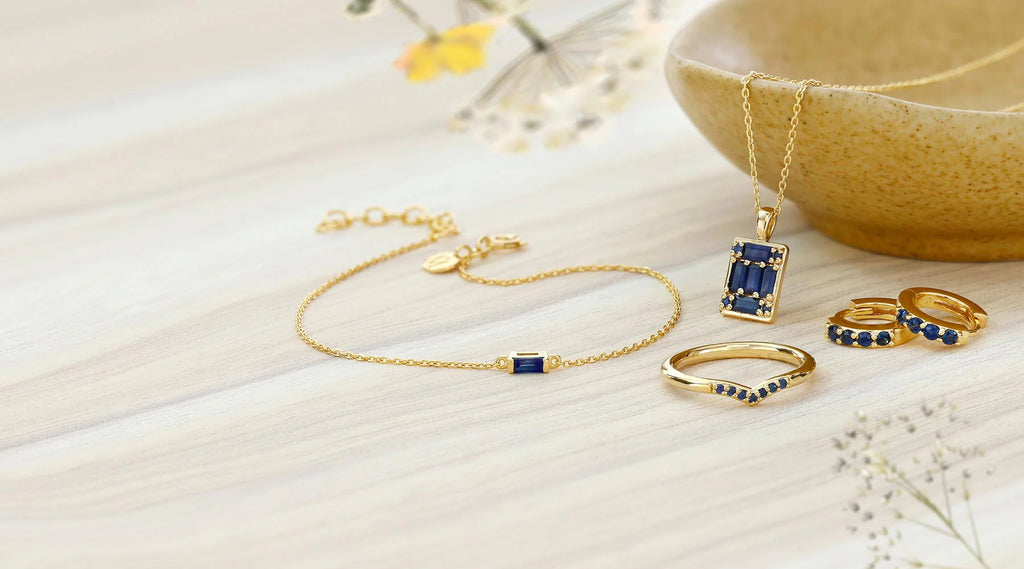
18ct vermeil jewellery set with sapphires by Mayuri: bracelet, pendant, rings and hoops
Caring for vermeil, in brief
Vermeil is a noble material that requires appropriate care. Two phenomena can occur over time: tarnishing (the silver beneath the gold oxidising on contact with sulphur, reversible with a polishing cloth) and plating wear (the gold layer gradually thinning with friction, requiring professional re-gilding).
High-quality French vermeil lasts between 1 and 5 years with daily wear, depending on your skin chemistry and how carefully care instructions are followed. With occasional wear, its lifespan can exceed 10 years.
High-quality French vermeil offers a unique balance of quality, accessibility, and ethics:
A noble material, not costume jewellery: 18ct gold and 925 Silver, two precious metals combined. Vermeil has a centuries-long history in French haute orfèvrerie.
An accessible price point: vermeil makes fine jewellery attainable at a fraction of the cost of solid gold, typically 60 to 80% more affordable.
Hypoallergenic: the 925 Silver base and 18ct gold layer contain no nickel (at Mayuri), making it suitable for sensitive skin.
A responsible choice: vermeil uses less gold than solid gold, and its 925 Silver base is fully recyclable.
A first step into fine jewellery: vermeil can serve as an initial investment before transitioning to solid gold. At Mayuri, we offer a trade-in programme allowing you to exchange your vermeil pieces for 9ct or 18ct gold.
For clients who wish to choose jewellery to complement their complexion, the warm radiance of yellow gold vermeil is particularly well suited to warm and neutral undertones.
When vermeil is not the right choice
In the spirit of transparency, vermeil is not the answer to every need. Here are the cases where we recommend solid gold instead:
Wedding rings and engagement rings: these pieces are designed to be worn every day, for a lifetime. The regular upkeep of vermeil, including periodic re-gilding, can become demanding over time. For a piece of jewellery that symbolises a lifelong commitment, 9ct or 18ct gold is a sounder investment.
Intensive daily wear with no maintenance: if you are looking for a piece you will never take off (in the shower, during sport, while sleeping) and prefer not to maintain, vermeil is not the right choice. The gold layer will wear away more quickly.
Those who want zero constraints: vermeil requires a few simple habits (removing it before contact with water, storing it in a pouch) to stay looking its best. If that feels like too much, our 9ct or 18ct gold creations may be a better fit.
Vermeil is a smart, informed choice, not a default compromise.