Natural diamond vs lab-grown diamond: the complete guide
Natural or lab-grown diamond? Explore differences, certifications, and value to make the right choice.
Written by Johan Nel, Jewellery designer & goldsmith · trained in gemmology · Mayuri ParisReading 12 min8 chapters
What the maison says
What to remember
Place two diamonds side by side on a light table. The same brilliance, the same hardness, the same radiance when worn. No expert can tell them apart with the naked eye. And yet, one took one billion years to form 150 kilometres beneath the Earth's surface, under pressures found nowhere else on the planet. The other was created in three weeks inside an industrial reactor. That is where everything begins.
This guide addresses the real question: what practical difference does it make for a buyer, in terms of value, ethics, and certification? Neither is objectively superior. They are two stones of a different nature, and transparency about those differences is the only imperative that truly matters.
1. Two Identical Stones, With One Exception
A lab-grown diamond and a natural diamond share the same chemical formula: pure carbon (C) with a cubic crystalline structure. Hardness 10 on the Mohs scale, refractive index of 2.417, dispersion of 0.044. Across these four fundamental physical and optical parameters, no measurable difference exists between the two types.
To the naked eye, under a standard x10 loupe, and even with a refractometer: there is no way to tell them apart. The distinction is not visual. It is analytical.
Only one test can identify them with certainty: infrared spectroscopy or photoluminescence, conducted in a specialist gemological laboratory such as the GIA (Gemological Institute of America) or the SSEF (Swiss Gemmological Institute). These analyses detect growth signatures specific to each method of production.
It is precisely this chemical identity that makes the question so complex for buyers. A lab-grown diamond is not an "inferior" stone or an imitation. It is a real diamond, different only in its origin.
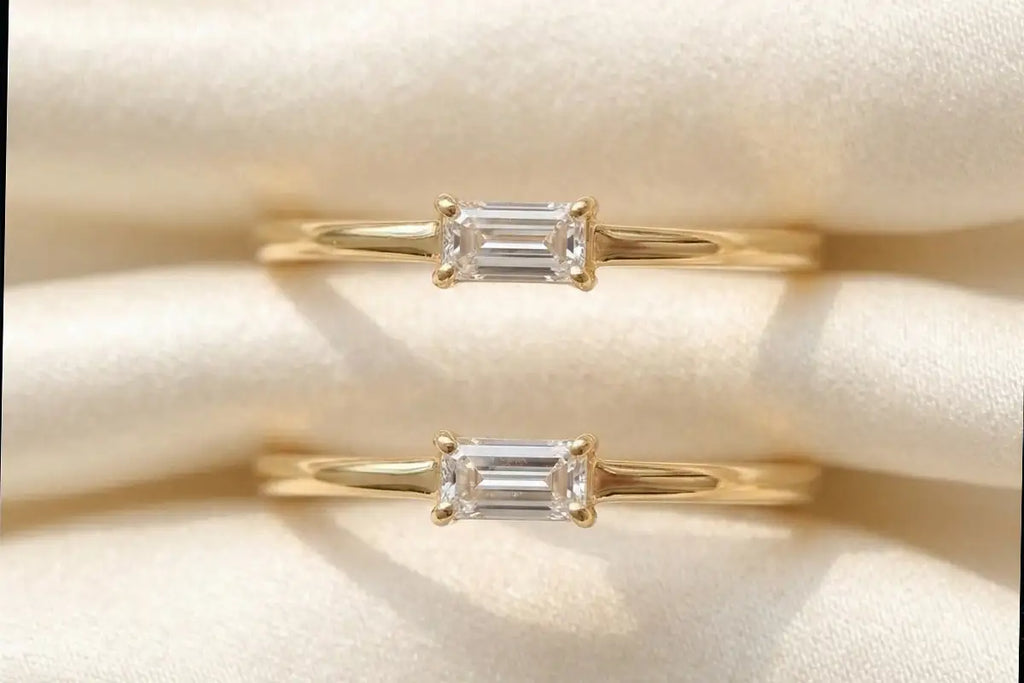
Natural diamond and laboratory-grown diamond compared side by side
2. How a Natural Diamond Is Formed
Natural diamonds form in the Earth's mantle, between 150 and 200 kilometres below the surface, under extreme conditions: temperatures ranging from 900 to 1,300°C, and pressures of 4.5 to 6 GPa. This process takes between 1 and 3.5 billion years: the oldest diamonds we know predate more than a third of the Earth's own age. They existed long before any form of complex life appeared on our planet.
They reach the surface through deep volcanic eruptions, carried upward within columns of rock known as kimberlites. These kimberlite pipes, rare and scattered across the continents, are the only primary sources of diamonds in the world. Fewer than 700 have been identified across the entire continental lithosphere, and only a minority contain diamonds in commercially viable quantities. Secondary deposits, known as alluvial deposits, consist of diamonds eroded from kimberlites over millions of years and redistributed into riverbeds and coastal sediments. Namibia and the west coast of Africa are among the most well-known examples.
This origin explains the structural rarity of natural diamonds. There is no way to simply produce more of them. Deposits are what they are, geologically fixed since time immemorial. And of all the diamonds extracted, fewer than 20% reach gem quality; the rest are used in industry, primarily for abrasion and the cutting of hard materials. The journey from the earth's mantle to a ring is both improbable and millennia in the making.
Raw kimberlite with a natural diamond inclusion
3. How a Laboratory Diamond Is Created
Two industrial processes are used to produce certified diamonds, both capable of generating true carbon crystals rather than simulants such as moissanite or cubic zirconia.
CVD (Chemical Vapor Deposition): carbon-rich gas is introduced into a low-pressure vacuum chamber. Carbon is deposited layer by layer onto a seed substrate, typically a thin slice of natural diamond. The crystal forms over a period of three to six weeks. This is now the dominant method for gem-quality diamonds, particularly because it allows for precise control of purity.
HPHT (High Pressure High Temperature): this method replicates the conditions of the earth's mantle, with pressures of 5 GPa and temperatures of 1,300°C. Faster, though highly energy-intensive, it is used primarily for industrial stones and smaller sizes.
From a gemological perspective, the characteristic inclusions distinguish the two processes under a specialist microscope: CVD produces columnar graphitic inclusions and parallel growth lines, while HPHT leaves metallic inclusions of iron, nickel, and cobalt from the catalyst. These signatures are not visible to the naked eye or through a standard loupe.
4. The 4Cs Apply to Both
The 4Cs (Cut, Color, Clarity, Carat) established by the GIA apply in exactly the same way to both natural and lab-grown diamonds. No separate grading grid, no parallel system. Both types of stone are assessed according to the same criteria and the same standards, by the same trained gemologists, using the same instruments.
Cut quality (GIA Excellent Cut) remains the single most important criterion for both: a well-cut diamond will sparkle, whether natural or lab-grown. A poorly cut diamond will appear dull even at D/FL. This holds true for the round brilliant as much as for the emerald cut, for a natural stone as much as for a lab-grown. Cut is the only human decision in the diamond value chain; everything else is either natural or industrial.
The difference lies in the visible certification: a GIA certificate for a natural diamond carries no "lab" designation. A GIA certificate for a lab-grown bears the notation "Laboratory-Grown" printed in red, sometimes accompanied by the production method (CVD or HPHT). This disclosure has been mandatory since 2018 across all major certification laboratories. Prior to 2018, some certificates omitted this information, a practice that contributed to significant confusion in the market.
HRD certificates (Hoge Raad voor Diamant, Antwerp) use the term "Synthetic". The IGI (International Gemological Institute), widely present in the lab-grown market, certifies both types as well; some experts note that its grades can be slightly less stringent than GIA or HRD for natural stones, particularly regarding colour and clarity.
A practical rule: for any diamond purchase above £850, natural or lab-grown, always request a GIA or HRD certificate. Every GIA certificate can be verified online via the GIA Report Check using the unique number laser-inscribed on the stone.
5. Resale Value: a Significant Divergence
This is the most tangible difference for a buyer, and the one most rarely explained clearly by retailers.
Laboratory diamond prices have fallen by 70 to 90 percent on the secondary market since 2020. The cause is structural: CVD industrial production has surged, primarily in India and China, saturating global supply in a way the secondary market cannot absorb. A lab-grown diamond purchased in 2020 is today worth a fraction of its original purchase price.
The comparison is striking. A natural 1-carat G/VS1 Excellent diamond resells years later with slow depreciation and an active secondary market, supported by specialist resellers (resale platforms, auction houses, jeweller buyback programmes) who purchase at still meaningful prices. The equivalent lab-grown, identical across all 4Cs, finds buyers on the secondary market only at a very low residual value, often just a few hundred pounds regardless of the original GIA quality, because the available supply of lab-grown diamonds is unlimited by definition.
According to the Rapaport Diamond Report 2024 and the Edahn Golan Diamond Research Lab-Grown Price Index 2024, the underlying trend is downward and is expected to continue as global production capacity grows. Market saturation is not a temporary anomaly: it is the logical consequence of a product whose manufacturing cost continues to fall year on year.
This reality invites two equally valid perspectives. If you are purchasing a piece of jewellery to wear, to give as a gift, or to pass on through everyday use, resale value is of no consequence, and a lab-grown diamond remains a perfectly legitimate choice. If you are purchasing with a view to long-term asset value, a family heirloom, or the possibility of reselling one day: the difference is structural and cannot be overlooked.
6. The Ethical Argument: More Complex Than It Appears
The argument most often made in favour of lab-grown: no mines, no armed conflicts, clean production. This is partially true, but the reality is more nuanced on both sides, and the argument deserves honest examination rather than serving as a marketing slogan.
On the side of responsible mining: the major certified mines in Botswana, Canada and Namibia create direct local employment, pay significant royalties to governments and fund essential infrastructure. The Orapa mine in Botswana directly employs 4,000 people and contributes up to 30% of national GDP. In these countries, the diamond industry funds hospitals, schools and roads in regions that would otherwise have no access to these resources. The Kimberley Process, established in 2003 and bringing together 85 member countries, certifies the absence of armed conflict financing. It is not perfect: some experts point to its limitations regarding the definition of "conflicts." It does, however, represent a genuine and binding traceability framework.
On the lab-grown side: CVD manufacturing is extremely energy-intensive. One carat produced using fossil energy consumes approximately 250 kWh, the equivalent of 300 washing machine cycles for a single stone. The largest CVD diamond producers are today located in India and China, two countries whose energy mix remains predominantly coal-based. Some manufacturers communicate their use of renewable energy, but energy traceability remains difficult to verify for the end buyer. The carbon footprint of a CVD diamond produced in India from the national electricity grid is substantially higher than that of a natural diamond extracted from a certified mine using modern environmental practices.
The reality is that both options carry an ethical and environmental footprint that depends on the parties involved and the specific conditions of production. Neither is universally "clean" or "dirty." The most informed ethical choice is to request traceability for the stone you are purchasing, regardless of its origin.
At Mayuri, our natural diamonds are sourced through certified suppliers, traceable from mine to market, and entirely outside conflict zones. This is a sourcing commitment we have upheld since the founding of Mayuri.
Our jewellery features exclusively natural diamonds. This choice is grounded in three fundamental reasons, which we stand behind fully.
Long-term value for our clients: a Mayuri piece is designed to last for generations. The intrinsic value of a natural diamond is central to that vision. Giving or receiving a natural diamond jewel means passing on something enduring, in the most tangible sense of the word.
Traceability and ethical commitment: we work with carefully selected suppliers, traceable from the mine, certified outside conflict zones. This rigorous sourcing demands ongoing effort, and it is not something we are willing to sacrifice for a reduction in purchase cost.
The natural origin of the stone: a natural diamond forms over 1 to 3.5 billion years, under the immense pressure of the Earth's mantle. That origin is an integral part of our relationship with materials. We create jewellery that exists within the long arc of time; the stone comes from there.
For bespoke projects, we can source laboratory-grown diamonds upon special request. Transparency and flexibility always take precedence over doctrine.
Neither is objectively superior to the other. What matters is aligning your choice with your genuine priorities, and not purchasing one while believing you are purchasing the other. This table summarises the key differences across six practical criteria for any buyer.
Criterion
Natural Diamond
Lab-Grown Diamond
Use
Everyday jewellery, heirloom, engagement
Pleasure jewellery, everyday wear
Price at equal quality
Reference price
30 to 60% less expensive
Resale value
Slow depreciation, active secondary market
70 to 90% loss in value since 2020
Ethics
Varies by sourcing (KP certifications available)
Varies by energy source used
Recommended certification
GIA or HRD
GIA, HRD or IGI accepted
Appearance when worn
Identical
Identical
The one absolute requirement: knowing exactly what you are buying, and why. Always request a GIA or HRD certificate, regardless of the stone you choose. Verify that the mention "Laboratory-Grown" appears if you are being sold a lab-grown diamond. Never pay the price of a natural stone for an uncertified synthetic. And if your retailer hesitates to provide a certificate or to specify the origin of the stone, that is the clearest sign to look elsewhere.
The diamond market has seen significantly greater transparency in recent years, driven by buyer demand and the regulatory requirements of certification laboratories. This is very good news for consumers. Taking advantage of this transparency is within reach of any buyer who takes the time to ask the right questions before committing to a purchase.
Yes. A laboratory-grown diamond is pure carbon with a cubic structure, chemically and physically identical to a natural diamond. The term "synthetic" does not mean "fake"; it refers to the artificial origin, not the composition. Both can be certified by the GIA and HRD using the same evaluation methods.
How can you tell a natural diamond from a lab-grown one without a laboratory?
It is impossible. Not with the naked eye, not with a x10 loupe, not with a standard refractometer. Only spectroscopic analysis conducted in a specialised laboratory such as the GIA, HRD, or SSEF can distinguish them with certainty. This is precisely why certification is indispensable.
Is a laboratory-grown diamond less expensive?
At equivalent quality (the same 4Cs), a lab-grown diamond costs 30 to 60% less than a natural diamond. Prices have fallen significantly since 2020, driven by the saturation of global industrial supply, primarily from India and China.
Can a laboratory-grown diamond be insured?
Yes, like any piece of jewellery. Specialist jewellery insurers cover lab-grown diamonds without restriction. The insured value is based on the purchase price or current replacement value, which may be considerably lower than the original purchase price if market prices have decreased in the meantime.
Why have lab-grown diamond prices fallen so sharply?
Industrial production of CVD diamonds has surged since 2018, driven primarily by India and China. Supply now far exceeds demand on the secondary market. Industry experts (Rapaport, Edahn Golan) anticipate that this downward pressure is structural and will persist as global production capacities continue to expand.
Can Mayuri source a laboratory-grown diamond on request?
Yes, for specific bespoke projects. Our team can source certified laboratory diamonds on request, with the same transparency regarding origin, manufacturing method, and certification. Contact us to discuss your project.