The virtues and meaning of black diamond: Vedic tradition, crystal healing, and the symbolism of carbonado.
Written by Déborah Baid, Founder · Mayuri ParisReading 10 min6 chapters
What the maison says
What to remember
White diamonds are the stone of radiant light. The Black Diamond is the stone of depth. One shines outward; the other holds everything within. This is not an absence: it is another form of power.
Vedic, Western, and crystal healing traditions alike recognize qualities in it that only a stone this singular could possess: protection, transformation, grounding. This guide explores the meaning of the Black Diamond through three distinct perspectives, remaining precise about what belongs to documented tradition and what belongs to contemporary belief.
For everything you need to know about Black Diamonds before you buy, consult our complete guide.
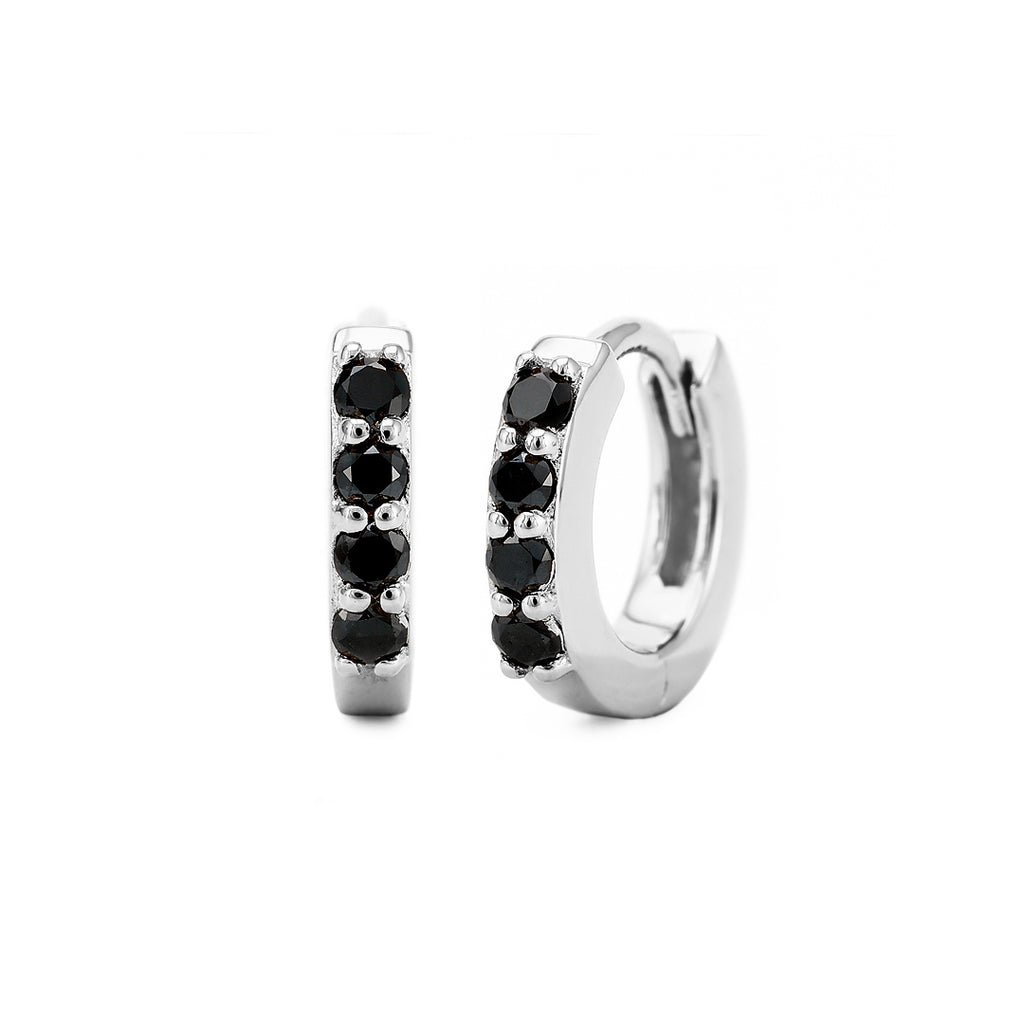
Sumitra earrings in 18ct white gold and black diamonds, Mayuri collection
1. The Black Diamond: an exceptional stone with powerful symbolism
Before exploring these traditions, a useful note from gemology to help understand the origins of the symbolism.
The Black Diamond is pure carbon, just like the white diamond. But where the white diamond is monocrystalline and transparent, the Black Diamond is rendered opaque by a vast quantity of inclusions (graphite, pyrite, metallic oxides). This total opacity lies at the heart of all its symbolism.
Other fancy colour diamonds (blue, pink, yellow) allow light to pass through: their colour comes from a chemical element integrated into the structure. The Black Diamond, however, captures light without reflecting it. It does not reflect: it absorbs. This physical property is the origin of its entire symbolic register: mystery, inwardness, restrained strength, silent transformation.
Its hardness is identical to that of the white diamond: 10 on the Mohs scale. Nothing can scratch it. It is no coincidence that traditions attribute to it virtues of protection and resilience: physics and symbolism rarely align so directly.
2. The Vedic tradition: Rahu and the energy of the Black Diamond
In the Jyotish system (Vedic astrology), the nine planets of the Navagraha are each associated with a gemstone. This practice, the wearing of ratnas (gemstones) to strengthen or balance a planetary energy, has been observed in India for thousands of years. This is not popular esotericism: it is a codified system, passed down by Vedic astrologers from generation to generation.
Rahu is the ascending lunar node. A "shadow" planet, invisible, Rahu governs what simultaneously eludes and compels us: unfulfilled ambitions, radical transformations, destinies that defy established conventions. Rahu is the planet of those who refuse the path laid out before them. Its energy is intense, at times destabilising, and always transformative.
The classical stone of Rahu in the Jyotish tradition is the gomed (hessonite, an orange-brown garnet). However, many contemporary Vedic astrologers associate the Black Diamond with the energy of Rahu because of its deep colour and total opacity. A stone that absorbs light, paired with a planet that absorbs ordinary destinies.
For wearing, astrologers generally recommend the little finger of the right hand or the non-dominant hand. In fine jewellery, however, the piece is also chosen according to one's own intuition and intention.
The names of Mayuri's collections resonate directly with this energy: Kali (the transformative force), Nisha (the night), Ujala (the light that pierces the darkness), Shanti (the peace that follows chaos). These Sanskrit names are not merely decorative: they carry an intention.
Sources: [Wikipedia FR, Rahu (Vedic astrology)](https://fr.wikipedia.org/wiki/Rahu); Jyotish tradition.
3. Western symbolism: mystery, strength, dark elegance
In the West, black was not always associated with luxury. For centuries, it was the colour of mourning, of effacement, of religious solemnity.
Coco Chanel upended this cultural code in 1926 with the little black dress. Black became chic, understated, timeless. A choice that says "I need nothing else to exist." The Black Diamond carries this revolution into fine jewellery: a black stone is not an absence of colour, it is an asserted presence.
The symbolism of the Black Diamond in the Western world rests on two combined qualities. The first: total hardness. Hardness 10, nothing can scratch it. Absolute outer strength. The second: total opacity. Nothing is visible within. Mystery preserved. These two qualities united in a single stone produce something singular: a power that has no need to put itself on display.
The geological history of the natural Black Diamond adds another layer. The graphite inclusions that give it its colour formed billions of years ago during crystallisation. This is not a flaw; it is a memory. A story that no one else possesses in quite the same way.
To give a Black Diamond jewel is to say something precise: I see you as you are, complex and deep, and that is exactly what I love.
> Note: this section presents the beliefs and traditions of crystal healing. These properties do not constitute medical or therapeutic claims. No stone replaces professional medical care.
In the crystal healing tradition, the Black Diamond is associated with the Root Chakra (Muladhara), the first chakra located at the base of the spine. It governs grounding in the body, fundamental security, and connection to the earth.
The properties that tradition attributes to it:
Energetic protection. The Black Diamond is regarded by crystal healing practitioners as a shield against negative energies and intrusive thoughts. Its total opacity, physically verifiable, is interpreted as a form of symbolic impermeability.
Grounding. Tradition attributes to it the ability to help one "stay present in the body" during periods of stress or intense change. A reminder of solidity, of what does not shift.
Clarifying intentions. According to practitioners, the Black Diamond amplifies determination and mental clarity. A stone for those who know what they want, or are seeking to find out.
Purification. Cold or lightly salted water for a few minutes. The Diamond tolerates this treatment well., unlike porous stones or those sensitive to acids.
Recharging. Full moon light is preferred over direct sunlight (a standard precaution for treated stones, even though diamonds do not discolour easily under normal conditions).
In meditation. Some practitioners place a Black Diamond jewel on the lower back or wear it on the body to deepen grounding during sessions.
5. The carbonado: a stone literally born from the cosmos
The cosmic dimension of carbonado belongs in a category of its own, and it deserves to be told properly.
Carbonado is a rare form of polycrystalline Black Diamond: an aggregate of thousands of carbon microcrystals (graphite, diamond, amorphous carbon), with a structure the Earth could not have formed on its own. It is found only in Brazil and the Central African Republic, never in classic kimberlite mines.
The most credible scientific theory, published by the GIA in *Gems & Gemology* in the summer of 2017, suggests that carbonado formed in a supernova explosion approximately 3.8 billion years ago, long before the birth of our Sun, and is believed to have arrived on Earth as a meteorite around 2.3 billion years ago. This theory is supported by the presence of hydrogen in carbonado (absent from terrestrial diamonds) and by its unique isotopic composition. The fact that the only two known sources in the world (Brazil and the Central African Republic) are fragments of the same ancient continental mass (Gondwana) further strengthens the hypothesis of a single, concentrated arrival event.
In fine jewellery, carbonado is very rarely cut: its irregular, porous structure makes the cutting process extremely difficult. The rare pieces that feature it are true collector's items.
A client came to us asking for a pendant set with a natural Black Diamond. We presented several stones, some with very pronounced inclusions. A few resembled miniature galaxies. He chose the most inhabited one. He wanted a stone with a story no one else could tell. Wearing a carbonado jewel is perhaps wearing stellar matter itself: carbon forged in the depths of a dying star, fallen onto our planet billions of years before human life ever appeared.
Mayuri black diamond jewellery on a dark background, a symbolic and deep atmosphere
6. The Mayuri Black Diamond collection
At Mayuri, our choice to incorporate Black Diamond into several of our designs was no coincidence. Every piece carries a name rooted in Sanskrit, and its resonance with the symbolism of Black Diamond is entirely intentional.
Kali: the force that transforms. The goddess who destroys so that something new may be born.
Nisha: the night. The most direct evocation of all.
Ujala: the light that pierces the darkness. The opposition between light and shadow, resolved in a single piece of jewellery.
Shanti: the peace that follows chaos. The calm that comes after transformation.
Sakshi: the witness, the one who sees without judgment. A silent presence.
Dhanya: inner prosperity, the kind that does not depend on the gaze of others.
Sumitra: the true ally. The strength one carries within.
Asonya: the indomitable. That which cannot be undone.
These pieces are available in 18ct yellow, white, or rose gold. Each combination offers a different language: Black Diamond on white gold for pure contrast; on yellow gold for warmth and unexpected tension; on rose gold for the interplay between softness and depth.
This is a piece for someone who has no need to shine for others. Not the expected gift: the gift that says something precise about the person giving it, and the person receiving it.
Does the Black Diamond bring bad luck?
No. This belief does not exist in Vedic, Western, or crystal healing traditions. On the contrary, tradition attributes protective energetic properties to it.
On which finger should you wear a Black Diamond jewel to benefit from its Vedic energy?
The Jyotish tradition recommends wearing it on the little finger of the right hand, or the non-dominant hand. In fine jewellery, however, wear it wherever feels right to you: a piece is also chosen according to your own instinct.
Can a Black Diamond be combined with other stones?
Yes. Black Diamond pairs beautifully with light stones, such as white diamond, White Sapphire, and white topaz, for a striking contrast effect. It also works with rubies or blue sapphires for warmer, more dramatic combinations.
Is the Black Diamond suited to all astrological signs?
In Jyotish, the recommendation of a gemstone depends on the individual natal chart. Consulting a Vedic astrologer is advised if you are seeking precise, personalised guidance.